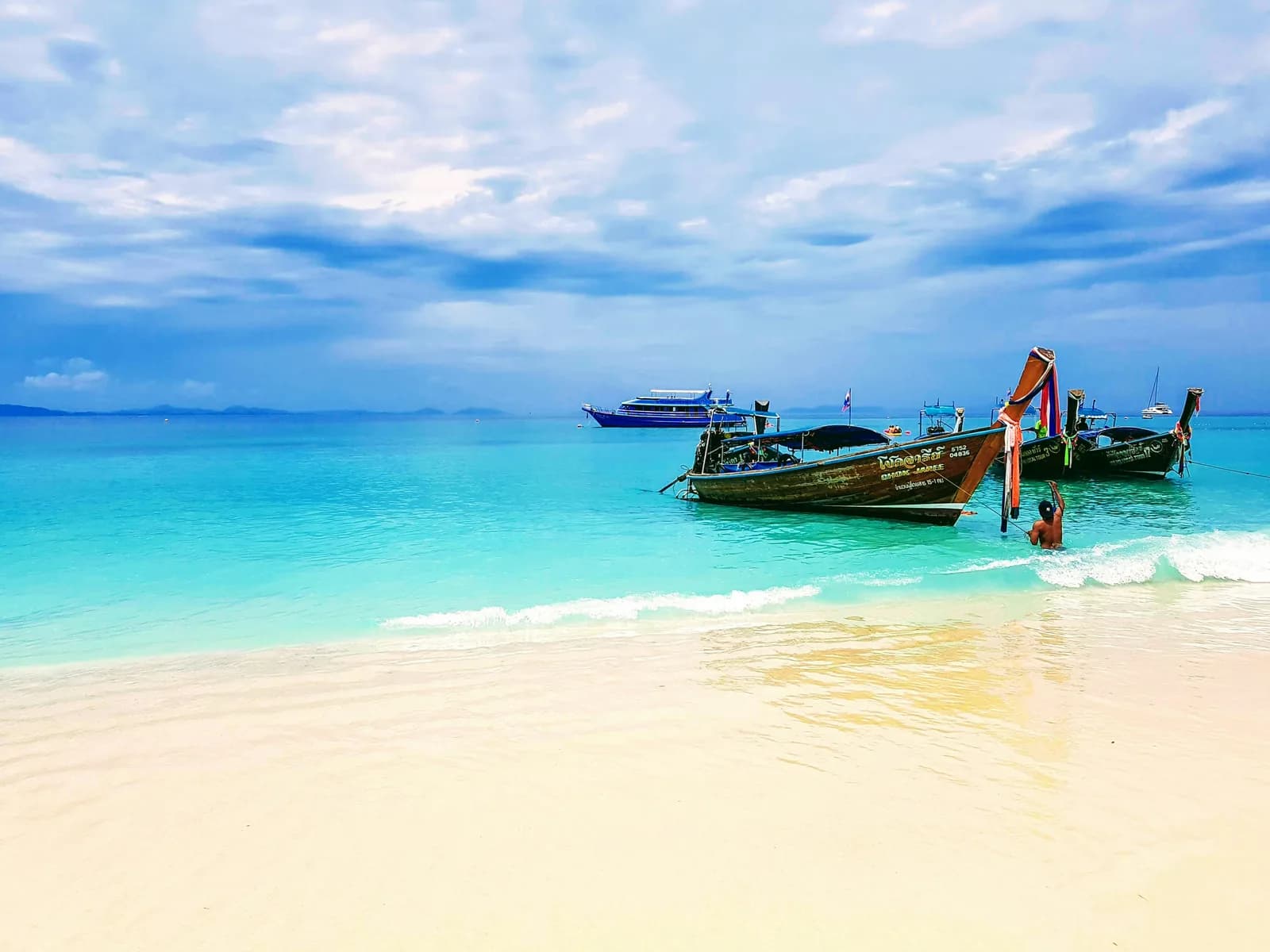
Phuket.
Thailand's big island, decoded: which of the ten beaches is actually yours, the Sino-Portuguese Old Town nobody budgets time for, the Phi Phi question answered honestly — and the monsoon calendar that decides everything else.
Phuket is less an island than a small beach country: fifty kilometres top to bottom, an international airport, a UNESCO-candidate old town, and a west coast strung with a dozen named beaches that each run their own economy and their own personality. It is Thailand's most developed resort island by a distance — which cuts both ways: the infrastructure is effortless and the excesses are real, sometimes within the same kilometre. The skill is placement. Choose the right beach and Phuket is a warm, easy, absurdly well-fed holiday with world-class day trips; choose blind and you may spend a week in a traffic jam wearing a bucket hat.
One calendar rule outranks everything, and our own editorial principles quote it as the house example: Phuket in September is a wet, ferry-cancelled mess. So we start there.
When to go — the monsoon decides
November through April is the dry season and the entire recommendation: 30–33°C, the Andaman flat and clear at 28–29°C, boats running on schedule. Within it, December–February is peak comfort and peak pricing; March turns hotter (33°C, sea 29°C — the March guide's last calm window) and April hits the year's maximum heat with Songkran, the mid-April water-fight new year, as the season's exclamation mark.
May through October is the southwest monsoon and the database's avoid list, all six months: not constant rain — sunny days happen weekly — but swell that closes swimming on the west coast (the red flags drown several tourists every year who ignore them), cancelled island boats, and a humidity that makes everything feel like laundry. September is the statistical bottom. Prices halve for a reason; we don't recommend buying the discount.
Getting there
HKT lands in the island's north — direct seasonal lift from parts of Europe, one-stop via the Gulf hubs or Bangkok otherwise. Transfers: pre-booked car or the airport bus south (the metered-taxi queue is functional; the island's regular taxi cartel less so — Grab and Bolt work and undercut, despite periodic turf theatrics). Internal truth: Phuket traffic is real; beach-hopping by scooter is the local economy's default but our Bali scooter guide's licence-and-insurance sermon applies verbatim here. A hired car with driver for day trips runs €40–60 and removes every variable.
The beach taxonomy — placement is everything
North to south down the west coast:
- Mai Khao / Nai Yang — the quiet north: long empty sand by the airport (the plane-spotting beach), turtle nesting ground, resort-only infrastructure. For people whose plan is the hotel.
- Bang Tao — the Laguna estate and a long democratic beach; polished, family-stable.
- Surin / Kamala — the calmer money: good sand, beach clubs without the circus.
- Patong — the machine: jet skis by day, Bangla Road's neon gauntlet by night, every excess on a laminated menu. Knowing exactly what it is, some people book it deliberately. It is very good at being Patong.
- Karon — the long buffer: big sand, mid-market, breathing room.
- Kata / Kata Noi — the balance point: surfable waves in season, family mornings, walkable town, sunsets off the headland. If in doubt, Kata.
- Nai Harn — the south's local-favourite bay: lake-backed, lighthouse views, the connoisseur's pick.
- Rawai / Chalong (east) — boat country: longtails, dive shops and seafood grills rather than swimming.
Where to stay
Luxury — The Surin, Pansea Beach
Cottage modernism on a private cove between Surin and Bang Tao — the quiet-money classic with one of the island's prettiest pools. Around €300–400/night in season. Check rates on Booking →
Mid-range — Katathani, Kata Noi
The full-service spread on Kata Noi's near-private sand: six pools, every room minutes from the water, family-engineered without surrendering adults. Around €150–200/night. Check rates on Booking →
Budget — Lub d Phuket Patong
The design hostel-hotel hybrid opposite Patong beach: private rooms around €40–60, a pool deck and co-working lobby, and a curated version of Patong's energy you can retreat from. Check rates on Booking →
The Old Town nobody budgets time for
Phuket Town is the island's actual surprise: streets of Sino-Portuguese shophouses in ice-cream pastels, built on 19th-century tin money by the Hokkien families whose Peranakan kitchens still run the food culture. Thalang Road and its sois reward a slow morning — heritage cafés in pharmacies' bones, ancestral mansions (Baan Chinpracha), street-art alleys — and the Sunday Walking Street market turns it into the island's best evening: grilled everything, local teenagers, not a jet ski in earshot. Pair with the viewpoint chedi of Khao Rang and you've spent the day Phuket's brochures forgot to print.
The island's other landmarks, ranked honestly: the Big Buddha (45 m of white marble on the southern ridge — go for the 360° view, dress modestly), Wat Chalong (the working heart of island Buddhism), and the Promthep Cape sunset scrum (once is enough; Nai Harn's lighthouse hill gives the same sun without the coach park).
The Phi Phi question, answered honestly
Yes — Ko Phi Phi and Maya Bay are as beautiful as the films claim, and the day-trip economics guarantee you will not have them to yourself. The honest playbook: book a small-boat early-departure tour (07:00 speedboats reach Maya Bay before the main fleet; the bay itself now runs managed entry with no-swim zones since its restoration closure — respect them, they're why the sharks came back), or invert the trip and overnight on Phi Phi so the lagoons at 07:30 and 17:30 belong to residents only. The standard 10:00 catamaran circuit delivers queues with a turquoise backdrop.
The alternatives that often beat it: Phang Nga Bay by sea canoe — James Bond Island is kitsch, but drifting through the hongs (collapsed sea-cave lagoons) at water level with John Gray's original night-departure operation is the area's genuinely great trip (€90–110, book days ahead); Coral and Racha islands for easy snorkel days; and in season the Similan Islands liveaboards for the Andaman's best diving (October–May only — the park closes for the monsoon).
Eating — the island's quiet superpower
Phuket's Peranakan food heritage out-cooks its resort reputation by a mile:
- Raya (Old Town) — the heritage-house institution: crab curry with rice noodles (mee hoon poo), Moo Hong pork belly. The island's one unmissable table. €15–25.
- One Chun — same canon, café setting, queue accordingly.
- Kopitiam by Wilai (Thalang Road) — Hokkien noodles and history on the walls.
- The night markets — Chillva (Tuesdays-weekends, young-local) and the weekend Naka — for the €5 dinner crawl: moo ping skewers, oyster omelettes, mango sticky rice, roti pancakes.
- Beach-road seafood: pick the place weighing fish openly with prices listed per 100 g; "market price" without a scale is a tourist tax.
Practical notes
- Red flags mean it — monsoon-season rip currents on the west coast are the island's deadliest hazard, not a suggestion.
- Scooters: IDP, helmet, sobriety, insurance — the scooter rules transplanted whole.
- Money: baht; cards in hotels and malls, cash in markets; ATMs charge a fixed foreign fee — withdraw large, fewer times.
- Conduct: temples want covered shoulders/knees; the monarchy is constitutionally beyond joking; Songkran soaks everything you carry — bag the phone.
- Tap water: no; ice from sealed bags: fine.
The summary
Fly HKT in the November–April window, place yourself deliberately — Kata/Katathani for the balanced default, Surin for quiet polish, Lub d if Patong's voltage is a feature. One Old Town day ending at a night market, one Phang Nga sea-canoe day or the 07:00 Phi Phi run, one Big Buddha–Wat Chalong–Nai Harn south loop, beach rhythm between, Raya booked for the farewell dinner. Phuket at the right beach in the right month is the easiest great holiday in Asia; both of those words — beach, month — are doing real work.