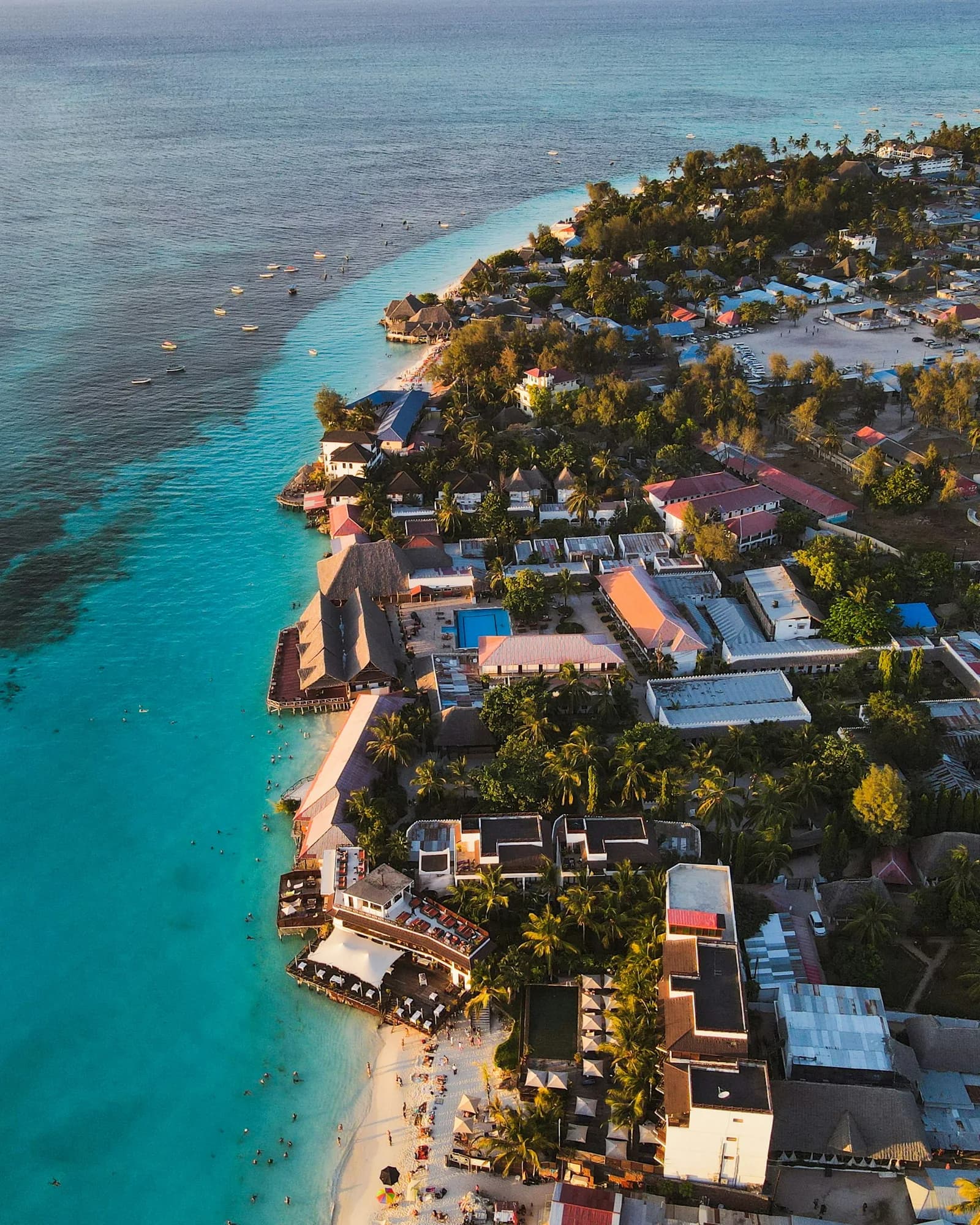
Zanzibar.
The spice island with a tide table: why the east coast's sea walks away twice a day, where the swimming always works, Stone Town beyond the postcard — and the February secret the July crowd never learned.
Zanzibar carries more loaded history per square kilometre than any beach destination on this site: the Swahili coast's great entrepôt, where Omani sultans ran the clove trade and, for a dark century, East Africa's slave markets — a past the island faces squarely at the Anglican cathedral built over the market site. Around that history: an island that produces the postcard at industrial strength — bone-white sand, a turquoise that looks colour-graded, dhows crossing every sunset — with one piece of small print the brochures omit and this guide leads with: the tide.
Get the tide geography right and Zanzibar is the best-value tropical island a European winter or summer can reach. Get it wrong and you'll spend noon staring at a kilometre of exposed seabed wondering where the Indian Ocean went.
When to go — two seasons, one secret
The database's window is unusual and worth reading carefully: June through October, plus January and February.
June–October is the cool dry season ("cool" meaning 28–29°C): the long rains finished, humidity at its annual low, the kite wind blowing on the east coast. This is peak season and earns it — the safari-pairing crowd fills July–August.
January–February is the secret, said straight in the February guide: the short dry window between the rains — hot (32°C), blue, spice farms green from the December showers — while the booking masses assume it's "only a July place". Fewer people, softer prices, hotter swimming.
The avoid list: April and May — the long rains, when 300+ mm months close beach bars and dirt roads alike. March and November–December are the shoulder gambles: the short rains (November especially) come in afternoon bursts that a flexible itinerary shrugs off and a honeymoon resents.
Getting there
Zanzibar (ZNZ) takes direct seasonal European charters plus year-round connections via the Gulf hubs and Dar es Salaam. Visas for most nationalities are e-visa or on-arrival (USD, bring crisp notes); the mandatory travel-insurance levy is bought online before flying. The island is bigger than it looks: Stone Town to the northern tip runs 90 minutes by taxi (€35–50), to the east coast about an hour. Pre-book transfers; in-stay, taxis negotiate and the dala-dala minibuses cost pennies for the adventurous.
The tide truth — read before booking
The east coast (Paje, Jambiani, Matemwe, Pongwe) fronts a barrier-reef lagoon with a tidal range of metres: at low tide the sea retreats up to a kilometre, leaving rippled flats where seaweed farmers work and swimmers walk. It happens twice daily, it is entirely predictable, and it divides opinion neatly — kitesurfers and walkers love the cycle; swim-on-demand people hate it.
The north coast (Nungwi, Kendwa) sits deeper: the sea stays swimmable at every tide. That single fact is why the north hosts the resort density.
The honest matrix: Nungwi/Kendwa for tide-free swimming and sunset bars (and the crowds that follow); Paje for the kite scene and backpacker energy; Jambiani for village-stay authenticity; Matemwe for barefoot quiet opposite the Mnemba atoll snorkel grounds. There is no wrong answer — only a wrong expectation.
Stone Town — give it two nights
Most itineraries treat Stone Town as an airport buffer. Give it two nights:
- The old city is a UNESCO labyrinth of coral-stone merchant houses, brass-studded carved doors (the island's signature artefact — Indian-influenced arches, Omani geometry), shaded bazaars and sudden harbour views. Wander lost; it reassembles itself.
- The slave-trade memorial at the Anglican cathedral — built deliberately over the market, altar on the whipping post's site, the underground holding chambers preserved — is the island's necessary hour. Go.
- Darajani market for the produce-and-fish theatre; the spice tour outside town (€15–25) is the rare "tour" that earns its name — cloves, vanilla, cardamom and pepper vines identified by smell in working plantations; Zanzibar ran the world's clove trade and the air still says so.
- Forodhani Gardens night market: harbour-front grills under lanterns. Calibrate honestly — the "Zanzibar pizza" is neither, the seafood skewers vary with your stall-picking eye, the sugar-cane press and the atmosphere are the actual product.
- The Freddie Mercury house (he was born Farrokh Bulsara here in 1946) is a five-minute photo, priced accordingly by the museum.
Eat: Lukmaan for the local canteen canon (pilau, octopus curry, urojo — the tamarind "Zanzibar mix" soup that is the island's street dish); Emerson on Hurumzi's Tea House (below) for the rooftop dinner; juice stands for everything the spice farms grow.
The water
- Mnemba atoll (boats from Matemwe/Nungwi, €30–45) — the island's best snorkelling: turtles, reef walls, dolphin escorts on lucky mornings. Pick operators who brief on distance-keeping; the atoll's popularity is its own management problem.
- Kitesurfing, Paje — flat warm lagoon, steady seasonal wind (June–September, December–February), schools by the dozen: one of the world's great learning waters (€250–350 for a starter course).
- The dhow sunset — from Nungwi or Kendwa, lateen sails against the orange: the cliché survives contact.
- Kizimkazi dolphins, flagged honestly: the cheap morning tours run motorised pursuit of resident pods — crowding animals into flight. Either book the few slow-approach ethical operators or take the Mnemba escorts as your dolphin luck and skip it.
- Safari Blue (from Fumba) — the polished full-day sandbank-and-seafood dhow circuit of the southwest bay: touristy, well-run, a good single splurge (€60–80).
Add-ons ashore: Jozani forest for the endemic red colobus monkeys (€10ish, boardwalk mangroves included) and Prison Island's giant tortoises off Stone Town (half-day by boat).
Where to stay
Luxury — The Residence Zanzibar, southwest coast
Villas with private pools down a kilometre of casuarina-shaded beach on the quiet southwest: the polished-seclusion end of the island's spectrum. Around €400–500/night. Check rates on Booking →
Mid-range — Z Hotel, Nungwi
The boutique anchor of the north tip: rooftop pool, sea-facing rooms, the swim-at-any-tide beach below and Nungwi's sunset strip outside. Around €180–230/night. Check rates on Booking →
Character stay — Emerson on Hurumzi, Stone Town
The famous merchant-house hotel in the labyrinth: antique-stuffed rooms no two alike, and the rooftop Tea House dinner — cushions, curry courses, the call to prayer drifting over the rooftops — that is Stone Town's defining evening. Around €120–160/night. Check rates on Booking →
Practical notes
- Money: Tanzanian shillings and US dollars run parallel; cards at hotels (often +3–5%), cash everywhere else; ATMs in Stone Town and the resort hubs only.
- Conduct: Zanzibar is conservative and Muslim — beachwear belongs strictly to the beach; shoulders-and-knees in Stone Town and villages is respect, and during Ramadan daytime discretion with food and drink applies.
- Health basics: this is a malaria zone — prophylaxis per your travel clinic; bottled or filtered water; reef shoes for the urchin-studded flats.
- Tide table: every lodge posts it; plan swims, kite sessions and flat-walks around it rather than against it.
- Pairing: the classic combination — northern Tanzania safari then Zanzibar — works seamlessly via local flights; even a Serengeti-less trip pairs well with two Stone Town nights bracketing the beach.
The summary
Fly ZNZ for June–October or the January–February secret. Two nights Stone Town first (cathedral memorial, spice tour, Tea House dinner at Emerson's), then the coast matched to your honest preference: Z Hotel's Nungwi for tide-free swimming, Paje for the kite lagoon, Matemwe for quiet with Mnemba mornings. One dhow sunset, one snorkel atoll day, Jozani's monkeys in transit, the dolphin pursuit declined. Zanzibar runs deeper than its postcard — the trick is reading the tide table and the history with the same straight eyes.