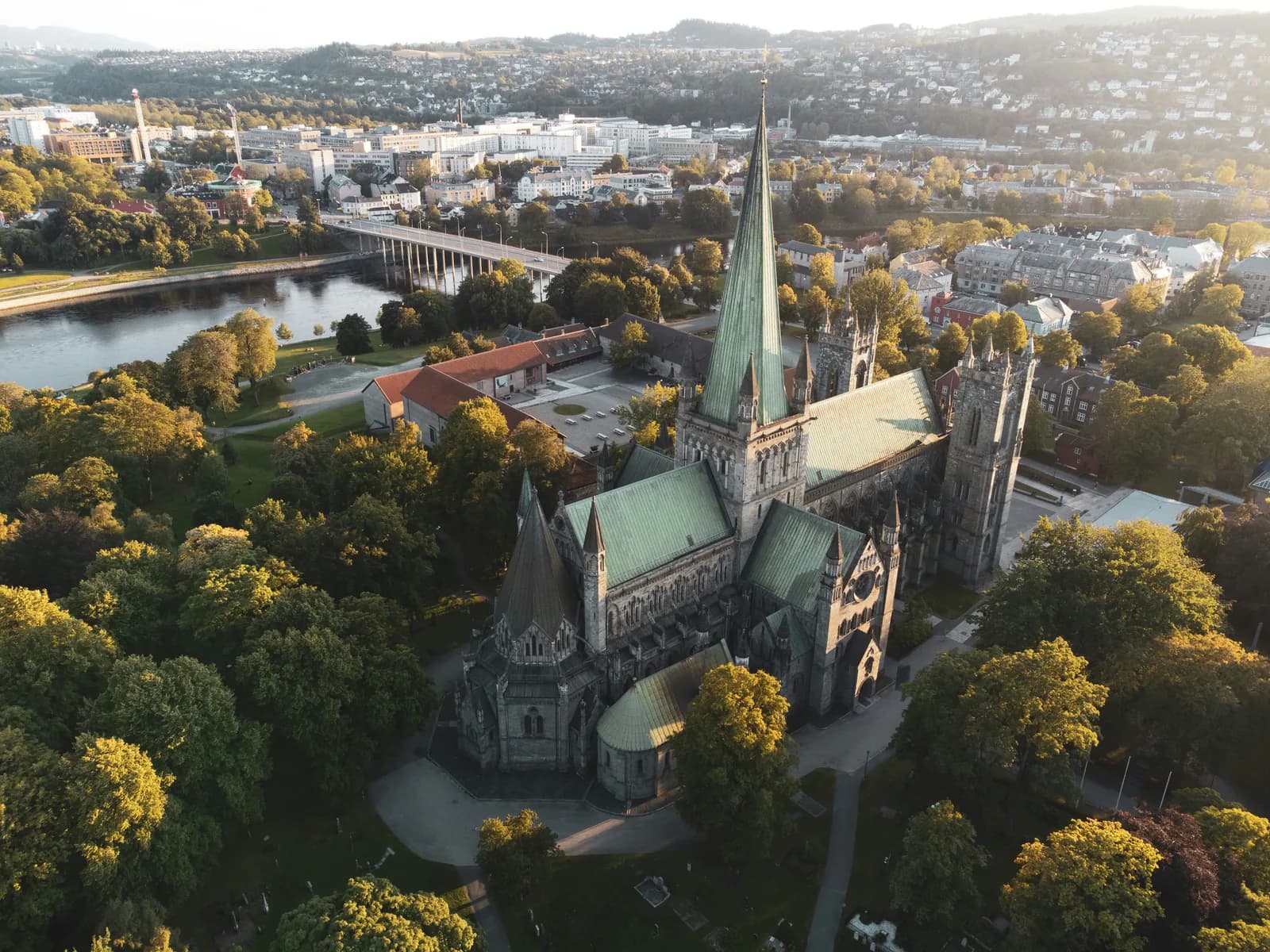
Trondheim.
Norway's third city and medieval heart: the great Nidaros cathedral, the pastel wooden warehouses of Bakklandet, a fjord at the doorstep and a student-city lightness. A dependable high-teens summer, far enough north to shrug off the heat.
Trondheim is Norway's historic soul — the medieval coronation city, the end of the St. Olav pilgrim ways, built around the largest cathedral in Scandinavia — wearing it lightly, because it's also a young university town threaded by a river and opening onto a fjord. It sits far enough north (latitude 63) that summer means a dependable 17–20°C and light that barely fades, with none of the heat-spike risk that troubles Oslo. For the traveller who wants history, fjord air and a genuinely cool, walkable city while the south burns, it's an easy, underrated answer.
Honest note: this is the temperate-cool tier — high teens, the odd 22°C day, far-north light. No heatwave reaches it with any force; pack a layer and a waterproof.
When to go
June to August, with the near-endless northern light at its best around Midsummer. June–July are warmest and brightest; the St. Olav Festival in late July (around the 29th, Olsok) fills the city with medieval markets, music and pilgrims. August holds the warmth as the students return and the term-time buzz revives. Cooler, quieter shoulders either side.
Getting there
Trondheim Værnes (TRD) is 35 minutes northeast — the airport train (Trønderbanen) and Flybussen coach both run to the central station. The compact centre is walkable; the city's quirk is the Trampe, the world's only bicycle lift, which hauls cyclists up the steep Brubakken hill behind Bakklandet (a genuinely fun two-minute novelty).
Where to stay
Base in the Midtbyen (the central island in the river's loop — walkable to everything) or just across the old bridge in Bakklandet for the wooden-wharf charm.
Scandic is the dependable Nordic default and runs several central hotels — browse Scandic's Trondheim properties (Scandic Nidelven, repeatedly voted Norway's best hotel breakfast, sits on the river; Scandic Bakklandet is in the heart of the old quarter), breakfast included, bookable without research. The boutique end sits in the Booking strip below.
The city itself
- Nidaros Cathedral — the reason Trondheim exists: the soaring Gothic cathedral built over St. Olav's grave, the burial-and-coronation church of Norwegian kings, the goal of the pilgrim ways across Scandinavia. The west front of carved figures is extraordinary; climb the tower for the view, time a summer organ recital.
- Bakklandet — the pastel wooden warehouses and cottages along the Nidelva river, now cafés, vintage shops and cobbled lanes: the city's most photogenic quarter, and a slow, lovely wander.
- Gamle Bybro — the "Old Town Bridge", the red-portalled wooden bridge over the river with the wharf-house view that is Trondheim's postcard.
- Kristiansten Fortress — the hilltop fort above Bakklandet (the Trampe lift or a short climb gets you up): ramparts, cannon, and the panorama over the city, river and fjord.
- The river wharves (Bryggene) — the old timber storehouses lining the Nidelva, mirrored in the water; the Bakklandet side is the one to walk.
- Ringve music museum and the Rockheim (the national museum of pop and rock) round out the rainy hours; the Stiftsgården, the largest wooden palace in Scandinavia, anchors the centre.
The water and the green
- Munkholmen — the islet in the fjord (a former monastery, then a prison and fort), reached by a short summer boat from the fish-market quay: ramparts, a swimming spot, a café — the easy half-day on the water.
- The fjord and the Bymarka — the forested hills right behind the city (a tram ride to Lian) hold lakes you can swim and trails with the fjord view; the wilderness is on the doorstep.
- Cycling — the Trampe lift and the flat riverside paths make Trondheim a genuine bike city; rent a set of wheels.
The food
Trøndelag is one of Norway's serious food regions — rich farmland meeting the cold fjord. The signatures: fjord trout and salmon, the local cheeses (including the famous brown brunost), game from the inland forests, and the new-Nordic kitchen the region punches above its weight in.
- Scandic Nidelven's breakfast is locally a destination in itself; for dinner, Fagn (Michelin-starred) is the splurge, Bula Bistro and Sellanraa the relaxed quality.
- Ravnkloa fish market for the casual seafood lunch and the Munkholmen boat.
- A fika in a Bakklandet café — the cinnamon bun, the riverside table — is the correct afternoon.
Day trips worth taking
- Munkholmen — the fjord islet, above.
- The St. Olav Way — walk a stretch of the medieval pilgrim path into the city, or out to the Sverresborg open-air folk museum for the wooden-Norway history.
- The Trøndelag coast and the Fosen peninsula — fjord-and-island country for the self-driver with an extra day.
Practical notes
- Money: Norwegian kroner; cashless — cards and phones.
- Light: June nights barely darken this far north — eye mask helps.
- Dress: high-teens and changeable — a waterproof and a layer, always.
- Cost: Norwegian-expensive; the cathedral, the riverside walks, Munkholmen and the bike lift keep it grounded.
The summary
Fly TRD, take the 35-minute train. Give the cathedral its hour and climb the tower, wander Bakklandet and cross the Old Town Bridge, ride the Trampe and the ramparts of Kristiansten, take the boat to Munkholmen for a fjord swim, eat the legendary Nidelven breakfast. June to July for the medieval festival and the endless light. Far north, dependably cool, deeply historic — the quiet, characterful answer when the continent overheats.