Oslo.
A fjord capital remade: islands you swim off a ferry from City Hall, a marble opera house you walk up, floating saunas, and a new museum waterfront. The summer playbook — and the honest caveat that Oslo runs the warmest of the Nordic cities here.
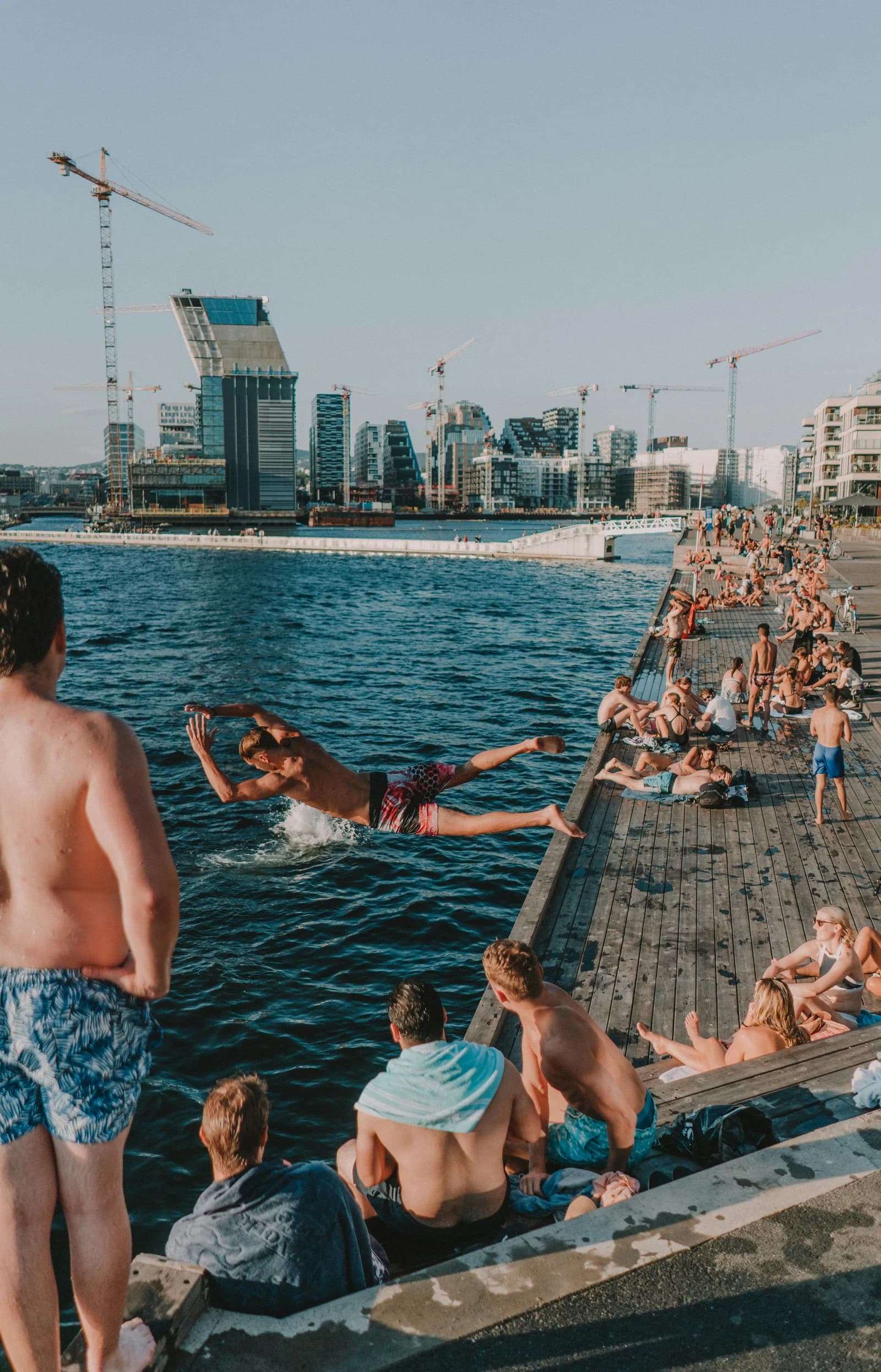
Oslo spent the last fifteen years rebuilding its waterfront and quietly becoming one of the best summer city breaks in the north. The fjord reaches into the heart of it; a chain of green islands sits a short public ferry from City Hall; and the new architecture — the marble opera house you can walk up, the Munch tower, the Deichman library, the floating saunas — gives the old, slightly stiff capital a genuinely playful summer face. When the continent overheats, you swim off an island at 22°C, sauna on the fjord, and eat new-Nordic seafood in light that lasts past 22:00.
One honest flag, and it matters more here than for its coastal siblings: Oslo is the warmest entry on the cool list. Sitting at the head of a long fjord rather than open sea, it usually does 22–24°C but can spike past 30°C in a real heat dome — it hit 34.6°C at Blindern on 27 July 2018, its hottest reading on record. It's reliably cooler than the Med and built for outdoor summer life — but it's a temperate city that gets the odd genuinely hot week, not an Arctic refuge. For that, Tromsø or Bergen are the surer cool bets.
When to go
Mid-May to mid-September, with the light doing the heavy lifting.
June is glorious: 20–23°C, sunset near 22:30, the islands and saunas open, the parks full. July is warmest and quietest of locals (Norwegian holiday month — the city mellows, the fjord fills). August brings the warmth back with the city repopulated and the festival season. May and September are cooler and cheaper, with the spring light or the autumn clarity.
Getting there
Oslo Airport Gardermoen (OSL) is 50 km north — the Flytoget airport express reaches the central station in 20 minutes, or the regular Vy trains do it for less in not much longer. The compact centre is walkable; the metro, trams and the island ferries (part of the Ruter transit system) cover the rest, the ferries included on a normal ticket.
Where to stay
Base around the centre / Aker Brygge (the waterfront, walkable to everything), Grünerløkka (the hip former working-class east — Mathallen, the river walk, the best bars), or Bjørvika (the new opera-and-Munch waterfront).
Scandic is the dependable Nordic default and runs a spread of central hotels — browse Scandic's Oslo properties (Scandic Vulkan by Mathallen and the central Scandic Karl Johan are well placed), breakfast included, bookable without research. The design and boutique end — The Thief on the waterfront, Amerikalinjen by the station — sits in the Booking strip below.
Swim the fjord islands — the city's best move
This is the trick most visitors miss: the Oslofjord islands are public transport. Ferries leave from Aker Brygge / Rådhusbrygge on your normal Ruter ticket and reach a chain of swimmable green islands in 10–30 minutes.
- Hovedøya (10 min) — the closest: monastery ruins, meadows, rocky swimming coves, a summer café. The easy, anyone-can-do-it island.
- Langøyene (25 min) — the proper beach island: actual sand, lawns, the city's favourite swim-and-picnic day.
- Gressholmen — quieter, walkable, the wild option.
Fjord water hits 18–21°C in high summer — bracing, clean, and the thing that makes an Oslo summer click. Pack a swimsuit; you'll use it more than you'd expect this far north.
The waterfront and the saunas
Oslo's reinvention is best read on foot along the harbour:
- The Opera House — the Snøhetta landmark you literally walk up: a sloping marble roof rising from the fjord, free, open, the city's communal terrace. Go at golden hour.
- The Munch museum — the leaning tower beside it: thirteen floors of Edvard Munch (yes, The Scream), with a top-floor bar and view.
- The floating saunas — at SALT and around Sukkerbiten / Langkaia: wood-fired saunas on pontoons where you sweat and drop straight into the fjord. Book one for the evening; it's the most Oslo thing you can do.
- The Astrup Fearnley modern-art museum and the Tjuvholmen sculpture park close the waterfront walk, with a little beach at the end.
The classic sights
- Vigeland Park — the world's largest sculpture park by a single artist (Gustav Vigeland): 200 nude bronze and granite figures in the green expanse of Frogner Park. Free, open always, genuinely strange and moving.
- Bygdøy museums — the peninsula of museums, a ferry from City Hall: the Fram (polar exploration ship), Kon-Tiki (Heyerdahl's raft), the Norwegian Maritime and the open-air Folk Museum. (Note the Viking Ship Museum is closed for a major rebuild — check its reopening before banking on it.)
- Holmenkollen — the ski-jump tower above the city, a metro ride up: the jump, the museum, and a sweeping view over the fjord. Surreal in summer.
- The Deichman Bjørvika library and the new National Museum (the Munch Scream original among Norway's art) round out a rainy hour.
The food
Norwegian summer food is seafood-forward and pricey-but-good: reker (fjord shrimp, peeled at the table with bread, mayo and lemon — the summer ritual), fresh-boiled crab, salmon every way, and the new-Nordic kitchen that Oslo does seriously.
- Mathallen — the Vulkan food hall: oysters, charcuterie, the graze-and-craft-beer lunch.
- The harbour shrimp boats at Aker Brygge — buy a bag of fjord shrimp off the boat, find a bench, peel and eat. The €15 quintessential Oslo lunch.
- Vippa — the harbourside street-food hall in a former warehouse: cheap global plates with a fjord view.
- New-Nordic dinners (Maaemo is the three-star splurge; Hot Shop, Brutus, Hrímnir for the mid-tier) book ahead.
Day trips worth taking
- The Oslofjord by boat — beyond the swim-islands, summer fjord cruises and the Drøbak run (the village with Norway's "official" Santa post office and the WWII fortress that sank the Blücher) make an easy half-day on the water.
- Drammen and the Spiral, or the forest-and-lake Nordmarka right behind the city (metro to Frognerseteren, walk to a lake, swim) — the wilderness is a tram ride away.
- Fredrikstad (1 hr) — the moated old fortress town for a different Norwegian day.
Practical notes
- Money: Norwegian kroner; Norway is effectively cashless — cards and phones only, even on the island ferries.
- Cost: Oslo is genuinely expensive (one of Europe's priciest). The free islands, the opera roof, Vigeland, the shrimp-boat lunch and the parks are how you keep the budget human.
- Light: June nights barely darken — eye mask. Fjord evenings cool fast; pack a layer.
- The heat caveat, restated: check the live forecast before you bank on "cool" — Oslo's fjord-head position means it can spike. The destination page carries the 14-day outlook.
The summary
Fly OSL, take the 20-minute express. Walk the opera roof and the harbour, swim off Hovedøya or Langøyene on the warm afternoons, book a floating sauna for an evening's fjord-plunge, give Vigeland and the Munch tower their hours, eat shrimp off the boat at Aker Brygge. June for the light, August for the warmth. It's the warmest of the cool cities — but on most summer weeks it delivers exactly what the heatwave-fleeing traveller wants: a fjord, an island, a sauna, and 23°C in shirtsleeves at ten at night.