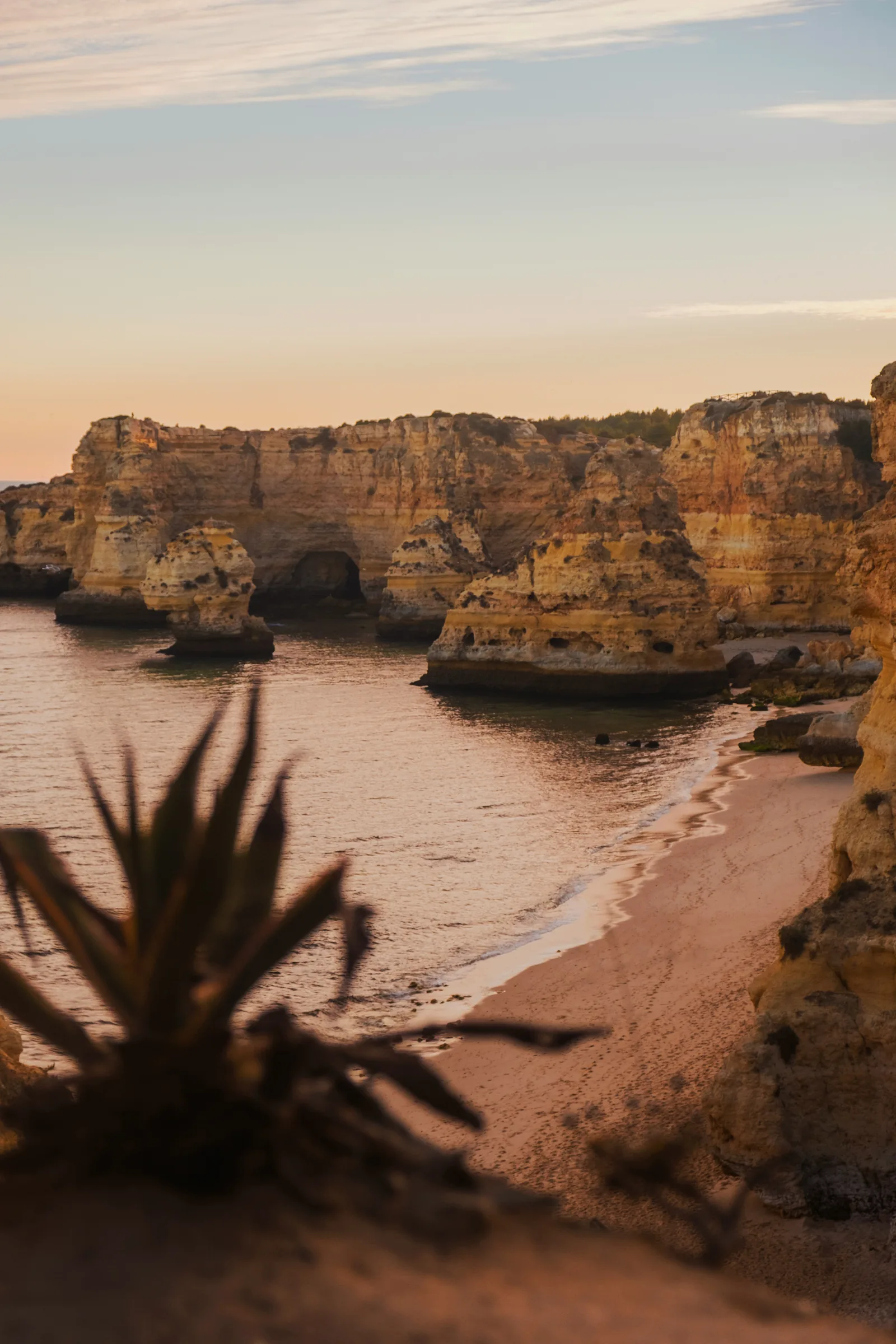
Faro.
Tied with Rhodes for Europe's sunniest coast — 300+ sun days a year, Atlantic breezes that temper the heat, and a lagoon ferry system most package tourists never find. What to book, when to go, and what to eat.
Faro sits at the south-east corner of Portugal's Atlantic coast, capital of the Algarve, and quietly the short-haul sun destination with the most consistent weather in continental Europe. The Nortada — the prevailing northerly wind that runs down the Iberian peninsula in summer — keeps Faro 3–5°C cooler than the Spanish Mediterranean at the same latitude, which means that while Seville is hitting 45°C and its restaurants are closing lunch service, Faro is sitting at 29°C with a reliable breeze and the beaches are bearable. That's the reason seasoned British and German travellers have quietly migrated east across the Algarve over the last fifteen years, and the reason Faro itself — which most of them still treat as an airport to fly into before driving somewhere else — is worth staying in.
That Atlantic tempering is increasingly the point. Our 2026 climate study flags the wider Mediterranean as a heat-risk region in midsummer (multiple 44–48°C events 2021–2024); the Algarve sits just outside that window, and Faro specifically benefits from the cooler Atlantic flow.
When to go
Faro has the longest comfortable sun season in Europe.
- April–June is the sweet spot: 22–27°C, Atlantic water at 18–21°C, and Portuguese school holidays haven't started.
- September–October is the other sweet spot: the sea is at its warmest (22–23°C), the summer crowds are gone, and temperatures are back to the comfortable range after August's brief heatwaves.
- July–August is hot but not punishing — highs of 30–33°C, sea 22°C, beaches busy but not chaotic.
- November–March is quiet, 16–20°C, mild enough for walking holidays but not swimming weather except during the rare southern winter lull.
Rain is the feature to understand: October through March sees most of the Algarve's annual 500mm, concentrated in a few dramatic storms rather than the grey drizzle Northern Europeans are used to. Summer is effectively dry.
Getting there
Faro Airport (FAO) is 6 km from the city centre. All the low-cost carriers fly here: Ryanair, easyJet, TAP, Wizz Air, Jet2. Flight time from London is 2h 45min, from Amsterdam 3h, from Oslo 4h, from Frankfurt 3h.
From the airport, bus 16 runs every 20–30 minutes to Faro city centre for €2.30. Uber and Bolt are both available; expect €8–12 to the centre. A taxi from the rank is €10–15. If you're heading to a resort further west (Albufeira, Vilamoura, Carvoeiro, Lagos), pre-book a transfer — the train service exists but is infrequent.
Where to stay — three Faro hotels
Faro itself has a walkable historic centre (cidade velha) wrapped in medieval walls, a marina, and access to the Ria Formosa lagoon. Stay in the centre if you want to walk everywhere; stay in Praia de Faro if you want beach first. The centre is better for the first-time visitor.
Luxury — Pousada Palácio de Estoi. 10 km north of Faro in the village of Estoi — a rococo palace converted to a 63-room pousada. Gardens, pool, formal dining room. Around €250–350 in shoulder season. Check rates on Booking →
Mid-range — AP Eva Senses Hotel. In Faro centre on the marina, rooftop pool with ria views, spa. 9.1 across 1,400+ recent reviews. Walkable to everything; bus 16 stop outside for the airport. €130–180 in May. Check rates on Booking →
Budget — Hotel Faro & Beach Club. Marina-front, simple but well-kept rooms, small rooftop with lounge chairs. 8.4 across 3,000+ reviews — that review count matters. €75–95 in May. Check rates on Booking →
The Ria Formosa ferry hack
This is the thing most Faro visitors miss. Directly in front of the old town, the Ria Formosa — a 60 km lagoon of salt marshes, sandbanks, and barrier islands — stretches along the coast. Five of the islands are inhabited: Faro Beach (road-connected), Barreta (uninhabited, day-trip), Culatra, Armona, and Farol. The last three are car-free fishing villages, reachable only by ferry, with long empty beaches that face the Atlantic on one side and the sheltered lagoon on the other.
The ferries leave from Faro's downtown ferry dock (Porta Nova), cost €2–4, and take 20–40 minutes depending on which island. In July and August they run every hour; in shoulder season every 2–3 hours. Farol and Culatra are the ones to prioritise. Farol has a lighthouse, a single beachfront restaurant (Aquário), and approximately zero tourist infrastructure. Culatra has a proper village — fishermen's cottages, three or four seafood restaurants, kids playing football in the sand. You can rent a small apartment on Culatra for €60–90 a night and have the most authentic coastal experience in Portugal.
Almost no one doing a packaged Algarve holiday finds this. It's genuinely one of the best things you can do on a European sun trip.
The move: book two nights in Faro centre, take the ferry to Culatra or Farol for a day (or overnight if you're adventurous), then taxi 45 minutes west to a proper resort for the beach days. Best of three worlds.
What to eat — and the cataplana story
Portuguese food is not Spanish food, even though tourists treat them as interchangeable. The Algarve's signature dish is cataplana de marisco — seafood (usually clams, prawns, and white fish) steamed in a hinged copper pot with tomato, onion, coriander, and a white wine reduction. The pot is the dish. The technique came with the Moors 1,000 years ago — the name and the shape are directly descended from Moroccan tagine cookware — and it's still made by hand in a few workshops in Loulé, 20 km north of Faro.
Where to eat it: Tertúlia Algarvia in the old town is the formal version, O Castelo in front of the cathedral is the neighbourhood version, and Restaurante Camané at Praia de Faro is where the locals actually go. All three cost €22–35 for a cataplana for two. The touristy versions in the marina area cost €45 and are worse.
Beyond cataplana, try carne de porco à alentejana (pork with clams — yes, an actual thing), polvo à lagareiro (octopus roasted with olive oil and garlic), and the Algarve's Portuguese cakes: Dom Rodrigo (fios de ovos, almond, cinnamon). Pastelaria Gardy on Rua de Santo António is the 60-year-old bakery Faro locals drive across town for.
Legal, practical, and safety notes
- Currency: Euro. Card accepted essentially everywhere; Multibanco (the Portuguese debit network) is cheaper for ATM withdrawals than foreign-bank ATMs.
- Visa (UK/US/Canada): Schengen 90/180 rules apply. ETIAS is expected to launch late 2026 — €20 pre-authorisation online.
- Water: Tap water is drinkable everywhere in Faro, though locals often prefer bottled for taste. Safe.
- Language: English is widely spoken in tourist-facing businesses; less so outside the centre. Obrigado/obrigada (gendered) and bom dia/boa tarde go a long way.
- Tipping: Not expected. Round up the bill in bars; 5–10% in restaurants for good service is generous.
- Plug type: Type F (European standard two-pin). 220V.
- Solo-female safety: Portugal is one of the safer EU countries. Faro specifically is low-crime; standard precautions apply in the marina bars after midnight.
Day trips worth taking
- Tavira (45 min east by train, €3): arguably prettier than Faro. Roman bridge, salt flats, octopus restaurants.
- Lagos (90 min west by train, €7): the dramatic sea-cliff coastline with Benagil Cave.
- Silves (45 min north by train, €2): red sandstone Moorish castle, medieval old town, inland.
- Loulé (30 min north by train): the Saturday Gypsy market is a genuine weekly event.
- Seville (2 hours by direct bus, €25): Yes, you can go to Seville for the day. Most UK tourists don't know this.