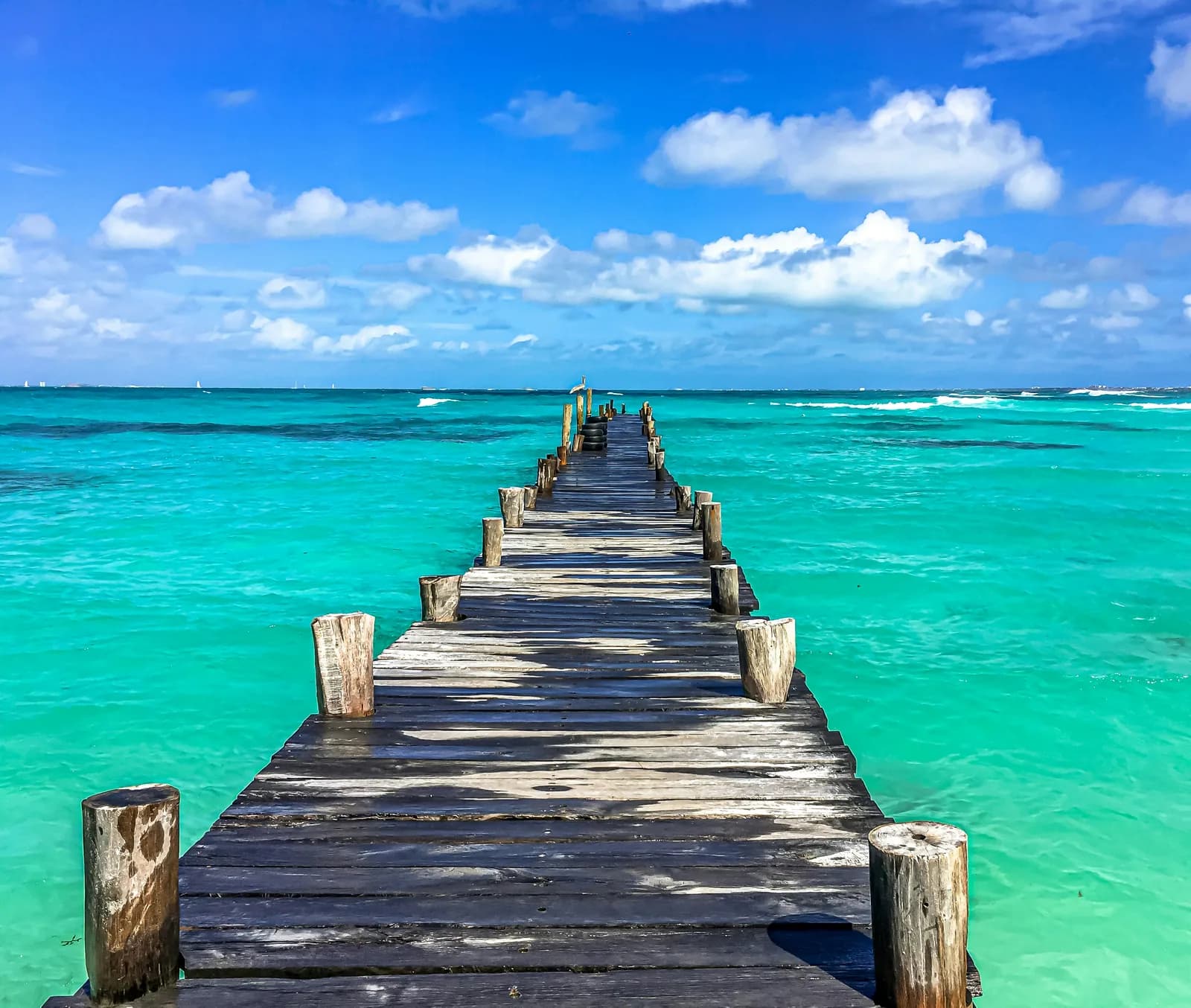
Cancún.
The Yucatán's gateway, decoded: hotel zone or centro, the cenotes that outclass the beach days, Chichén Itzá before the buses, Isla Mujeres by golf cart — and the sargassum and hurricane calendar stated honestly.
Cancún was invented by committee — in the late 1960s Mexico's tourism planners ran the numbers on an empty Caribbean sandspit and built a resort city to spec — and it has spent fifty years outgrowing the punchline. The 22-kilometre hotel zone delivers exactly what it was designed to: white sand, blue ladder of sea, all-inclusive machinery at every budget. But the real reason Cancún earns its flights is what radiates from it: the Yucatán peninsula, where Maya pyramids rise out of jungle, colonial towns run on pink facades, a reef system second only to Australia's tracks the coast — and the limestone underfoot hides thousands of cenotes, freshwater sinkholes that constitute the best swimming on the continent.
The honest guide treats Cancún as a base camp with a very good beach attached — and is straight about the two seasonal asterisks the brochures bury.
When to go — and the two asterisks
December through April is the database's window and the Caribbean dry season: 28–30°C, sea 26–27°C, trade-winds, statistically negligible storm risk. March called it the Yucatán's cleanest month with one caveat — US spring break colonises the hotel zone's party segment that month; Tulum-side bases and the centro barely notice.
The asterisks:
Hurricane season runs June through November (peaking August–October) — the database's avoid list. Most weeks pass uneventfully; the risk is real enough that travel insurance and flexible bookings stop being optional, and September–October bookings are a literal gamble on the season's roulette.
Sargassum — the brown seaweed tide — arrives in drifting rafts roughly May through October, some years lightly, some years burying the postcard. The north-facing beaches (the hotel zone's top arm, Isla Mujeres' Playa Norte) catch least; the east-facing strip and points south catch most. In season, check the daily sargassum maps before paying beachfront premiums — and remember the cenotes don't care.
Getting there and around
CUN is the Caribbean's busiest gateway — direct lift from across Europe and relentless US competition keeping fares mobile. The ADO buses run airport→centro cheaply and reliably; pre-booked shuttles and official taxis cover the hotel zone (€25–35). In town, the R1/R2 buses ride the whole hotel zone for under a euro at all hours — Cancún's best-kept transport secret — while the colectivo van network and ADO coaches reach the whole Riviera Maya without a rental car. Rent one only for the cenote-trail and Valladolid days, where freedom pays.
Hotel zone or centro — the split decision
The hotel zone (Zona Hotelera) is the 7-shaped barrier island: lagoon one side, Caribbean the other, resorts shoulder to shoulder. The top arm (facing north, Isla Mujeres on the horizon) gets the calmest water and least sargassum; the long east-facing arm gets the surf and the sunrise. El centro — downtown Cancún — is a working Mexican city ten minutes inland: a third the nightly rate, the real food (below), and buses that put the beach fifteen minutes away. Resort holiday: zone. Yucatán expedition with beach days: centro, or split the stay.
Luxury — Nizuc Resort & Spa, Punta Nizuc
The quiet southern tip, away from the strip's volume: low villas in mangrove gardens, two beaches, the city's best resort dining and a spa with genuine ambitions. Around €450–550/night in season. Check rates on Booking →
Mid-range — Beachscape Kin Ha Villas, north arm
On the protected Playa Linda stretch of the top arm — calm, swimmable, family-easy water with Isla Mujeres on the horizon — at €140–190/night, the location the megaresorts charge triple for. Check rates on Booking →
Budget — Hotel Plaza Caribe, centro
Opposite the ADO terminal: pool courtyard, dependable rooms, every bus in the peninsula at the door. Around €50–70/night — the expedition base. Check rates on Booking →
Cenotes over beach days
The peninsula's limestone shelf has no rivers; the water runs underground and surfaces in cenotes — sinkhole pools of filtered 25°C clarity, sacred to the Maya and superior to any beach day the moment the sargassum or the crowds arrive. The taxonomy: open (Azul, near Playa del Carmen — the family swimming hole), semi-open (Gran Cenote outside Tulum — turtles under the boardwalks), cavern (Dos Ojos — snorkellers drift between two flooded chambers; divers continue into the planet's longest underwater cave systems), and the photo-famous (Suytun's light-beam platform near Valladolid — go at opening or own the queue). Entries run €10–20; mornings beat tour-bus hours; rinse off sunscreen first (the rule that keeps them this clear).
The day trips that justify the airport
- Chichén Itzá (2h30) — the Maya world's marquee city: El Castillo's calendar-pyramid, the great ball court's acoustics, the cenote of sacrifices. The play: leave at 06:30, be at the 08:00 gate ahead of the coach armada and the heat, pair with Suytun or Valladolid for lunch. Equinox weeks add the serpent-shadow spectacle and triple the crowd. Car-less? The early-access guided runs solve the 06:30 problem for you.
- Tulum ruins (1h45) — the only Maya city on a cliff over the Caribbean: small, scenic, shadeless — 08:00 sharp, swim the beach below after.
- Valladolid — the pink-and-ochre colonial town that pairs with either ruin run: convent, cochinita lunch at the market, cenote Zací in the town centre.
- Isla Mujeres — the 20-minute ferry from the zone or Puerto Juárez: rent a golf cart (the island's vehicle), loop Punta Sur's cliffs, finish at Playa Norte — waist-deep turquoise that shrugs off sargassum season. The best easy day on the coast.
- Cozumel (via Playa del Carmen) — the reef island: drift-diving's world capital, snorkel boats for the rest of us.
- Whale sharks (June–August only) — the summer's one argument: snorkelling alongside the planet's biggest fish off Isla Contoy, with licensed small-boat operators.
Eating — the centro is the point
Hotel-zone dining runs from buffet to celebrity-chef; the city's actual food lives downtown:
- Parque de las Palapas — the evening square: marquesitas (crêpe-cones with cheese and Nutella, trust the locals), antojitos stalls, families until late.
- Mercado 23 — the locals' market (Mercado 28 is its souvenir cousin): cochinita pibil tacos at breakfast, salbutes and panuchos after.
- Los de Pescado — the fish-taco institution: Baja-style battered, a squeeze of lime, repeat.
- La Habichuela — the white-tablecloth Yucatecan stalwart: cochinita, sopa de lima, garden courtyard. €25–35.
Drink the peninsula: agua de chaya, Yucatecan craft beer, and mezcal treated with the respect tequila's cousin deserves.
Practical notes
- Money: pesos always beat the "we take dollars" rate; cards standard, market cash.
- Sea honesty: 26–28°C year-round; east-facing surf has rips and flag discipline; the lagoon side is for sunsets, not swimming (crocodiles are residents, signage means it).
- Sargassum intel: check the day's map (the monitoring networks publish constantly) before committing beach plans May–October.
- Safety calibration: the tourist corridor is heavily invested and statistically calm; standard city sense applies downtown at night.
- Timing chichén: the 06:30 rule is the difference between a wonder and a queue.
The summary
Fly CUN in the December–April window, split the stay — three nights centro at Plaza Caribe for the expedition phase (Chichén at dawn, cenote trail, Valladolid), three on the north arm at the Beachscape tier (or Nizuc for the polish) for the beach-and-Isla phase. Golf-cart Friday on Isla Mujeres, cenotes whenever the beach disappoints, palapas square for the cheap dinners and La Habichuela for the long one. Cancún the resort is fine; Cancún the base camp is the best-connected doorway in the Americas to swimming holes the Maya considered sacred — and they were right.