Agadir.
Morocco without the maze: a six-kilometre crescent of beach, 300 sunny days, a souk where the prices behave, Paradise Valley's palm-gorge pools — and Taghazout's world-class surf forty minutes up the coast.
Agadir is the Morocco for people who found Marrakech magnificent and exhausting — or who skipped the test entirely. The reason is grim and liberating at once: the 1960 earthquake levelled the old city in fifteen seconds, and what rose instead is Morocco's one planned resort town — wide boulevards, low white blocks, a palm-lined promenade and a six-kilometre crescent of sand facing the Atlantic. No labyrinth, no hassle economy, no navigation by minaret. What survives of "old" Agadir is a kasbah outline on the hill spelling God, Country, King in lights; what thrives below is the most straightforward beach holiday in Africa's top-left corner.
The honest framing: Agadir trades atmosphere for ease. Then it hands the atmosphere back through day trips — a palm gorge an hour north, the surf coast at Taghazout, a walled Berber market town inland — that the resort strip quietly underuses.
When to go
The database's window is wide — April through June, September through November — and the Atlantic explains it: the same ocean cap that runs our "not too hot" thesis keeps Agadir's summer civilised and its winter mild.
April–June: 23–26°C, the inland excursions at their greenest, the April guide's repeat pick. September–November: 26–24°C descending, the sea at its 21–22°C best, low-season pricing arriving before the weather leaves. July–August run a capped 27–30°C — entirely workable, with the one caveat of the chergui, the Saharan east wind that spikes a few days past 35°C most summers. December–February: 20–22°C days and Europe's classic cheap-winter-warmth play, with the honesty that the sea is a brisk 17–18°C and evenings want a jumper.
One Atlantic quirk to know: morning coastal cloud (the locals shrug it off) burns away by mid-morning more days than not. It is not a forecast error; it is breakfast weather.
Getting there
Al Massira (AGA) sits 25 km southeast — low-cost directs from across Northern Europe year-round. Transfers run €20–25 by taxi (agree the price first; it's the airport's one bazaar moment); hotel shuttles and ride-apps (InDrive works locally) undercut it. In town, petits taxis are orange, cheap (€1–3 across the centre) and metered when reminded.
Where to stay
The hotel quarter lines the beach's southern arc — the practical question is promenade-front versus a block back, since the front pays €30–50 more for the same breakfast.
Luxury — Sofitel Agadir Royal Bay
The strip's establishment anchor at the quiet southern end: Moorish-modern pavilions, gardens to the dune line, a thalasso spa that takes the Atlantic seriously. Around €200–260/night in season. Check rates on Booking →
Mid-range — Riad Villa Blanche
The exception to rebuilt-Agadir's blockiness: a boutique riad-style villa with a courtyard pool and hammam at the marina end. Around €120–160/night. Check rates on Booking →
Budget — Hotel Timoulay
A friendly four-star a few streets back from the sand: pool garden, hammam, rates around €80–110/night that fund the day trips this guide actually cares about. Check rates on Booking →
The beach and the promenade
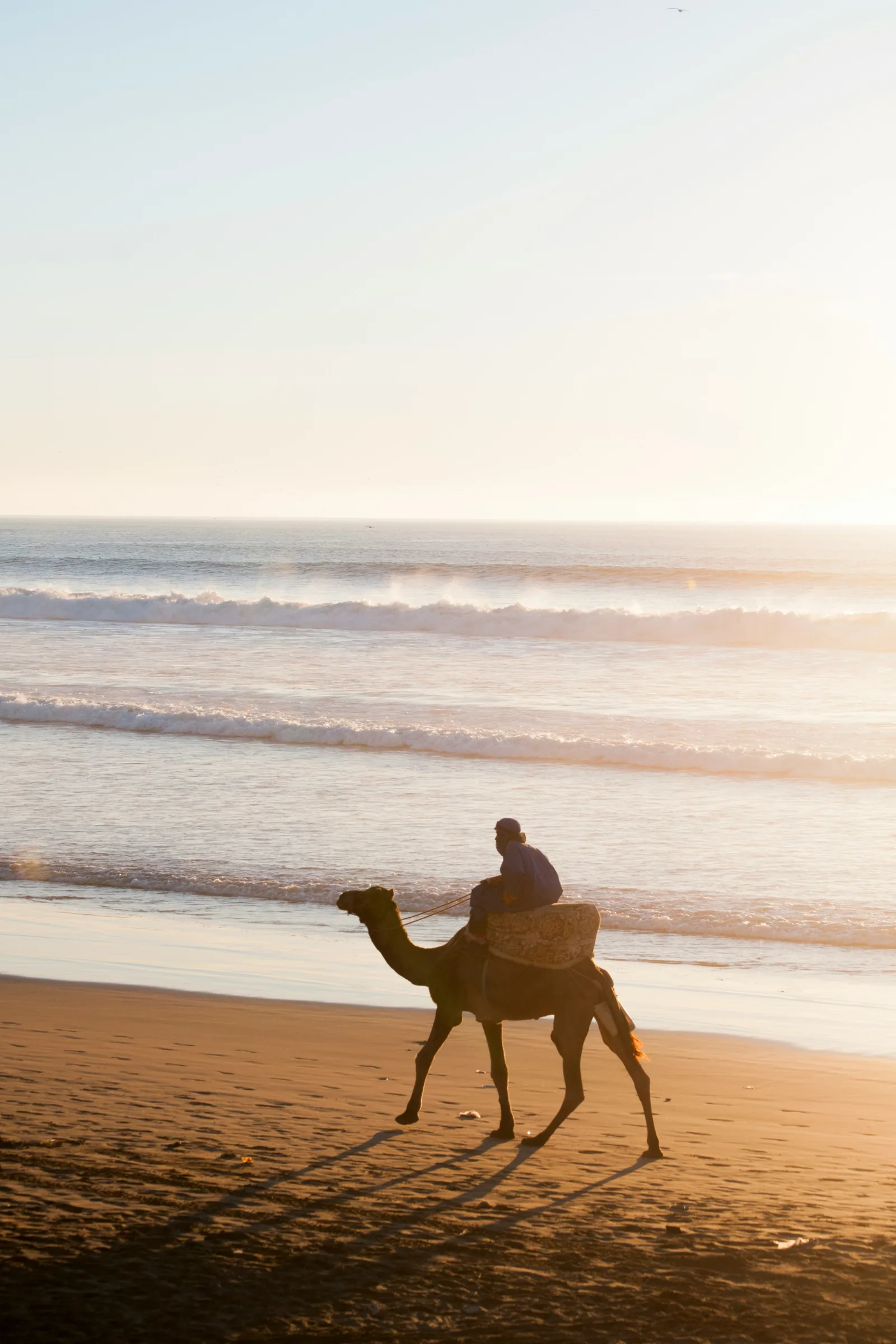
The crescent is the town's argument: six kilometres of broad sand in a sheltered bay, swimmable in the protected southern half, with a promenade of cafés running its full length — the evening corniche stroll is Agadir's one universal ritual. Atlantic rules apply: waves with intent (flags matter, lifeguards exist in season), water 17–22°C by month, and afternoons breezier than the brochure admits — which is precisely why the camel-and-quad operators work the dune end and the surf schools fill vans every morning heading north.
Above it all, floodlit at night, the kasbah hill (Agadir Oufella) — the earthquake's memorial viewpoint, now reached by a cable car (€10ish return) or taxi, with the whole bay below at sunset.
Souk El Had — the anti-Marrakech
Agadir's market is the largest souk in the region and the gentlest introduction to Moroccan commerce anywhere: 3,000-odd stalls inside earthen walls, where locals do their actual shopping, prices start near reality and the hassle dial sits at two out of ten. The targets: argan oil (verify the cooperative label), olives and preserved lemons by the kilo, spices pyramided like pigments, babouches without the Marrakech markup. Closed Mondays; liveliest weekend mornings. Treat it as half a day with a juice stop, not an errand.
Paradise Valley — the palm gorge
An hour northeast in the Atlas foothills, Paradise Valley is the day trip that converts beach-resort sceptics: a palm-lined gorge of smooth granite pools strung with little terrace cafés, where the swim is fresh, the tajine arrives at the pool's edge and the walk in (twenty shadeless minutes from the parking) does the gatekeeping. Go early — by 11:00 in season the pools host a crowd — and pair it with the honey villages further up the road. Half-day tours run €25–35; a grand taxi negotiated for the morning does it on your own clock.
Taghazout and the surf coast
Forty minutes north, the coast turns into one of the world's famous right-point procession grounds: Taghazout, the fishing village that became Morocco's surf capital, with Anchor Point as the marquee wave (winter swells draw the international circuit) and a string of breaks — Killers, Panoramas, Devil's Rock at Tamraght — covering every level. For non-surfers the village still earns the trip: blue boats, banana-shake cafés, yoga decks, a generational collision of Berber fishermen and laptop nomads that somehow functions. Beginner packages (board, suit, lesson, lunch) run €40–60 a day; the surf-camp week is its own holiday genre. November to March is prime swell; summer offers gentler learning water.
What to eat
The port does the heavy lifting: at the fish grills by the harbour gate, you choose from the morning's ice — sardines, sole, calamari, the spiny urchins if you're brave — pay by weight, and eat it charcoal-grilled at communal tables for €8–12 all in. It is the best cheap meal on this coast and the reason to skip one hotel dinner minimum.
Elsewhere: amlou (the argan-almond-honey spread that ruins peanut butter forever) at every riad breakfast; Sous-region tajines heavy on preserved lemon; La Scala for the white-tablecloth fish evening (€25–35); and the orange-juice carts on the promenade doing their one perfect thing. Agadir's bar scene exists (a rarity in Morocco) — the marina and hotel bars pour with licences the medina cities lack.
Day trips further afield
- Taroudant (1h30 inland) — "little Marrakech" with its honesty intact: intact ramparts, two souks at local prices, calèche rides below the walls. The medina experience Agadir lacks, at one-tenth the pressure.
- Souss-Massa National Park (45 min south) — estuary birdlife including the last wild colonies of the northern bald ibis, one of Earth's rarest birds; flamingos in the lagoons in season.
- Essaouira (2h45 north) — doable as a long day, better as an overnight; the blue-and-white windy sister this coast keeps for contrast.
Practical notes
- Money: dirhams; ATMs everywhere in the centre; the souk runs on cash.
- Hassle calibration: promenade vendors are persistent-lite; a smiled la, shukran suffices. After Marrakech it feels like silence.
- Goats in argan trees: the roadside photo-op herds are staged for tips — the wild version exists, but not posed on the N8 at noon.
- Dress: resort-normal in town and on the sand; modesty earns its keep at Souk El Had and inland.
The summary
Fly AGA, base at the Timoulay or Villa Blanche. Beach-and-promenade rhythm as the default; Souk El Had on a weekend morning; Paradise Valley early one day with the honey road after; a Taghazout surf-or-spectate day with a banana shake verdict; Taroudant if the trip runs past five nights. April–June or September–November for the ideal version, midwinter for the cheap-warmth one. Agadir won't romance you the way the imperial cities do — it just delivers sun, sand and logistics that work, then lets the day trips do the poetry.