Rhodes.
Europe's largest living medieval town with a beach island attached. The Street of the Knights, Lindos timed correctly, the two-coast rule that organises every day — and an honest word about midsummer.
Rhodes holds two superlatives that rarely share an island. The Old Town of Rhodes is Europe's largest inhabited medieval town — a walled UNESCO city of 6,000 residents where the Knights Hospitaller ran their island state for two centuries before Malta — and around it stretches one of Greece's most complete holiday islands: 200-odd kilometres of coast, a white village under an ancient acropolis, pine mountains, and a flight network that makes it the easiest Greek island to reach from almost anywhere in Europe.
It is also, in July and August, one of the hottest — so the calendar matters here more than most, and we'll be straight about it.
When to go
May, June, September and October — the database's verdict, emphatically seconded.
May: 24–26°C, sea at 19–20°C, the island green from spring and the Old Town walkable all day. June: 28–29°C, sea 22–23°C, the full holiday machine running before peak crowds. September is the pick of the year: 27–28°C, the sea at its 25°C maximum, Lindos breathable again. October keeps 24°C days and a 23°C sea — Rhodes runs one of the longest swim seasons in Greece.
July and August are flagged honestly. Rhodes is among the Aegean's hot spots: 33–36°C standard, spikes beyond, and the climate study treats the midsummer southern Aegean as a heat-risk window by default. The July 2023 wildfires that forced evacuations along the island's southeast were the pattern at its worst — not an annual event, but the direction of travel. Shoulder season here isn't a compromise; it's the better product.
Getting there
Rhodes (RHO) lands 14 km southwest of town — seasonal directs from all over Europe (one of the densest Greek-island route maps), year-round via Athens. Bus to town a few euros, taxi €25–30. Ferries connect the Dodecanese chain and, in summer, the Cyclades; the Symi catamaran (below) leaves from the commercial harbour by the Old Town walls.
Getting around: the east-coast bus spine (Rhodes Town–Lindos) is frequent and cheap; a rental car for two or three days unlocks the south and the mountain interior.
The two-coast rule
The island's geography organises every day for you. The east coast is the holiday coast: calm, warm, sandy — Kallithea's lidos, Tsambika's golden bay under its monastery, Agathi, St Paul's at Lindos. The west coast takes the prevailing wind: shingle, waves, and at the southern tip — Prasonisi, where the two seas meet across a sandbar — one of Europe's great kitesurf arenas. Beach mornings east, sights and sunsets west is the native rhythm.
The east's set pieces deserve their own lines: Anthony Quinn Bay (named when the actor bought land here filming The Guns of Navarone — emerald water over rocks, snorkel territory, early or late only in season) and Tsambika, the island's best sand with the fewest buildings, watched by the monastery on its crag.
Lindos, timed correctly
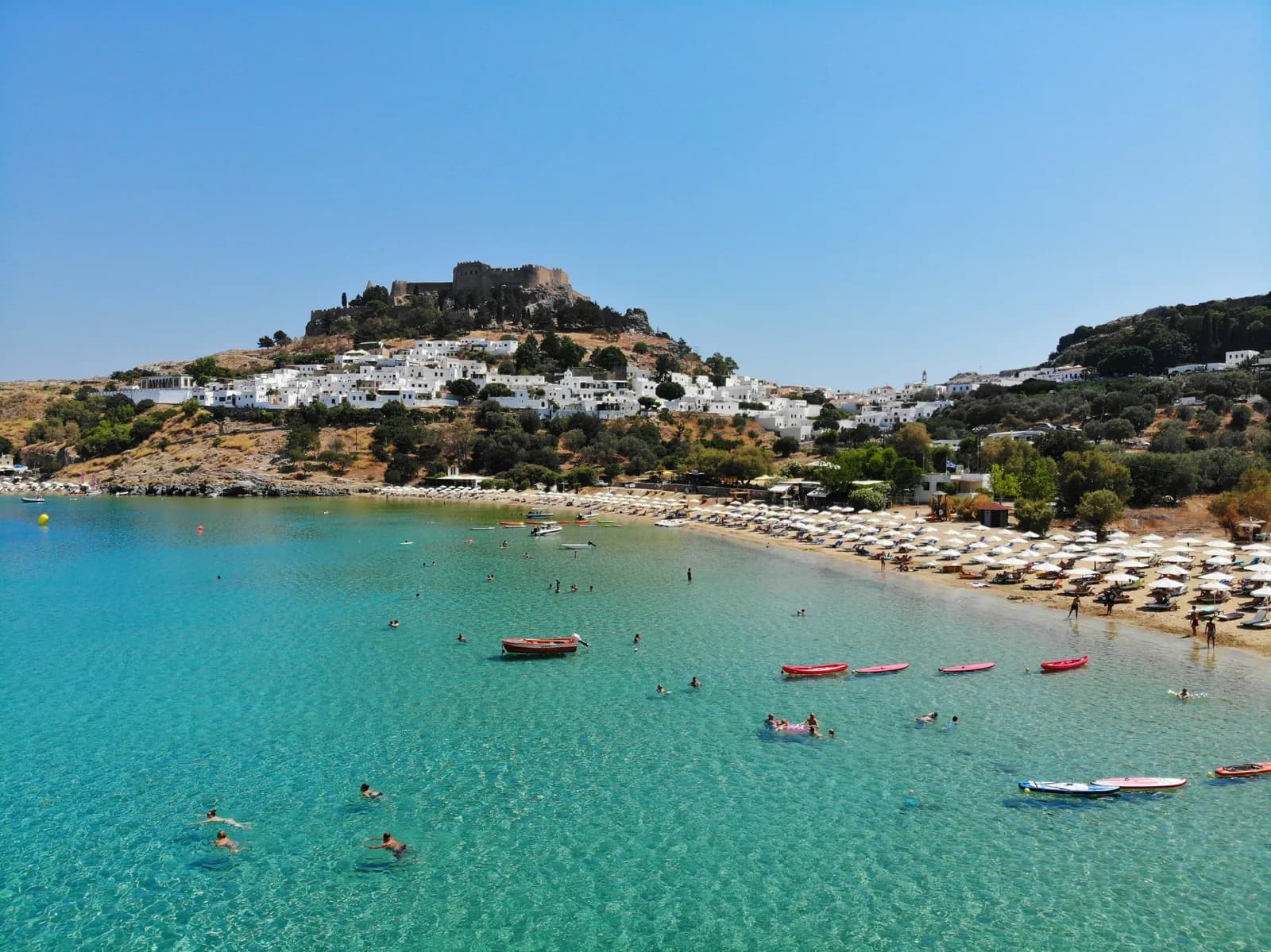
Lindos is the island's second act: a sugar-white village stacked beneath an acropolis where a 4th-century-BC Temple of Athena shares its rock with a Knights' castle, above a bay St Paul allegedly entered in a storm. It is genuinely one of the great sights of the Greek islands, and at 13:00 in August it is a shadeless queue with a gift-shop soundtrack.
The protocol: arrive by 08:00 (acropolis opens early; €12ish) or after 16:30, climb on foot — the path is short; skip the donkeys, which the island's own veterinarians would thank you for — swim St Paul's Bay below, and either clear out before the coach wave or stay for dinner on a rooftop when the village empties and recovers itself. Mavrikos, on the main square since 1933, is the storied kitchen: fish in caper-leaf sauces, a wine list that has seen things (€35–50).
The Old Town, given a full day
Enter at the Gate d'Amboise and let it sprawl: the Street of the Knights, the most complete Gothic street in Europe, climbing past the inns of each knightly nation to the Grand Master's Palace — a 1930s Italian reconstruction (Mussolini intended it as a residence; the honesty matters, and the medievalism is theatrical rather than archaeological, which is its own story). Below, the commercial maze absorbs the cruise crowds while the southern quarters — the old Jewish and Turkish neighbourhoods around Plateia Evreon Martyron — stay lived-in: laundry lines, bougainvillea, cats with administrative authority.
Two upgrades: walk the moat — the dry ditch circles the full walls in garden quiet, free, inexplicably empty — and time the Palace and Street for before 09:30, when the ships disgorge. Evening belongs to the Old Town anyway, when day-trippers leave it to the people who live there and the lamplight does the rest.
The Symi day
The fast boat from Rhodes harbour reaches Symi in about an hour (€25–35 each way, book a day ahead in season): a fjord-harbour of neoclassical mansions in ochre and terracotta climbing both slopes — the Dodecanese's prettiest single view, assembled by 19th-century sponge-diving money. Climb the Kali Strata stair before the heat, eat the famous tiny Symi shrimp fried whole at a quayside taverna, swim at St George's Bay beneath its sheer cliff if your boat calls there, and sail back into the Rhodes sunset. The best-value day trip in this corner of the Aegean.
Where to stay
Base in or beside the Old Town for the full version; Lindos for the village-romance alternative; the east-coast resorts (Kallithea, Faliraki, Tsambika) for conventional beach bases — with the note that Faliraki is the party brand, knowingly.
Luxury — Kókkini Porta Rossa, Old Town
Six suites inside a knight's house at the Red Gate: stone, timber, candlelit courtyard, hosts who treat hospitality as a craft. Around €280–350/night. One of Greece's special small hotels. Check rates on Booking →
Mid-range — Spirit of the Knights, Old Town
A restored Ottoman-era house under the western walls: six rooms, stained glass, a courtyard fountain, silence two minutes from the bustle. Around €160–210/night. Check rates on Booking →
Budget — Cava d'Oro, Old Town
Stone-vaulted rooms in a 14th-century building by the harbour walls, family-run, around €90–120/night in season. Check rates on Booking →
What to eat
Rhodes feeds well beyond the tourist mile. The island specialities: pitaroudia (chickpea fritters), slow goat, the Dodecanese take on melekouni (sesame-honey wedding sweet), and serious local wine — the Embonas villages on Mount Attavyros grow Athiri whites and Mandilaria reds; CAIR and Emery run tastings. In town: Marco Polo Café in its Ottoman garden (the Old Town's romantic table, €35–45), Tamam for the modern-meze counterpoint, and the working-harbour fish places at Akandia where the menu is whatever surfaced that morning. Lindos has Mavrikos, above. Everywhere: if a waiter stands outside with laminated photographs, the kitchen has already told you everything.
Practical notes
- Crowds calendar: cruise ships stack the Old Town late morning to mid-afternoon — plan around the wave.
- Sea honesty: east coast calm and warm (25°C September peak); west coast wind and shingle — surf-watching, not swimming, for most.
- Wildfire awareness: in high summer, heed local guidance and the island's alert system; the southeast's 2023 burn scars are part of the landscape now.
- Money: Euro; cards standard, village tavernas appreciate cash.
The summary
Fly RHO, sleep inside the walls at Spirit of the Knights or the Kókkini Porta. One full Old Town day opened before the ships and closed after them; one Lindos morning on the 08:00 protocol with the St Paul's swim; one Symi boat day; one east-coast beach run (Tsambika, Anthony Quinn, Kallithea) with a rental car that continues into the Embonas wine hills. May, June, September or October — September if you can choose freely. Rhodes built Europe's best medieval city and parked it on a beach island; the only mistake available is the month.