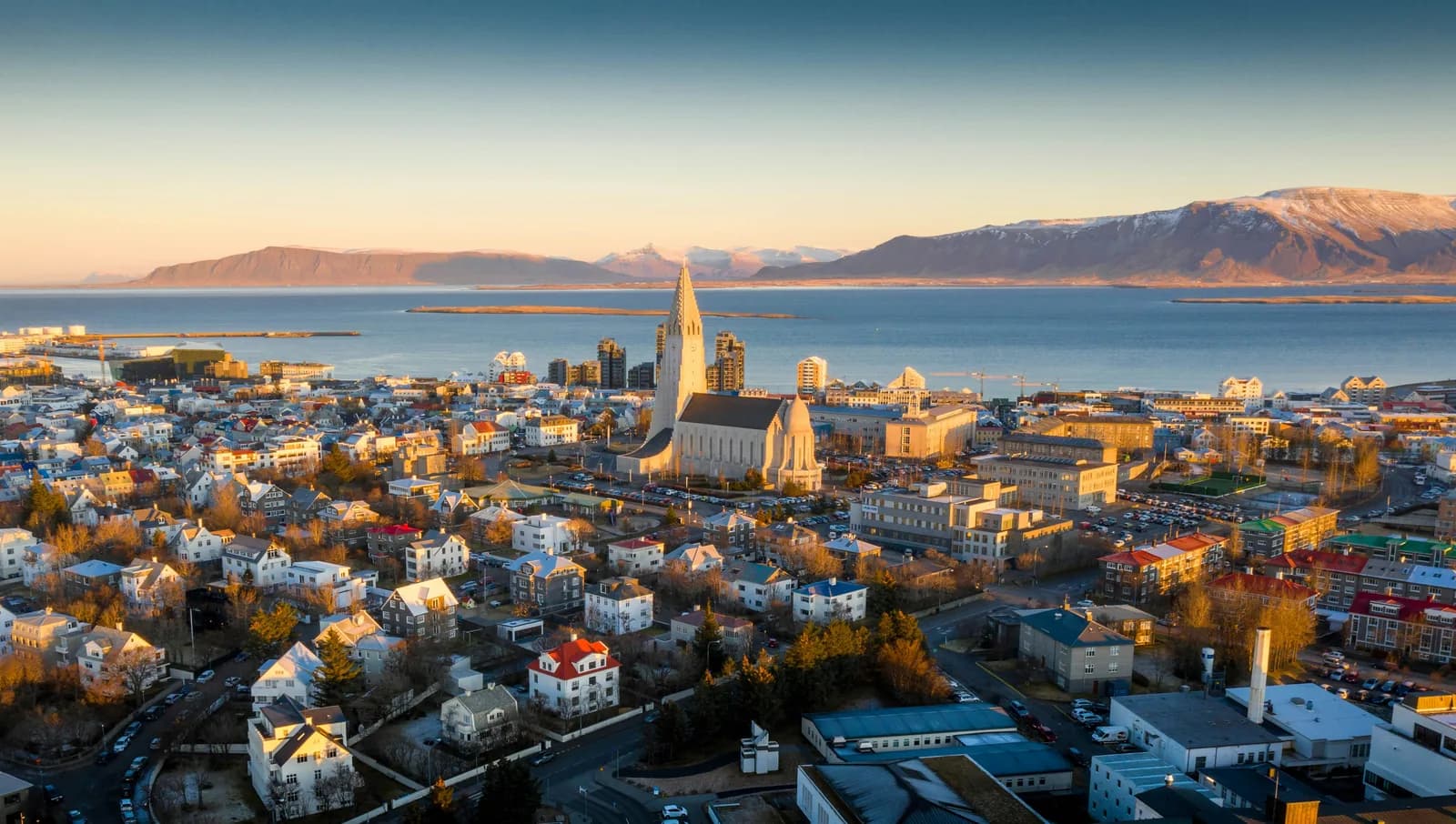
Reykjavík.
The biggest temperature delta on the map: 13–15°C while Athens roasts near 33, bathed in 21 hours of July light, where you soak in 40°C geothermal pools at midnight. The purest anti-heatwave escape there is — sold on light and water, not warmth.
If the brief is escape the heat entirely, Reykjavík wins outright. It posts the biggest gap on this whole site — a July daytime high of about 13–14°C against 33°C in Athens, roughly 19°C cooler — and it's bathed in light that essentially never goes out: on 1 July the sun sets near midnight and rises again three hours later, so you sightsee, swim and hike around the clock. (Athens runs hotter still downtown; even against a coastal 32°C the gap is enormous.) The Gulf Stream keeps it milder than its latitude deserves, but make no mistake: this is a cool, raw, windswept capital where the pleasure is the light, the geothermal water and the wild interior an hour away — not the beach.
The honesty here runs the opposite way to the Mediterranean guides. There is no heat to worry about (Reykjavík's all-time record is just 25.7°C, set in 2008). The caveats are layers, wind, a sea too cold to swim, and the fact that summer means no northern lights — the sky is too bright. Sell yourself the light, not a tan.
When to go
June to August is the season — warmest (such as it is), lightest, with every interior road open. Late June holds the near-midnight sun at its peak. September cools and quietens, brings the first aurora chances, and drops the prices. Winter is the other, completely different Iceland — four hours of daylight, cold, and the northern-lights product; this guide is the bright-summer one.
Getting there
Keflavík International (KEF) is 50 km southwest of the city — the Flybus / airport coach runs to the BSÍ terminal in about 45 minutes; taxis are eye-wateringly expensive (skip them). Direct summer flights reach KEF from Madrid, Barcelona, Rome, Milan and Lisbon, plus the Icelandair/PLAY hub network. A useful quirk: the Blue Lagoon sits ~20 minutes from the airport, so it's the classic first-or-last stop, luggage in the car.
In the city, downtown 101 Reykjavík is small and walkable; a rental car earns its keep only for the Golden Circle and the south coast. Iceland is expensive across the board — budget accordingly.
The geothermal pools — the heart of it
Pool culture is Icelandic social life, and every pool is geothermally heated — this is the city's living room and your daily ritual:
- Laugardalslaug — the largest public pool: an Olympic outdoor pool, slides, and a row of heitir pottar hot tubs at 40–42°C. Cheap (~ISK 1,300), local, the real thing.
- Sundhöllin — the 1937 art-deco downtown pool with rooftop hot tubs. Central and characterful.
- Nauthólsvík — the man-made geothermal beach: golden sand where hot water meets the sea (a ~15–19°C lagoon plus a 38°C hot tub). Free in summer, a short coastal walk or cycle from downtown.
- Sky Lagoon (Kópavogur, ~7 km) — the premium oceanfront geothermal spa with an infinity edge over the Atlantic and a seven-step ritual; book ahead.
- Blue Lagoon — the famous one, but NOT in the city (~49 km, by the airport): premium, milky-blue, book well ahead; best done on the airport run.
The etiquette that matters: shower thoroughly, without a swimsuit, before entering any pool — it's a strict, non-negotiable hygiene rule, and the signs (and locals) will enforce it. Soaking in a 40°C tub at midnight under a bright sky is the defining Reykjavík experience.
The city itself
- Hallgrímskirkja — the rocket-ship basalt church on the hill, the city's landmark; take the lift up the tower for the rainbow-rooftops-and-bay panorama.
- Harpa — the glittering glass concert hall on the waterfront, free to wander, a Sigur-Rós-soundtrack of architecture.
- The Sun Voyager — the steel viking-ship sculpture on the shore path; the sunset-walk photo.
- Perlan — the dome on the hill: a genuinely good museum (a real indoor ice cave, planetarium, the Látrabjarg bird cliff) with a 360° viewing deck.
- The Old Harbour — whale-watching and puffin boats leave here; the Grandi district behind it has the food hall and the maritime museum.
- Laugavegur — the main shopping-and-bar street; the 101 Reykjavík quarter is small enough to wander end to end.
The food
Icelandic food is fish, lamb and dairy, and it is expensive — set the budget honestly. The fixed points: the hot dog (pylsa) from Bæjarins Beztu Pylsur, the iconic harbour stand, "with everything" (Clinton ate one; you will too — it's the cheapest great bite in town); lamb soup (kjötsúpa); fresh cod and Arctic char; lobster soup at the legendary Sægreifinn (the Sea Baron) on the Old Harbour; skyr (the thick Icelandic dairy) for breakfast.
- Grandi Mathöll — the harbour food hall for the affordable graze.
- Dill — the Michelin New-Nordic splurge.
- Brauð & Co — the cult bakery (the cinnamon rolls).
- Note: Icelandic beer and dining add up fast; the food hall, the hot-dog stand and the supermarket bónus pig keep it survivable.
The day trips — the real reason
Reykjavík is a base camp for the most dramatic interior in Europe, all running on near-endless light:
- The Golden Circle — the classic loop and Iceland's top-selling tour: Þingvellir (the rift valley where two continents pull apart, and the old parliament site), Geysir (the original geyser, and the still-erupting Strokkur beside it), and Gullfoss (the thundering two-tier waterfall). A self-drive or a guided day; the single best day out.
- The South Coast — the bigger expedition: the waterfalls Seljalandsfoss (walk behind it) and Skógafoss, the black-sand beach at Reynisfjara (respect the killer "sneaker waves"), and the glacier tongues. Long, spectacular, best with a guide or an early start.
- Whale watching — from the Old Harbour: minke and humpback in summer waters.
- The Reykjanes Peninsula — the moonscape by the airport, the bridge between continents, and (geology permitting) the recent eruption sites; pair with the Blue Lagoon.
A note on hotels
Iceland has no Scandic (the chain doesn't operate here), so book through the wider market — the Booking strip below carries live prices. The landmarks across the tiers: The Reykjavik EDITION (5-star, harbour), Hotel Borg (the historic art-deco grande dame on Austurvöllur), Canopy by Hilton and the Center Hotels group (central mid-range), and Kex / Loft (the design hostels for the budget end). Book early — Reykjavík's summer beds are the one thing that genuinely sells out.
Practical notes
- Money: Icelandic króna; Iceland is almost entirely cashless — cards and phones only.
- Light: the ~21-hour day is disorienting and wonderful — blackout curtains and an eye mask are essential; lean into the midnight walk.
- Weather: "summer" is 13–15°C with wind and frequent rain — pack proper layers and a waterproof, treat sun as a gift. The sea is ~11°C; swimming is for the geothermal pools, not the Atlantic.
- Cost: genuinely one of Europe's most expensive cities — the cheap public pools, the hot-dog stand and self-catering are how you keep it sane.
The summary
Fly KEF, take the 45-minute Flybus (Blue Lagoon on the way if the timing fits). Soak Laugardalslaug or Sky Lagoon, climb Hallgrímskirkja, walk the harbour and the Sun Voyager, eat the hot dog and the lobster soup — then give a full day to the Golden Circle and another to the South Coast, all under a sun that won't set. June to August. When Athens hits 33°C, Reykjavík sits at 14°C in 21 hours of light, with a 40°C pool waiting at midnight. The purest anti-heatwave escape on the map.