Paros.
The Cyclades' best-balanced island: Naoussa's miniature-Venice harbour, a 4th-century church of a hundred doors, granite-sculpted swimming at Kolymbithres, the Antiparos add-on — and an honest note on where the prices are heading.
Paros is the island Greeks recommend when you ask for "the Cyclades, but balanced": prettier nightlife than Naxos, saner prices than Mykonos, better beaches than Santorini, and a ferry hub position that makes it the natural pivot of any island-hopping route. Its marble built half of classical sculpture — the Venus de Milo and the Hermes of Praxiteles are both Parian stone — and its two towns split the island's personality neatly: Parikia the working port with the ancient bones, Naoussa the fishing harbour that became the chicest small waterfront in the Aegean.
The honest caveat up front: Paros is on the Mykonos trajectory. The international set discovered it properly in the last decade, Naoussa's cocktail bars now price like Athens' best, and each season the "quiet alternative" label fits a little less. It is still — clearly — the right side of the curve. Go before the curve disagrees.
When to go
May, June, September, October — the Cycladic gospel, fourth verse.
June: 26–27°C, sea 22–23°C, everything open, the wind usually polite. September: the pick — sea at its 24–25°C peak, golden light, Naoussa's tables bookable again. May and October bracket at 22–24°C with thinner ferry schedules and the island breathing normally. July–August: 30–32°C, the meltemi at full Cycladic strength (Paros catches it squarely — windsurfers plan around this; everyone else plans despite it), and peak pricing on the Naoussa axis. The study flags midsummer here as across the Aegean.
Getting there
Paros (PAS) takes 40-minute Athens hops on small planes that sell out earliest of anything in the Cyclades — book flights the moment dates firm up. By sea it's the network's best-connected node: 3–4 hours from Piraeus on the fast boats, 45 minutes to Mykonos, 30 to Naxos, two-ish to Santorini. The port is Parikia; everything radiates from there.
On-island: the bus spine (Parikia–Naoussa–Lefkes–Golden Beach) is genuinely usable, and a small rental car or scooter for two days covers the rest. Distances are modest; nowhere is forty minutes from anywhere.
The two towns
Parikia gets dismissed as "the port" and deserves better. Behind the ferry quay: a proper Cycladic old quarter where the Venetian kastro was built straight out of a dismantled Athena temple — column drums stacked sideways in the walls, casually, like the 13th century was just reusing packaging. And the Panagia Ekatontapiliani — "the church of a hundred doors" — is one of Greece's oldest working churches, a 4th-century Byzantine complex founded, the story goes, by Constantine's mother. The hundredth door, tradition says, will only appear when Constantinople is Greek again; ninety-nine are countable.
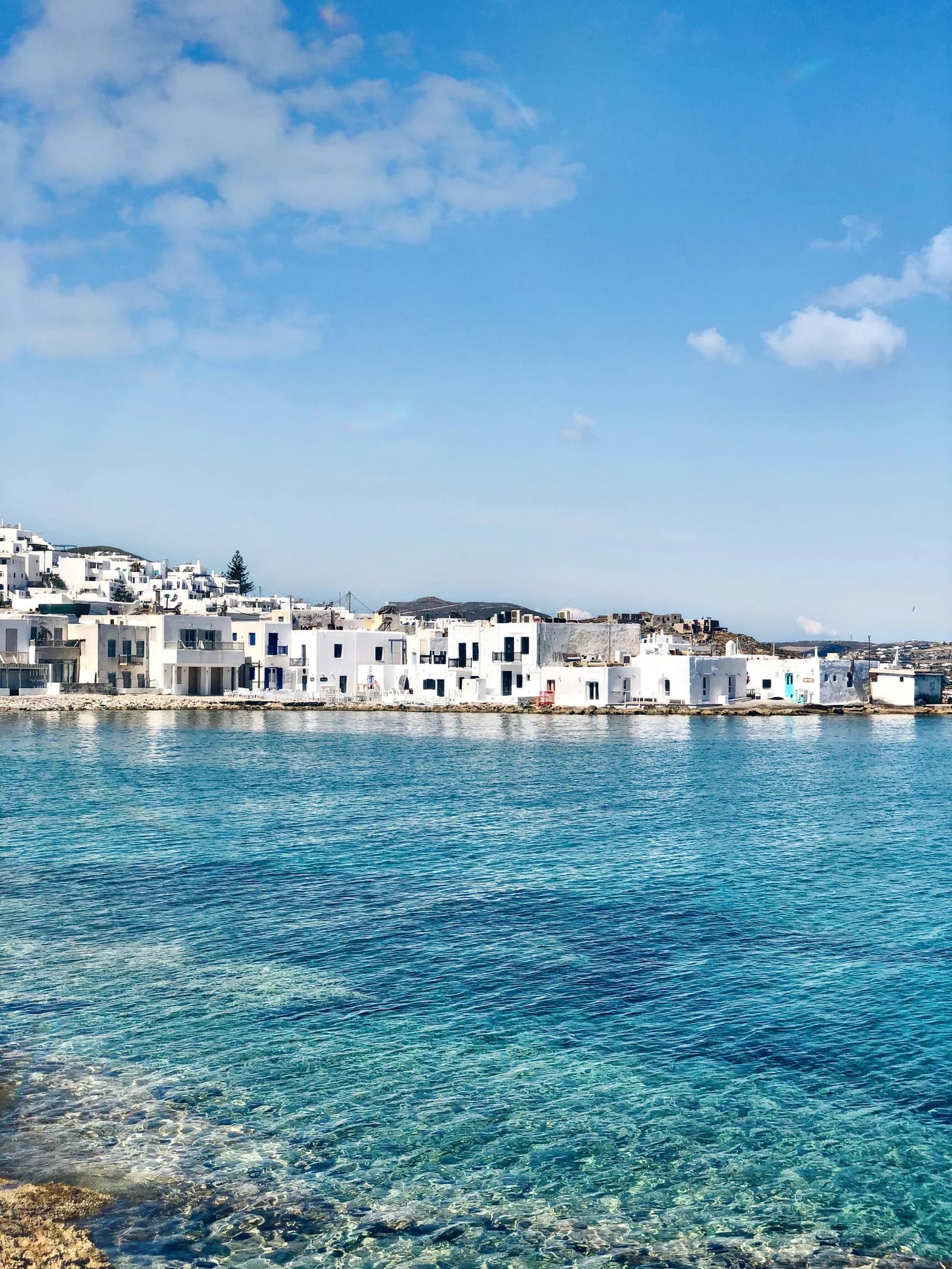
Naoussa is the postcard: a toy Venetian harbour where fishing caïques moor against a half-sunk kastro islet, octopus dries on lines at noon, and by 21:00 the same fifty metres of quay run some of the Aegean's best-dressed people-watching. The trick is using it at both ends: 08:00 coffee with the fishermen, then the evening performance. In between, be at a beach.
The beaches
- Kolymbithres — the signature: granite boulders weathered into smooth grey sculpture, dividing the bay opposite Naoussa into a dozen sandy pockets. Sheltered, shallow, photogenic; arrive by 10:00 in season or take the little harbour boat across.
- Monastiri — next cove over, organised, with the Paros Park cliff trails behind for the post-swim walk.
- Santa Maria — the family-easy north-east sweep with dive schools and tamarisks.
- Golden Beach (Chrysi Akti) — the windsurf headquarters on the east coast: 700 m of sand, world-cup pedigree, schools for every level. When the meltemi blows, this is where it's a feature.
- Faragas and the south pockets — quieter, leeward when the north blows.
Lefkes and the marble story
Lefkes, the old hilltop capital, is the interior's argument: marble lanes, amphitheatre views to Naxos, and a population that still outnumbers its gift shops. From its edge, the Byzantine road — a paved medieval mule path — walks 3 km gently downhill through olive terraces to Prodromos; have a coffee in each village and call it a morning.
The marble itself came from Marathi, ten minutes away: the ancient quarry mouths gape beside the road, unfenced and unsung, where the translucent lychnites stone of the Venus was cut by lamplight. Bring a torch and read the carved Roman inscriptions; entry costs nothing because nobody ever organised it. The Cyclades' most casual world-class site.
The Antiparos add-on
From Pounda on the west coast, the ferry to Antiparos runs every half hour and takes seven minutes — barely time to regret not bringing the car (bring it, or rent a scooter over there). The little sister offers: a single chora whose castle-courtyard core fills with bougainvillea and slow dinners, the Antiparos Cave — 400 steps down into a cathedral of stalagmites where Byron and a few thousand other vandals carved their names — and boat trips to Despotiko, the uninhabited islet opposite, where an Apollo sanctuary is being excavated above a swimming beach that hasn't heard of sunbeds. Tom Hanks has a house on Antiparos; the island treats this as mildly interesting.
Where to stay
Luxury — Parīlio, near Kolymbithres
A Design-Hotels member done in monastic Cycladic minimalism: arches, raw timber, a cross-shaped pool the architecture photographers queue for. Around €400–500/night in season. Check rates on Booking →
Mid-range — Paros Agnanti, Parikia
Terraced into the hillside across the bay from town: big views, pool levels, an easy walk to the port's tavernas. Around €160–210/night in season. Check rates on Booking →
Budget — Pension Sofia, Parikia
A garden pension of the old school — citrus trees, painted shutters, breakfast under the vines — ten minutes' walk from the ferry. Around €70–95/night in season. Check rates on Booking →
What to eat
Paros runs Cycladic classics with a fishing fleet attached: gouna (sun-dried mackerel, grilled — the island signature), octopus in every preparation justified by those drying lines, chickpea stew on Sundays, and the local Monemvasia white from the Moraitis winery in Naoussa (tastings, a few euros, walkable).
- Barbarossa, Naoussa — the harbour-front institution: fish by the kilo, gouna done correctly, the front-row tables earning their premium. €40–60.
- Levantis, Parikia — a garden kitchen in the old quarter, three decades of quiet excellence. €30–40.
- Siparos, Santa Maria side — the sunset-over-Naoussa-bay fish house; book the early table. €35–50.
- The souvlaki-and-bakery economy survives intact in both towns' back lanes — lunch under €10 remains a Parian civil right.
Practical notes
- Wind: the meltemi owns July–August afternoons — north-coast beaches go washing-machine, south coast stays swimmable. Plan accordingly.
- Ferries: Parikia's port is the Cyclades' best connected — build multi-island routes around it. Book peak-season fast boats a few days out.
- Sea honesty: 22°C June, 25°C September, the usual Cycladic arc.
- The trajectory: Naoussa dinner-and-cocktails now runs Mykonos-lite prices; Parikia and the villages haven't heard. Mix both.
The summary
Fly or ferry into Parikia, base at Paros Agnanti or Pension Sofia (or commit to Parīlio's pool). Day one: Parikia's kastro and the hundred-door church, Kolymbithres afternoon, Naoussa harbour by night. Day two: Lefkes and the Byzantine road, Marathi quarries with a torch, Golden Beach or Faragas. Day three: the seven-minute ferry — Antiparos cave, Despotiko boat, castle-courtyard dinner. June or September. Paros is the balanced ticket while the balance lasts; the Cyclades rarely keeps a secret this size for long.