Paphos.
The whole town is a UNESCO site and the mosaics outclass the resorts. The two Paphoses explained, the Akamas wilderness next door, turtle beaches, village halloumi — and why April and October beat August by a distance.
Paphos is the rare package destination with a Bronze Age pedigree: the entire town is on the UNESCO World Heritage list, Aphrodite was officially born just down the road, and you can walk from an all-day English breakfast to a 3rd-century Roman floor mosaic in four minutes. Western Cyprus got the gentler landscape — green hills, a wilderness peninsula, sea caves — while the east got the bigger party. That split is the reason to be here.
The town also has Europe's earliest proper spring. When our April guide opens the Mediterranean season, Paphos leads it.
When to go
The database's verdict — best in April, May, June, October and November — is unusually clear-cut.
April is the signature month: 22–24°C, the Akamas peninsula briefly green and carpeted in wildflowers, archaeological sites at walking-around temperature. The sea is the catch at 17–18°C; honest swimming starts mid-May. May–June runs 26–29°C with the sea warming to 22–24°C — the best all-round window. October holds 27°C with a 24–25°C sea, summer's leftovers without summer's crowds, and November still does 22°C days when Northern Europe has given up entirely.
July and August are flagged: 33–36°C on the coast with humidity, and the interior hotter still. Cyprus cools less at night than the Greek islands — the sleep-quality problem is real. The infrastructure copes (this is an air-conditioned island), but you'd be paying peak prices to hide from the day's middle.
Getting there
Paphos airport (PFO) is 15 minutes east of town, served year-round by the low-cost carriers — this is one of the few Mediterranean sun routes that doesn't hibernate in winter. A taxi to Kato Paphos runs €25–30; bus 612 does it for a couple of euros. Larnaca (LCA), the bigger airport, is 90 minutes away and occasionally cheaper — do the maths including the transfer before booking it.
One quirk to internalise: Cyprus drives on the left, a colonial leftover that surprises exactly the rental-car drivers who didn't read this paragraph.
The two Paphoses
The town splits in two, 3 km and 80 vertical metres apart, and knowing which is which is the whole orientation:
Kato Paphos ("lower") is the harbour strip: the castle, the archaeological park, the hotels, the restaurant mile. Touristy, flat, walkable, where you'll likely sleep.
Ktima ("upper" — old Paphos town) is where Cypriots actually live: the covered market, neoclassical streets, the mosque and hammam of the old Turkish quarter, kafeneia where the frappe outlasts the afternoon. Take the 30-minute uphill walk or the €5 taxi at least twice; it recalibrates the whole trip.
Luxury — Almyra, Kato Paphos
The design hotel of the coast: white minimalism from 1970s bones, a seafront lawn, the adults' rooftop terraces, and one of the better hotel kitchens on the island. Around €250–320/night in season. Its sister hotel Annabelle next door is the classic-grand alternative at similar money. Check rates on Booking →
Mid-range — Kiniras Traditional Hotel, Ktima
A creaking, character-soaked townhouse in upper Paphos with a courtyard restaurant under a giant rubber tree and the owner's paintings on the walls. Around €90–120/night. You trade the seafront for the real town; the trade is good. Check rates on Booking →
Budget — Axiothea Hotel, Ktima
Old-school, family-run, with a veranda view over the town's rooftops to the sea that hotels triple the price would envy. Around €60–80/night. Basic rooms, generous people. Check rates on Booking →
The archaeology underfoot
The Paphos Archaeological Park (next to the harbour, €4.50ish, half a day) holds the headline act: the Roman villa floor mosaics — Dionysos, Theseus and the labyrinth, Achilles — discovered by a farmer's plough in 1962 and still mostly displayed where they were found, sun-lit, with swallows nesting in the shelter eaves. They are genuinely among the best Roman mosaics anywhere, and the entrance fee is a rounding error.
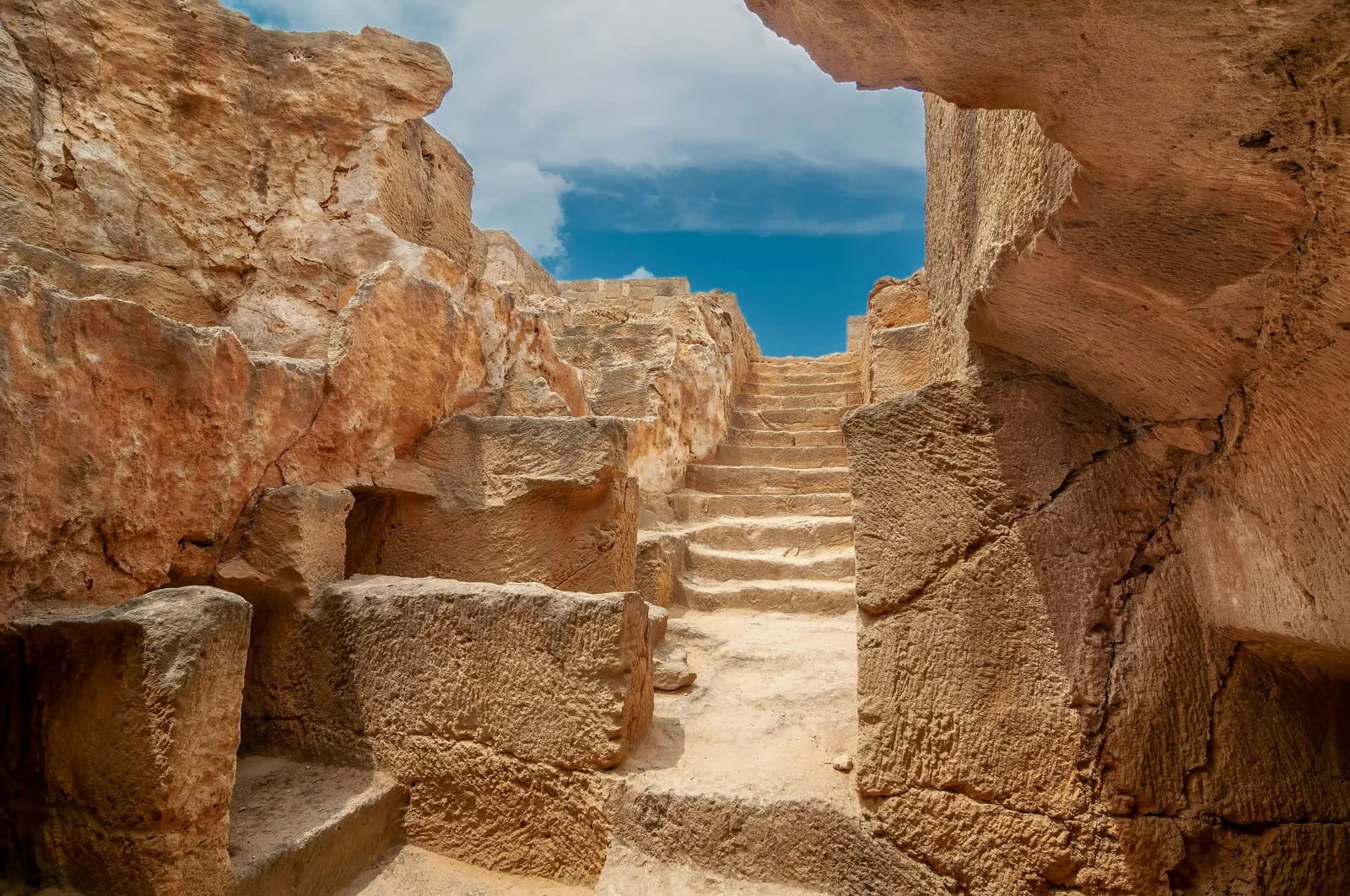
The Tombs of the Kings (2 km north, €2.50) buried Ptolemaic officials in underground Doric courtyards cut from the rock — no kings, great branding, best at 08:00 light. Add the catacombs of Agia Solomoni with its rag-tied wishing tree, and the medieval castle on the harbour mole for sunset.
Akamas — the wilderness next door
The Akamas peninsula, 40 minutes north past Coral Bay, is the reason to rent a car for two days: a roadless reserve of gorges, juniper and the island's emptiest coast.
- Avakas Gorge — a 30-minute walk into a slot canyon that narrows to three metres between 30-metre walls. Proper shoes; go before the heat.
- Lara Bay — the turtle beach: loggerheads and green turtles nest June–September, hatcheries are caged and signed, no umbrellas, no bar, bring everything. One of the Mediterranean's last undeveloped great beaches.
- The Blue Lagoon — turquoise over white sand near the peninsula's tip, reached by boat from Latchi (€20–30) or a brutal track by jeep. Mid-mornings get busy with the boat traffic; first departure or late afternoon wins.
- Baths of Aphrodite — the grotto where the goddess bathed, per the legend the tourist board licensed; the trailheads beyond it are the actual prize.
Petra tou Romiou, Aphrodite's birth rock 25 minutes east of town, photographs better than it swims (pebbles, currents, no shade) — sunset from the roadside viewpoint is its best version.
What to eat
Cypriot food is Greek with Levantine bass notes and a meze culture that takes prisoners. The full meze — 15 to 20 small plates, fish or meat — runs €20–28 per person and is the format the island's kitchens were built for. The local pillars: halloumi grilled (here it squeaks correctly), souvla (fat skewers over coals), afelia (pork in red wine and coriander seed), louvi (black-eyed beans with chard), village bread, carob syrup. Geroskipou, the next village east, has held a protected-origin status for its loukoumi (Cyprus delight) since the Ottoman era.
- 7 St. Georges Tavern, Geroskipou — the slow-food legend: whatever the garden and the foragers produced that day, served as a meze that takes the evening. Reserve. €25–30.
- Laona, Ktima — the lunchtime family kitchen in the old town: trays of the day's stews, no menu theatre. €10–15.
- Agios Georgios harbour, Akamas edge — fish meze over the sea after a Lara Bay day.
Drink the village wines — the Vasilikon winery in Kathikas is a 25-minute drive into the hills — and let someone else drive back.
Practical notes
- Driving: left side, UK-style roundabouts, rental cars marked with red plates so locals give you room. The Akamas tracks officially require a 4x4; the boat from Latchi is the saner Blue Lagoon route.
- Money: Euro. Card acceptance is total in town, patchier in village kafeneia.
- Sea honesty: the town beaches are adequate, not the point — Coral Bay (20 min) is the proper sandy one, Lara is the wild one.
- The season's tail: the island stays open in winter (16–18°C, quiet, green) — a hiking-and-history trip more than a sun trip.
The summary
Fly into PFO, base at the Almyra if the budget says yes or Kiniras if character wins, and split the stay: one day for the mosaics, tombs and a Ktima market lunch; one Akamas day (Avakas at 09:00, Lara after, fish at Agios Georgios); one lazy day at Coral Bay with a Geroskipou meze to finish. April, May, June, October or November. August is for people who enjoy air conditioning with sea glimpses — and the destination page will tell you, live, when the good windows are actually delivering.