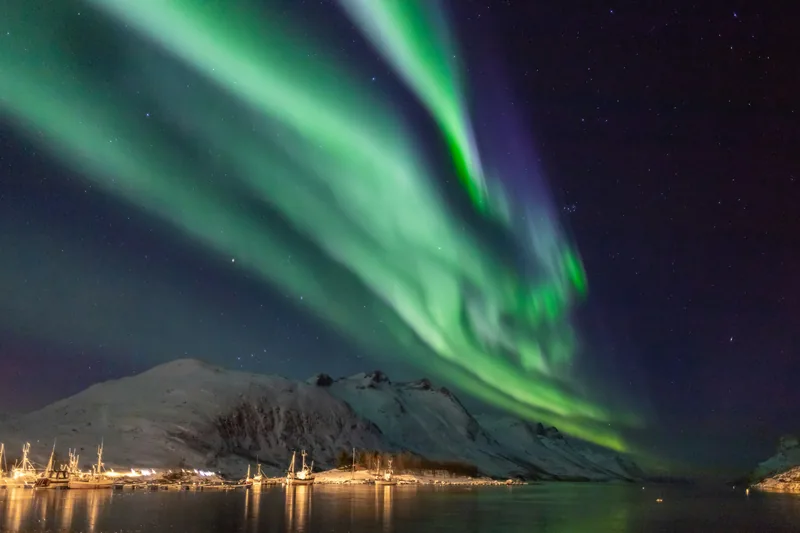
Northern lights in Tromsø: the honest odds.
Tromsø sits under the auroral zone, so the lights are up there far more often than anyone sees them. What decides your trip is darkness and cloud. The season, the drier valleys inland, what a chase costs and the myths, number by number.
In Tromsø the physics is rarely what stops you. The weather is. The geophysical observatory at the University of Tromsø puts it plainly: in Troms and Finnmark you can see the northern lights at least every other clear night. The catch is the word clear. Through the dark season the city averages 13 to 16 days a month with at least a millimetre of rain or snow. Plan around the cloud forecast and the odds are decent. Chase a big Kp number on an app instead, and you can spend a week looking at the underside of a cloud. A single night is a gamble, so we'd give it four nights.
When it is dark enough
The aurora is there all year; you can't see it against a bright sky. The observatory gives the season as the beginning of September to the middle of April, and Visit Tromsø stretches the edges to late August and early April. Most tours start in early September. The sun explains the dates. On 15 August it sinks only about 6 degrees below the horizon at midnight, which is still twilight. By 1 September it reaches 12 degrees, and by mid-September 17: proper night. In spring the same thing runs backwards. By 15 April the sun at midnight is back to only about 11 degrees under, and from 18 May to 26 July it doesn't set at all (sun positions from MET Norway's sunrise service for the city centre).
In the middle comes the polar night, mørketid: the sun doesn't rise from 28 November to 14 January. That isn't 24-hour darkness. In late December the sun stays about 3 degrees under the horizon at noon, so the middle of the day is a blue twilight rather than night, and the mountains around the city can keep the low sun out of sight for a while longer. On 15 January the sun is up for 37 minutes. A month later it is up for almost seven and a half hours.
Why the cloud forecast matters more than Kp
Kp is a 0–9 index of geomagnetic activity. The scale is quasi-logarithmic, so going from 8 to 9 is a far bigger jump than going from 0 to 1 (Norwegian Centre for Space Weather). A high Kp pushes the auroral oval south, which is why aurora watchers in Scotland or southern Norway live by it. Tromsø is already in the zone and doesn't need a storm. It needs a hole in the cloud. The aurora glows 90 to 130 km up, far above the weather, and a low overcast hides it completely. The space-weather centre's own advice is that the main obstacle is often the weather.
Two free tools do the work on the night. Yr's "other conditions" page for Tromsø puts the aurora outlook for now and the next three days beside the cloud forecast, and it rates the city's light pollution as very high, which is your cue to get out of town. The space-weather centre's site links to all-sky cameras in the dark season, including one at Skibotn, so you can check whether the sky inland is clear before you drive there. The best hours are roughly 20:00 to 02:00, according to both the centre and Visit Tromsø. And cloud moves. As Visit Tromsø puts it, a hole may suddenly appear, so give a grey sky some time before you give up on it.
Inland is drier, and much colder
Tromsø gets 1,091 mm of precipitation a year, on 160 days (MET Norway's 1991–2020 normals for the city station). The mountains wring out much of what comes in off the sea, and the valleys behind them are far drier:
- Skibotn, in the inner Lyngenfjord, about 130 km and a little over two hours by road in good conditions: roughly 450 mm a year (Yr's station normals, added up month by month).
- Kilpisjärvi, just over the Finnish border on the E8, 170 km and closer to three hours: 516 mm, on 105 days a year (Finnish Meteorological Institute normals).
- Abisko, in Sweden, about 300 km and five hours: 347 mm a year, the lowest normal of any SMHI station. SMHI puts that down to a rain shadow for most wind directions. The famous "blue hole" is that rain shadow under a marketing name. It shifts the odds. It isn't a guarantee, and we found no source for the fixed clear-sky percentages quoted online.
Less precipitation and fewer wet days are the best like-for-like measures we found. Nobody publishes comparable night-time cloud statistics for these places, so treat them as better odds and nothing more. The price is cold. A January night in Tromsø averages −5°C. In Kilpisjärvi it averages −17°C, and in Abisko −14°C.
Tromsø, month by month
| Month | Day / night | Wet days | Daylight | Night sky |
|---|---|---|---|---|
| January | −1 / −5°C | 15 | 37 min | Dark |
| February | −1 / −6°C | 13 | 7 h 25 | Dark |
| March | 1 / −4°C | 14 | 11 h 33 | Dark |
| April | 4 / −2°C | 13 | 16 h 03 | Too light from mid-month |
| May | 9 / 2°C | 11 | 22 h 00 | Too light |
| June | 13 / 6°C | 11 | Midnight sun | Too light |
| July | 16 / 9°C | 11 | Midnight sun | Too light |
| August | 15 / 8°C | 13 | 18 h 04 | Darkening late in the month |
| September | 11 / 5°C | 15 | 13 h 23 | Dark |
| October | 5 / 1°C | 16 | 9 h 09 | Dark |
| November | 2 / −2°C | 13 | 4 h 05 | Dark |
| December | 0 / −4°C | 15 | None | Dark |
October is the wettest month of the year, with 127 mm on 16 days, and September comes second. February and March are a little drier, with 97 mm each and 13–14 wet days.
Which months we'd pick
No month is reliably clear, so the choice is really about what else you want from the trip.
Late September and early October give you fully dark nights, temperatures above freezing (11°C by day and 5°C at night in September) and 9 to 13 hours of daylight for fjords and walks. The downside is cloud: September and October are the wettest stretch of Tromsø's year.
December and January are the darkest months and the most atmospheric, with seven weeks without a sunrise. You get the most hours of darkness to wait in and the fewest to do anything else.
Late February and March are our pick if you want both. The nights are still long, the days are back and the cloud is a little kinder. NOAA's space weather centre notes that the weeks around the equinoxes tend to be good for aurora, and March gets the equinox as well as the light. The cost is the cold: February nights average −6°C in the city, and they are much colder inland.
A guided chase or a hire car
For a first trip, a tour is usually the right call. The guides read cloud forecasts for a living, know where to stop safely, and drive the dark roads so you don't have to. On the tours we checked on Visit Tromsø's listings in November 2026, a seat cost NOK 750–1,300 on a big coach of up to 40 or 50 people, NOK 1,200–2,100 in a minibus of 15 to 18, and from about NOK 2,400 in a group capped at eight. The dearer tours add thermal suits, a hot meal or a fire, photos and tripods. Expect four to eight hours, leaving around 18:30 from October to mid-March and at 19:30–20:00 in September and late March. Bring your passport: when the coast is cloudy, some minibus tours cross into Finland, and they ask for a passport or ID card.
A hire car makes sense for a group, for the second and third nights, or for anyone who wants to sit out a gap in the cloud on their own schedule. It is also the part of the trip most likely to go wrong. In Troms, studded tyres are allowed from 16 October to 30 April, and in that period every tyre needs at least 3 mm of tread. Outside those dates you still need winter tyres or chains whenever conditions call for them.
The Troms police district's notice for tourists is blunt about photo stops: use marked parking areas, never stop on bends, hills or busy roads, and don't switch on the hazard lights to take pictures. Police can seize the licence of a driver whose winter driving they judge inadequate. The drink-drive limit is 0.2 per mille, so the hot toddy waits until you are back.
Animals wander onto the roads without warning. Just over the border, northern Finland counts 4,000–5,000 reindeer injured by cars and trains every year, mostly from October to December, with dusk and dawn the worst times. The E8 takes you from Tromsø via Skibotn to the Finnish border at Kilpisjärvi. The road to Abisko crosses E10 Bjørnfjell, one of the passes Statens vegvesen closes, or runs as escorted convoys, in bad weather. Check the road status before you leave, and never drive round a closed barrier. And from late November to mid-January there is no sunrise at all, so every drive is in twilight or dark.
What to wear
Most of an aurora night is standing still and waiting, so dress for that. Visit Tromsø's advice is woollen base layers next to the skin, then warm, dry jumpers and a jacket. Your boots should be big enough for an extra pair of wool socks, and ice grips help prevent falls. It also tells you to be ready for anything from −25°C to +5°C on Arctic outings, a range that says a lot about how much colder it can get out of town. Most of the minibus tours we checked include a thermal suit, so read the listing. Keep your phone in an inside pocket. Apple designs iPhones for 0–35°C and warns that using one in colder conditions can temporarily shorten the battery life or switch the phone off.
Photographing it on a phone
A recent phone does a decent job if you keep it still. On an iPhone 11 or later, night mode turns on by itself in the dark. Put the phone on something solid or a small tripod, then push the night-mode slider to Max for a longer exposure. On a Pixel, astrophotography wants the phone set down on a stand or tripod, not held, and kept still until the shot is finished. Turn the flash off and skip the digital zoom (Visit Norway). With manual settings, Visit Lyngenfjord's rule is that 5–10 seconds is normally enough, and 10–20 seconds for a slow-moving display. A fast, bright display wants a shorter exposure, or it smears. If you bring a camera, Visit Norway's starting point is f/2.8, ISO 1600 and 15 seconds.
The usual myths
"A full moon ruins it." It makes faint aurora harder to see. NOAA's wording is that the full moon diminishes the apparent brightness, not the actual brightness, and the Tromsø observatory says the days around full moon aren't the best. A strong display still shows. If your dates are flexible, check the moon. If they aren't, go anyway.
"It has to be −20°C." Ground temperature has nothing to do with an aurora 90 to 130 km up. The link people notice is that clear nights are colder: without cloud to hold the heat in, the ground loses it to space faster (NOAA). So the cold doesn't bring the lights. It just tends to arrive with the clear sky that lets you see them.
"Northern lights guaranteed." None of the listings we read promises a sighting, and most say outright that the aurora can't be guaranteed. "Guarantee" or "warranty" turns out to mean a second trip at half price, or a free seat on the same operator's coach tour, on another night, usually in the same season. It depends on availability, there is no refund, and none of the terms we read define what counts as seeing the aurora. One operator lets you cancel for a full refund at the meeting point if its guides rate the chance of a clear sky as very low. Once the bus has left, the money is spent.
Before you go
Our Tromsø page has the live 14-day forecast: day and night temperatures, rain or snow, and a grey wash on days when the 24-hour average cloud is high. It forecasts weather, and its cloud figure is a whole-day average, so it can't tell you about the sky at 22:00. Use it to find the drier stretch of your week, then check Yr's hourly cloud on the night itself.
And a word on the wheel. Shade mode is built for escaping summer heat, so it looks for days between 12 and 22°C. Tromsø can turn up there in June, July and August, when normal highs are 13–16°C. In winter it won't, and it isn't meant to.