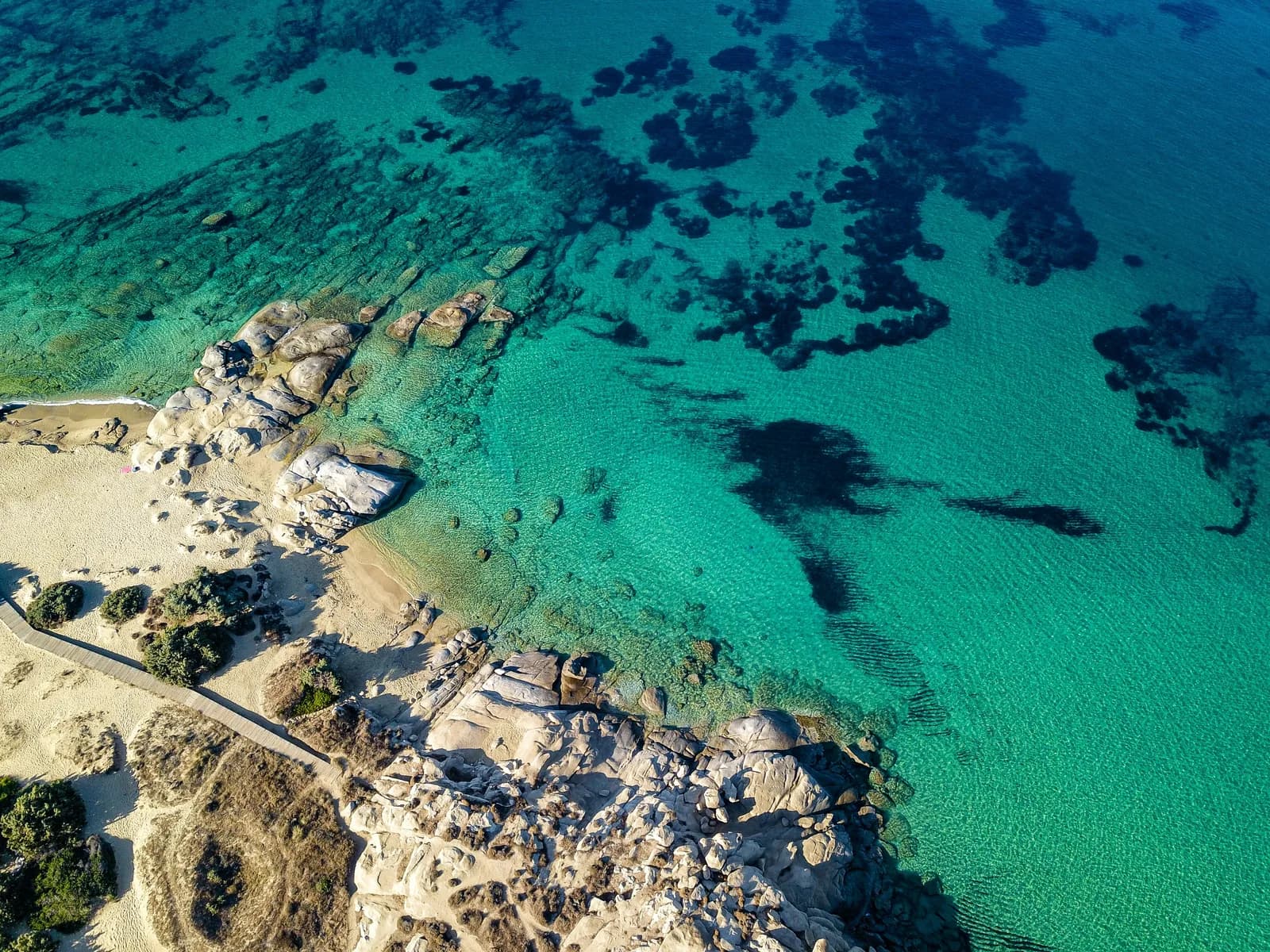
Naxos.
The largest Cycladic island and the case study for what Mykonos used to be. When to go, the best beaches, where to stay across three budget tiers, the mountain villages and the kitron tradition.
Naxos is the largest of the Cyclades by area, the second-largest by population (after Syros), and the one Greek-island regulars name first when asked where they'd go if they could only go to one. It has the things Mykonos and Santorini have — Cycladic whitewashed villages, deep blue Aegean, marble beaches — plus the things they don't: serious mountains (Mount Zas, the mythological birthplace of Zeus, at 1,001m), an interior of stone villages where Cycladic life is still legible, agricultural produce of its own (the citron-based kitron liqueur is a Naxian specialty), and beaches that are 8 km long and never crowded.
Crucially, Naxos costs roughly a third of Mykonos and half of Santorini for materially the same experience. The 2026 climate study (read it in full) places Naxos in the same Cycladic risk profile as the other islands — meaning July and August are heatwave-risk windows now — but the booking economics outside those weeks make it the rational Cyclades choice.
When to go
The Cyclades work on a narrow but reliable window.
Late April to mid-June — sea climbs from 18°C in late April to 22°C by mid-June, air sits at 22–26°C with the meltemi wind not yet blowing. May and early June produce empty beaches, full restaurants, and the agricultural island in its productive mode (lambs being born, wildflowers across the mountains, the cheese production peaking). The genuine sweet spot.
Mid-July to mid-August — the period when Mykonos and Santorini break. Naxos stays busy with Greeks and Italians but never as full or as expensive. The meltemi wind blows continuously, grounding ferries 30–40% of days, and inland the heat-risk window applies — July 2023 produced 39°C+ days. Coastal Naxos is breezier and more bearable.
Mid-September to mid-October — second sweet spot. Sea still at 24°C through October, prices drop 30–40% from August, the meltemi has subsided, the agricultural calendar shifts to wine harvest. This is the genuinely under-booked window.
November to April — most hotels close, the ferry network reduces to once or twice a week, the experience is rural Greek-island winter, not a beach holiday.
Getting there
Two real options.
Direct flight to Naxos (JNX) — the airport handles small Athens-Naxos flights (45 min, €60–100, Olympic and Sky Express, summer only). Use this if you're tight on time and willing to pay.
Ferry from Athens (Piraeus) — the much more common route. Three boats a day in summer.
- Blue Star Ferries conventional ferry — 5 hours, €40 deck class, €55 reserved seat. Comfortable, robust against meltemi cancellation.
- SeaJets fast catamaran — 3 hours, €70. Vulnerable to meltemi grounding.
From Athens airport (ATH): metro Line 3 to Monastiraki, change to Line 1, exit at Piraeus, walk 5 min to the ferry gates. 90 minutes airport-to-boat with reasonable margins.
Inter-island ferries make Naxos a useful base for hopping. Naxos–Mykonos: 1h on the SeaJet, €40. Naxos–Santorini: 2h on the SeaJet, €60. Naxos–Paros: 20 min, €18. Book the ferry-day legs of your trip in advance — the Cycladic ferries genuinely sell out in August.
Where to stay
Three meaningfully different bases on Naxos.
Naxos Town (Chora)
The harbour town with the Venetian castle (Kastro), the Apollo Temple ruins (Portara) on a hillside above the harbour, restaurants and bars, ferry-port adjacency. Choose this if you want the most "island life" feel without renting a car. The downside is you're 5 km from the best beach.
Agios Prokopios / Agia Anna
The beach-stay villages 5 km south of Chora. Best beaches on Naxos are here — Agios Prokopios specifically is the most-recommended Cycladic beach by Greek-beach veterans. Hotels are higher-end here on average; restaurants are tourist-leaning.
Mikri Vigla or Plaka
The further-south beach villages, 12–15 km from Chora. Less developed, longer beaches, the kitesurfing scene at Mikri Vigla. Pick this for the back-of-the-island calm; you'll want a scooter or car.
Luxury — Lagos Mare Boutique Hotel, Agios Prokopios
Adults-oriented, Cycladic-design suites with sea views and private terraces, pool deck overlooking the beach. Approximately €280/night in shoulder season; €450+ in August. The Mykonos equivalent would charge €500+. Check rates on Booking →
Mid-range — Hotel Grotta, Naxos Town
Family-run on a quiet hillside in Chora, two minutes' walk to the harbour and the Portara temple. Heated rooftop pool. 9.3 across 1,500+ reviews. The proper Cycladic mid-range — the price tier where Mykonos and Santorini overcharge. Around €160/night in shoulder season. Check rates on Booking →
Budget — Pension Sofi, Naxos Town
Family-run since the 1970s, 200m from the ferry port, simple rooms, breakfast in a courtyard with a fig tree. €40–60/night in shoulder season. The owner will outline your week's plan over breakfast — Sofi family tradition. Check rates on Booking →
The beaches
Naxos's west coast is one continuous 12 km of beach broken only by small rocky headlands. North to south:
- Agios Georgios — Naxos Town's town beach. Shallow, family-friendly, walkable from the harbour. Decent for kids; not where adults go.
- Agios Prokopios — the most photographed Naxian beach. Fine white sand, sheltered, turquoise water. Beach bars at the south end.
- Agia Anna — adjacent to Agios Prokopios, slightly quieter. The boat-jetty at the south end is the canonical postcard view.
- Plaka — 4 km long, fewer hotels, naturist section at the south. The afternoon-shade pine grove behind the beach is the local lunch spot.
- Mikri Vigla — twin beaches (Sahara on the north, Parthena on the south). Kitesurfing capital of the island thanks to constant meltemi wind. The Flisvos Kitecentre is the school.
- Pyrgaki / Aliko — far south, cedar grove forest behind the beach (a rare ecological feature in the Cyclades), and a small cliff hike to a hidden cove called Hawaii Beach.
The interior — Naxos's biggest differentiator
This is what most Cyclades islands don't have. Naxos's interior is mountainous, agricultural, and dotted with marble-quarry villages. Take a full day to drive the interior — Halki, Filoti, Apeiranthos, Sangri.
- Halki — the old island capital, now restored. Vallindras Distillery (5th-generation kitron production, opening hours posted on a hand-written sign) gives the kitron tasting. The 11th-century Panagia Drosiani frescoes are 1.5 km outside the village.
- Filoti — base for the Mount Zas hike (3 hours round trip, summit is the highest in the Cyclades). The square has two excellent kafeneions.
- Apeiranthos — at 700m altitude, the marble-pavement village. Five museums in a population of 1,000. The cuisine at Lefteris or Anna's is properly local.
- Sangri — Temple of Demeter ruins. Most under-visited classical site on the Cyclades.
The drive takes a full day. Add a swim at Moutsouna or Apollonas (east-coast fishing villages) on the way back.
What to eat
Naxos has its own agricultural identity, unusual in the Cyclades.
Cheese. Naxos produces graviera (the hard yellow cheese), arseniko (a sheep-milk specialty), and myzithra (the fresh ricotta-like one). All three are sold at the Union of Agricultural Cooperatives shop in Chora.
Kitron. The Naxian citron liqueur, produced from the leaves of the citron tree (not the fruit). The 5th-generation distillery Vallindras in Halki is the canonical place to learn the production; bottles are €15. Three strengths — yellow (mild), green (medium), clear (strong).
Potatoes. Naxos potatoes are protected-origin and genuinely better than mainland Greek potatoes. The dish to order is patates lemonates (lemon-roasted with oregano).
The restaurants:
- Apolafsi (Chora harbour) — fish stew, octopus, the classic harbour-side trapeze.
- To Souvlaki tou Mosa (Filoti) — peasant-Greek souvlaki the way it actually exists in the interior. Stand at the counter; the locals do.
- Lefteris (Apeiranthos) — mountain-village cuisine. Order the rabbit stew or the kontosouvli.
- Picasso Mexican Bistro (Mikri Vigla beach) — unexpectedly, the best non-Greek food on the island.
- Axiotissa (Sangri) — slow food, locally-foraged, the destination dinner.
Day trips worth taking
- Paros — 30 minutes by ferry, €18. Different vibe — wine, food, Naoussa harbour at sunset.
- Delos — UNESCO archaeological site, reached via Mykonos. Day trip via Mykonos catamaran.
- Koufonisia — small Cycladic islands east of Naxos, reached on the Express Skopelitis (small ferry, weather-dependent, traditional). Beach day, snorkelling, fish lunch.
Practical, legal, safety notes
- Currency: Euro. ATMs in Chora; rural villages have none — withdraw before you drive inland.
- Visa: Schengen 90/180.
- Water: Tap water tastes brackish on Naxos (desalination plus mineral); locals filter. Bottled is fine.
- Language: Greek, English widely spoken in tourism. The interior villages are Greek-only.
- Driving: Greek-EU driving licence accepted. Mountain roads are narrow and goats genuinely do step into the road.
- Solo-female safety: Cyclades are among the safest islands in Europe; petty crime essentially absent.
The summary
The cleanest Naxos week: two nights in Chora (Pension Sofi or Hotel Grotta), three nights at the beach (Lagos Mare or its tier), and two nights in the interior (Apeiranthos or Filoti). Eat at Axiotissa, taste kitron at Vallindras, swim Agios Prokopios at 09:00 before the wind, drive to Apollonas for a fish lunch. Cost: roughly half of the same week on Mykonos, with substantially more memorable experiences.