Milos.
A volcanic island with seventy beaches and no two alike: Sarakiniko's white moonscape, the essential Kleftiko boat day, fishing villages with boat-garage doors in primary colours — and the spot where Venus lost her arms.
Milos is what happens when a volcano, not a property developer, designs an island. The horseshoe of land around one of the Mediterranean's largest natural harbours is a geology lesson wearing a swimsuit: white pumice cliffs sculpted into lunar waves, sulphur-yellow coves, red and black sand, hot springs seeping into the sea, and — the consequence — some seventy catalogued beaches on an island you can drive across in forty minutes, no two made of the same stuff. The mining money this geology generated (obsidian in the Neolithic, bentonite and perlite still) kept mass tourism at arm's length a generation longer than its neighbours.
The Venus de Milo was ploughed up here by a farmer in 1820 and promptly exported to the Louvre; the island has been mining the joke, gently, ever since.
When to go
May, June, September and October — the Cycladic standard, with the database flagging July–August as everywhere in the chain.
June: 26–27°C, sea 22–23°C, the boat tours running daily and the famous beaches merely busy. September is the connoisseur slot: sea at its 24–25°C peak, golden light on the white rock, half the crowd. May and October are 22–24°C with a cooler sea and the island most itself. July–August bring 30–32°C, the meltemi, full ferries and a Sarakiniko that operates at theme-park density in the middle hours — the island copes better than Mykonos or Santorini, but the shoulder months are the honest recommendation.
Getting there
By air: Milos (MLO) takes 40-minute hops from Athens (Olympic/Sky Express, several daily in season; book early — the planes are small). By sea: 2.5–4.5 hours from Piraeus depending on boat class, and useful onward links through the western Cyclades. The port and main town is Adamas; the capital, Plaka, sits on the hill above with its kastro sunset.
On-island truth: the bus network is thin and the south-coast beaches sit at the end of dusty tracks — rent a car, small jeep or ATV (the local fleet's default) for at least the middle days. Roads are empty; distances are toy-sized.
The Kleftiko boat day — the one non-negotiable
The island's southwest corner — Kleftiko, the pirates' old hideout of white sea-arches and swim-through caves — has no road. You go by boat or you don't go, and you go: the classic full-day cruise loops the whole island (around €60–90 with lunch and snorkel stops, sailboat versions pricier), threading Sykia's collapsed cave, the Gerontas arch and an hour's swimming in Kleftiko's blue rooms. Book a small-boat operator over the big catamarans — half the passengers, twice the cave access; the day cruises compare easily here, with free cancellation. June and September seas are kindest; the meltemi cancels July–August departures often enough to build a spare day around.
The beaches, by geology
- Sarakiniko — the postcard: a white pumice moonscape polished by wind into waves, with a deep inlet for swimming and cliff-jumpers performing for the ledge audience. Go at 08:00 or for sunset — by 11:00 in season it's a photoshoot queue. There is no shade; the rock doubles as a reflector.
- Tsigrado — the adventure: a slot in the cliff descended by ladder and knotted rope to a pocket of turquoise. Genuinely tight; flip-flops genuinely fail; the reward genuinely earns it.
- Firiplaka — Tsigrado's easy neighbour: long, pastel cliffs, organised at one end and wild at the other.
- Paleochori — the geothermal one: red-and-yellow cliffs, volcanic vents warming patches of seabed, and a taverna that slow-cooks in the hot sand (below).
- Papafragas — a fjord-slot between cave walls where the sea glows; more swim-through than beach.
- Pollonia and Adamas town beaches — the family-calm defaults with tamarisk shade.
North coast for the meltemi days, south coast when it's still — the same wind rule as everywhere in the chain.
The villages — syrmata and sunsets
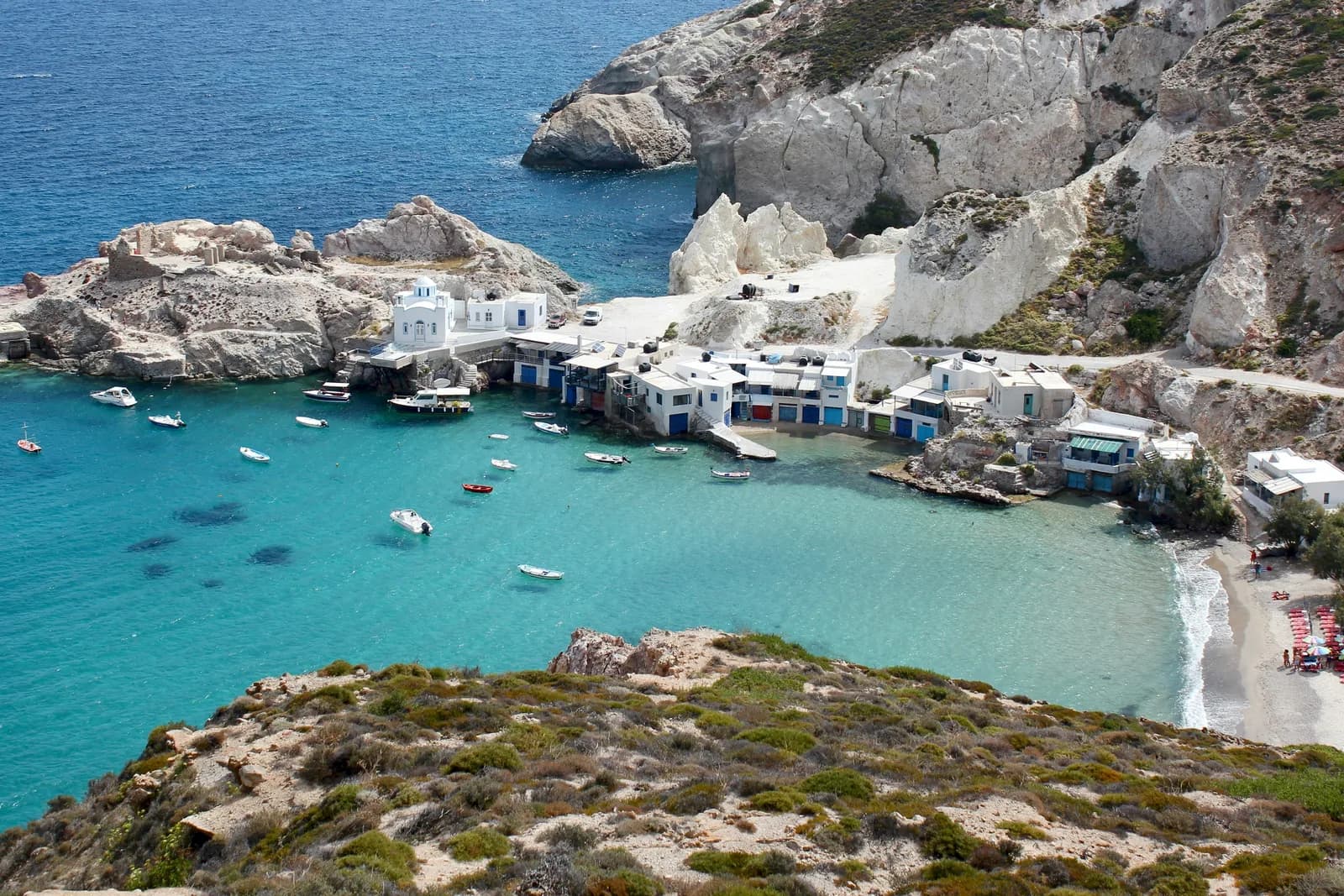
Milos's fishing hamlets perfected a typology: syrmata — boat garages cut into the rock at sea level, doors painted in whatever the boatyard had left, living quarters above. Klima is the gallery version, a single row of colour reflected in still water (sunset turns it ridiculous); Mandrakia and Firopotamos are the quieter siblings with the better swimming. Stay in a converted syrma if one comes up — falling asleep a metre above the harbour is the island's signature experience.
Plaka, the hilltop capital, owns the evening: climb to the kastro church for the full-harbour sunset (the Cyclades' best non-Santorini version, minus the crowd mechanics), then dinner in the lanes. Below it, the catacombs of Milos — among the oldest Christian burial complexes anywhere — and the ancient theatre share a hillside with the marked spot where the Venus turned up; the original is in Paris, the sign is photographed anyway, the farmer got 400 francs.
Where to stay
Adamas for ferry-and-bus practicality, Pollonia for the boutique-village version (and the Kimolos ferry), Plaka for romance without a car being optional.
Luxury — Milos Cove, near Pollonia
Suite-and-plunge-pool minimalism stepped down its own cove on the quiet east, with a sea-edge restaurant and the island's most photographed breakfast terrace. Around €350–450/night in season. Check rates on Booking →
Mid-range — Portiani Hotel, Adamas
The harbour-front standby: balconies over the bay, breakfast on the roof, every boat tour leaving from across the road. Around €150–190/night in season. Check rates on Booking →
Budget — Delfini Hotel, Adamas
Family-run simplicity a short walk from the port over Lagada beach, around €90–120/night in season. Check rates on Booking →
What to eat
Milos cooking is Cycladic with mining-town heartiness. The targets:
- O! Hamos!, Adamas — the legend opposite the port beach: handwritten menus, the family's own goat and cheese, lamb baked in parchment, a queue that starts before opening and a no-reservations policy that democratises it. €20–30 and the island's defining meal.
- Medusa, Mandrakia — octopus drying on lines over the harbour, then arriving grilled at your table with the village reflected behind it. €25–35.
- Sirocco, Paleochori — the volcanic-sand kitchen: pots buried in the geothermally heated beach overnight emerge as lunch. A gimmick the geology makes legitimate.
- Local specifics: pitarakia (the Milos cheese pies), watermelon karpouzopita, and the koufeto spoon-sweet at festivals.
Practical notes
- Driving: the south-beach tracks are graded dirt — fine driven gently; the ATV armada exists for a reason. Fuel up in Adamas.
- Sea honesty: 22°C in June, 24–25°C in September; the geothermal patches at Paleochori are warmer and finding them barefoot is the game.
- Crowds: Sarakiniko and Tsigrado operate on the 08:00-or-17:00 rule in season; everywhere else absorbs its visitors easily.
- Kimolos add-on: the 20-minute ferry from Pollonia reaches Milos's tiny sibling — Prassa's white sand and a skewer at the port taverna make an effortless half-day.
- Money: Euro; cash for the boat caïques and beach tavernas.
The summary
Fly or sail into Adamas, base at the Portiani or splash at Milos Cove, rent the jeep. Day one: Sarakiniko at 08:00, Papafragas, Mandrakia octopus lunch, Plaka kastro sunset. Day two: the Kleftiko boat, full loop. Day three: south-coast roulette — Tsigrado if your knees vote yes, Firiplaka regardless, Paleochori's warm patches to finish — and O! Hamos! queue at 19:00 sharp. June or September. Milos is the Cyclades' best geology and, plate for plate and cove for cove, currently its best value-for-wonder ratio.