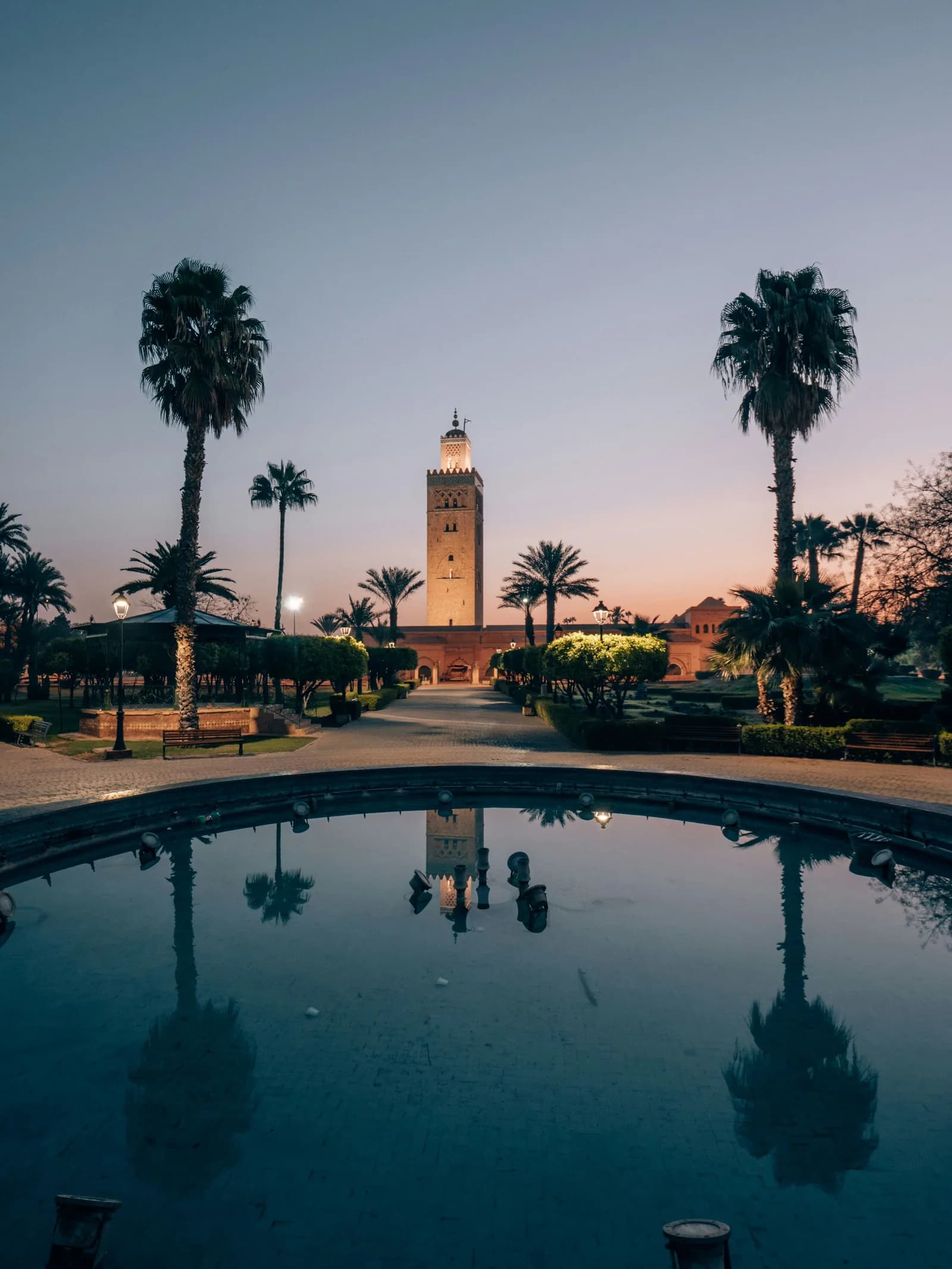
Marrakech.
The red city, navigated honestly: how the souks actually work (and the three lines touts use), the riad logic, Jemaa el-Fnaa's nightly theatre, the Majorelle queue — and the two months that are simply wrong.
Marrakech is the most intense short-haul trip Europe has: three and a half hours from most northern capitals to a thousand-year-old red-walled medina where the Middle Ages kept the wifi password. It assaults every sense on purpose — that is the product — and it divides travellers neatly into those who learned three or four operating rules first and loved it, and those who walked in cold and spent two days being herded. This guide is the first group's manual.
One thing said early: the city's hassle is real but vastly overstated by people who fought it. Learn the rhythm — mornings for sights, the riad's hush for the afternoon, the square for the evening — and Marrakech is not just manageable but addictive. Half the people reading this will be back within two years. It's that kind of place.
When to go
March, April, May, October and November — the database's list, and the reasoning is thermal.
March–April: 24–27°C, orange blossom over the lanes, the Atlas snow-capped behind the Koutoubia — the postcard assembles itself, as the March guide notes. May: 28–31°C, the riad pools earning their keep. October–November: 26–22°C descending, golden light, the October guide's repeat pick.
July and August are simply wrong: 38°C standard, 45°C in the bad spells, a dry interior heat the climate study flags without hedging. The city retreats indoors from eleven to six; you would too, having paid for the privilege. December–January is the underrated counter-season: 18–20°C sunny days, cold nights (6–8°C — pack actual layers; riads are stone), and the city at its calmest.
Getting there
Menara (RAK) sits twenty minutes from the medina, served by every low-cost carrier in Europe. The arrival move: pre-book the riad's airport transfer (€15–20). It costs the same as the taxi-rank negotiation and ends with a man who knows the unmarked door in the unmarked lane your luggage needs — the first navigation problem solved before it starts.
In town: the medina is walked, full stop. Petits taxis (beige, metered in theory, €2–4 in practice around town — agree or insist on the meter) handle Gueliz and Majorelle runs.
The riad logic
Sleep in the medina, in a riad — the inward-facing courtyard houses are the city's architecture and its survival mechanism: blank wall to the lane's heat and noise, then a door into birdsong, orange trees, a plunge pool, a rooftop at Koutoubia height. The hotel-district alternative (Gueliz, the Palmeraie) trades the whole point for easier taxi access.
Luxury — La Mamounia
The 1923 legend in twenty acres of royal gardens inside the walls: Churchill's wintering spot ("the loveliest place in the whole world", he told Roosevelt), renovated to a polish that absorbs the price. Around €450–650/night. Even if you don't sleep here, afternoon tea in the gardens is the city's most civilised hour. Check rates on Booking →
Mid-range — Riad Yasmine
The much-photographed green-tiled courtyard pool, eight rooms, palm-fringed rooftop breakfasts — book well ahead; its fame outruns its size. Around €140–180/night. Check rates on Booking →
Budget — Rodamon Riad
The riad-hostel hybrid done well: a proper courtyard pool and rooftop, private doubles around €40–70 and dorm beds under €20, plus the social layer solo travellers want here. Check rates on Booking →
The souks, operated correctly
The rules that change everything:
- Get lost on purpose, with time. The souks are a single organism north of Jemaa el-Fnaa — leather district, metalworkers' din, dyers' lane with wool drying overhead. Navigation is for leaving, not arriving; any €1 purchase buys directions, and Koutoubia's minaret recalibrates you from most corners.
- Haggling is theatre with rules. Opening prices run three to five times the close. Counter at a third, climb slowly, smile throughout, and walking away is a move, not an insult — half your best prices happen three steps out the door. Never start negotiating for something you won't buy; that is rude.
- The three lines — "the square is closed" (it is never closed), "that way is closed, I'll show you" (it isn't), "the tannery is only open today" (it's open daily and his cousin sells coats there). A cheerful non merci on repeat outperforms every other strategy.
- Mornings are honest. Before eleven the lanes belong to deliveries and locals; the pressure-cooker hours are late afternoon.
What's worth carrying home: leather babouches, brass and copper lamps from the smiths (not the resellers), argan oil from cooperatives with the press on display, and rugs only if you arrived knowing rugs.
Jemaa el-Fnaa — the nightly theatre
By day the square idles: juice carts (oranges pressed for a euro — drink several), water-sellers in fringed hats charging for photos, and the snake charmers and chained monkeys you should starve of attention and money on animal-welfare grounds alone — said plainly.
At dusk it becomes the thing UNESCO listed as a masterpiece of intangible heritage: a hundred food stalls materialise in smoke, Gnawa musicians circle against storytellers working crowds in Darija, and the whole city promenades. Eat at the stalls confidently with two rules — pick the ones mobbed by Moroccans, confirm prices before sitting — and work through grilled skewers, harira soup, and (for the committed) the snail bouillon. Then take a balcony seat at one of the café terraces with a mint tea and watch the organism from above. It runs every single night and never gets old.
The monuments, ranked
- Bahia Palace — the grand vizier's 19th-century flex: courtyards of zellij and carved cedar built for four wives and the political message. Go at opening. €7ish.
- Ben Youssef Madrasa — the 16th-century Koranic college, restored: the student-cell windows over the courtyard are the city's finest frame. €5ish.
- Saadian Tombs — sultans in marble and gold leaf, walled up for centuries and rediscovered in 1917. Small, exquisite, queue-prone — pair with Bahia at opening.
- El Badi — the previous dynasty's palace, stripped to vast red ramparts where storks nest on every tower. The ruins breathe; bring the camera at golden hour.
- Koutoubia — the 12th-century minaret that rules the skyline (non-Muslims admire from the rose gardens, which is enough).
- Jardin Majorelle + YSL Museum — the cobalt-blue garden Yves Saint Laurent saved, now the city's hardest ticket: book online days ahead or join a 9 a.m. queue that rounds the block. Combined ticket ~€18; the small Berber museum inside is the sleeper highlight.
The Atlas escape
The mountains start ninety minutes south, and one day out resets the city's intensity:
- Imlil (1h30) — the Toubkal trailhead village at 1,740 m: mule lanes, walnut terraces, waterfall walks, lunch on a kasbah rooftop staring at North Africa's highest peak. Easy to do independently with a grand taxi.
- Agafay (45 min) — the stone desert: dinner-and-sunset camps among bare hills, Atlas backdrop, no dune theme-park required — the honest near-Marrakech "desert" (the Sahara proper is two long days away; don't let a tout sell you otherwise).
- Ourika valley (1h) — the locals' Sunday: riverside tajine terraces with your feet near the water.
Eating beyond the square
- Nomad — modern Moroccan on a rooftop over the spice market; the cumin-lamb and the people-watching both deliver. €25–35. Its sibling Le Jardin, in a banana-palm courtyard, does the green-tiled lunch version.
- Al Fassia, Gueliz — the famous all-women kitchen: order the lamb shoulder for two and the pigeon b'stilla like everyone before you. €30–40.
- Amal — the non-profit training restaurant where the city's best-value lunch funds women's livelihoods; couscous Fridays book out.
- Tanjia — the city's own dish: beef slow-cooked overnight in urns buried in the hammam furnace ash. The Mechoui Alley stalls by the square serve it at lunch with cumin salt; arrive before it sells out.
Mint tea closes everything — poured from height, sweeter than dentistry recommends, non-negotiable.
Practical notes
- Money: dirhams, cash-leaning; ATMs cluster at the square's banks. Cards work in riads and Gueliz, rarely deep in the souk.
- Dress: shoulders-and-knees modesty reads as respect in the medina and changes interactions measurably; anything goes inside riads and Gueliz.
- Friday: the holy day quiets parts of the souk until afternoon — good morning for gardens and museums.
- Hammam: do one — neighbourhood public (€5 plus scrub-mitt purchase, full local immersion) or riad-arranged private (€30–60, zero logistics).
- Scams beyond the three lines: "free" henna hands that invoice afterwards; unofficial guides adopting you mid-lane. The cheerful no, again.
The summary
Fly RAK, pre-book the riad transfer, sleep at Riad Yasmine or the Rodamon. Day one: monuments at opening (Bahia, Saadian, Badi), square stalls at dusk. Day two: souk immersion all morning, riad pool through the heat, Nomad rooftop, balcony tea over the Fnaa. Day three: Majorelle on a pre-booked ticket, Gueliz lunch at Al Fassia, hammam, tanjia. Day four: Imlil or Agafay. March–April or October–November; never July–August. Marrakech rewards exactly the preparation it punishes you for skipping — and then it gets under your skin like nowhere else this close to home.