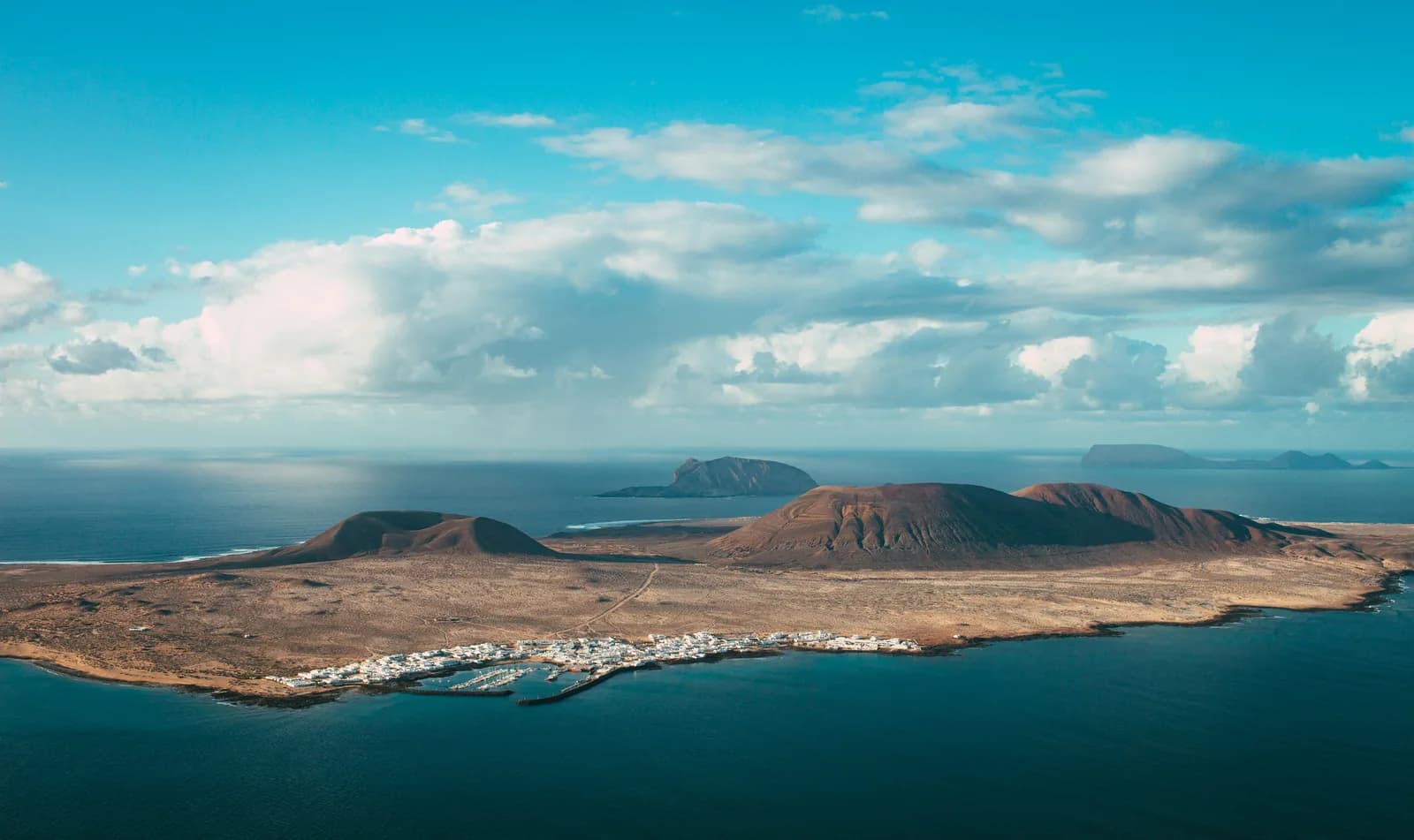
Lanzarote.
The island one artist designed: César Manrique's lava architecture, the Timanfaya fire mountains, wine grown in black ash funnels, the Papagayo coves — and the building code that kept every hotel below the palm line.
Lanzarote should, by the logic of 1970s tourism, look like Benidorm. That it instead looks like a design biennale staged on the moon is largely the work of one man: César Manrique, the local artist who came home from New York in 1966 and bullied, charmed and legislated his island into aesthetic discipline. No building taller than a palm tree (one hotel got grandfathered in; islanders still point at it). Every facade white, every shutter green or blue. No roadside billboards — to this day. Then he built the attractions himself, fusing lava tubes, craters and cliffs with white modernism until the line between gallery and geology disappeared.
The result is the rare mass-tourism island with a coherent soul, sitting on year-round Canarian weather a four-hour flight from the European cold.
When to go
Standard Canaries physics, winter-weighted: October to May is the heart of the product — 21–24°C, sea 18–20°C, dry air, while the continent freezes. Summer runs 26–29°C with the trade winds at their freshest (Lanzarote is breezy; slightly less so than Fuerteventura, more than Tenerife's south). The calima dust haze visits a few days at a time, here as everywhere this close to the Sahara. There is no month that doesn't work; there are only months that work differently.
Getting there
Arrecife (ACE) sits ten minutes from the capital and 15–25 from the three resort hubs: Puerto del Carmen (the established centre of gravity), Playa Blanca (the polished south, ferry port for Fuerteventura) and Costa Teguise (the quieter Manrique-planned third). Buses exist; taxis are €15–30 to most bases; and as with its neighbour, the island's best content is dispersed — rent a car for at least half the stay. The volcanic roadscape makes even transit days good days.
Where to stay
Luxury — Princesa Yaiza, Playa Blanca
The south coast's flagship: a white low-rise spread on Dorada beach with Fuerteventura filling the horizon, pools for every age bracket and a kids' setup that makes it the Canaries' best family-luxury address. Around €280–360/night in winter season. Check rates on Booking →
Mid-range — La Isla y el Mar, Puerto del Carmen
An adults-only boutique above the old town's harbour end: volcanic-chic rooms, a pool deck built for books, walking distance to the fish restaurants. Around €150–190/night. Check rates on Booking →
Budget — Hotel Lancelot, Arrecife
On the capital's city beach, plain and well-kept, around €90–110/night — and the contrarian base argument: Arrecife is a real Spanish town with real prices, the El Charco lagoon, and nobody selling you an excursion. Check rates on Booking →
Timanfaya — the fire mountains
Between 1730 and 1736 a quarter of the island disappeared under lava in one of history's longest eruptions; the parish priest of Yaiza kept the diary that still anchors the science. Timanfaya National Park is that event preserved: a hundred square kilometres of rust-and-charcoal cones where nothing has meaningfully grown back three centuries on. Access is deliberately controlled — you drive to the Islote de Hilario, where park buses run the loop road through the crater fields (included in the €12ish ticket; go before 10:30 or queue at the entrance), and demonstrators pour water into boreholes to summon geyser bursts: the ground at 13 metres is still 600°C.
El Diablo, the park restaurant, grills chicken over an open volcanic shaft. It's a gimmick. It's Manrique's gimmick, the view is absurd, and the chicken is fine.
On the park's seaward edge, El Golfo's half-drowned crater holds a malachite-green lagoon against black sand — pair it with the lava-arch coast at Los Hervideros on the drive south.
The Manrique circuit
The artist's interventions are the island's real itinerary, and they hold up:
- Jameos del Agua — a collapsed lava tube turned concert hall, white-and-turquoise pool garden and underground lake where blind albino crabs — the island's unofficial mascot — glint like dropped coins.
- Cueva de los Verdes — the same tube system raw: a kilometre of guided lava-cave theatre with one optical trick this guide won't spoil.
- Mirador del Río — the cliff-edge lookout he melted into the rock 470 m above the strait, facing La Graciosa. Coffee with the Canaries' best window.
- Fundación César Manrique, Tahíche — his own house, built inside five volcanic bubbles. The clearest statement of the whole project.
- Jardín de Cactus — the final work: a quarry amphitheatre of 4,500 cacti. Better than it sounds, like everything he touched.
Buy the combined-attractions ticket if you're doing three or more; it pays for itself.
La Geria — wine from black ash
The 1730s ash fall should have ended agriculture; instead the islanders invented a landscape. Across La Geria, every vine grows in its own hand-dug funnel (hoyo) behind a crescent of lava stone, mining moisture from air the clouds rarely visit — thousands of black craters with green hearts, one of the world's strangest wine regions. The grape is Malvasía Volcánica, dry, saline, genuinely good; El Grifo (founded 1775, the Canaries' oldest bodega, with a museum) and the roadside Bodega La Geria both pour tastings for a few euros. Book a no-drive option or argue over the keys: the LZ-30 through the vines is the island's best road.
Beaches, ranked honestly
- Papagayo coves — the south-tip chain: golden crescents in volcanic headlands, turquoise shallows, reached by a dusty toll track (€3) or boat from Playa Blanca. The postcard, deservedly.
- Playa Grande / Puerto del Carmen strip — the dependable resort sand with full services.
- Famara — the wild north: five kilometres under a 600-metre cliff wall, the island's surf school cluster, and currents that make it a walking-and-watching beach for non-surfers. At low tide the cliff mirrors in the wet sand; bring the camera, not the lilo.
- La Graciosa — the eighth Canary: 25 minutes by ferry from Órzola (€26ish return), sand streets, no tarmac, bikes for hire and Playa de las Conchas as the prize. The best day trip on the island.
- Caletón Blanco, Órzola — white-sand lagoons against black lava, kid-calm at low tide.
What to eat
The fish rows do the heavy lifting: El Golfo's lagoon-side grills and Arrecife's El Charco quarter both serve the day's catch with papas arrugadas and both mojos (€25–35). In the wine country, bodega kitchens pair goat cheese and gofio with the Malvasía. Teguise — the handsome old inland capital — runs the island's big Sunday market, worth timing a La Geria–Famara loop around. And the local dessert habit, bienmesabe over ice cream, translates as "tastes good to me", which is the correct review.
Practical notes
- Driving: easy, scenic, essential. The Papagayo track and La Graciosa's sand are the only off-tarmac moments.
- Sea honesty: Atlantic 18–22°C; south and east coasts are the calm ones, Famara is for surfers.
- Crowd logic: Timanfaya and Jameos queue mid-morning — hit one at opening, the other after 15:00.
- Timezone: GMT, one hour behind mainland Spain.
The summary
Fly ACE, rent the car, base at Princesa Yaiza (family), La Isla y el Mar (couples) or Arrecife (contrarians). One day Timanfaya–El Golfo–Los Hervideros, one Manrique north loop (Jameos, Cueva, Mirador del Río) closing at Famara for the cliff light, one La Geria afternoon between two bodegas, one Papagayo or La Graciosa beach day. Any month; October to May for the classic winter-sun case. Lanzarote proves a holiday island can have an author — and that the editing is what you remember.