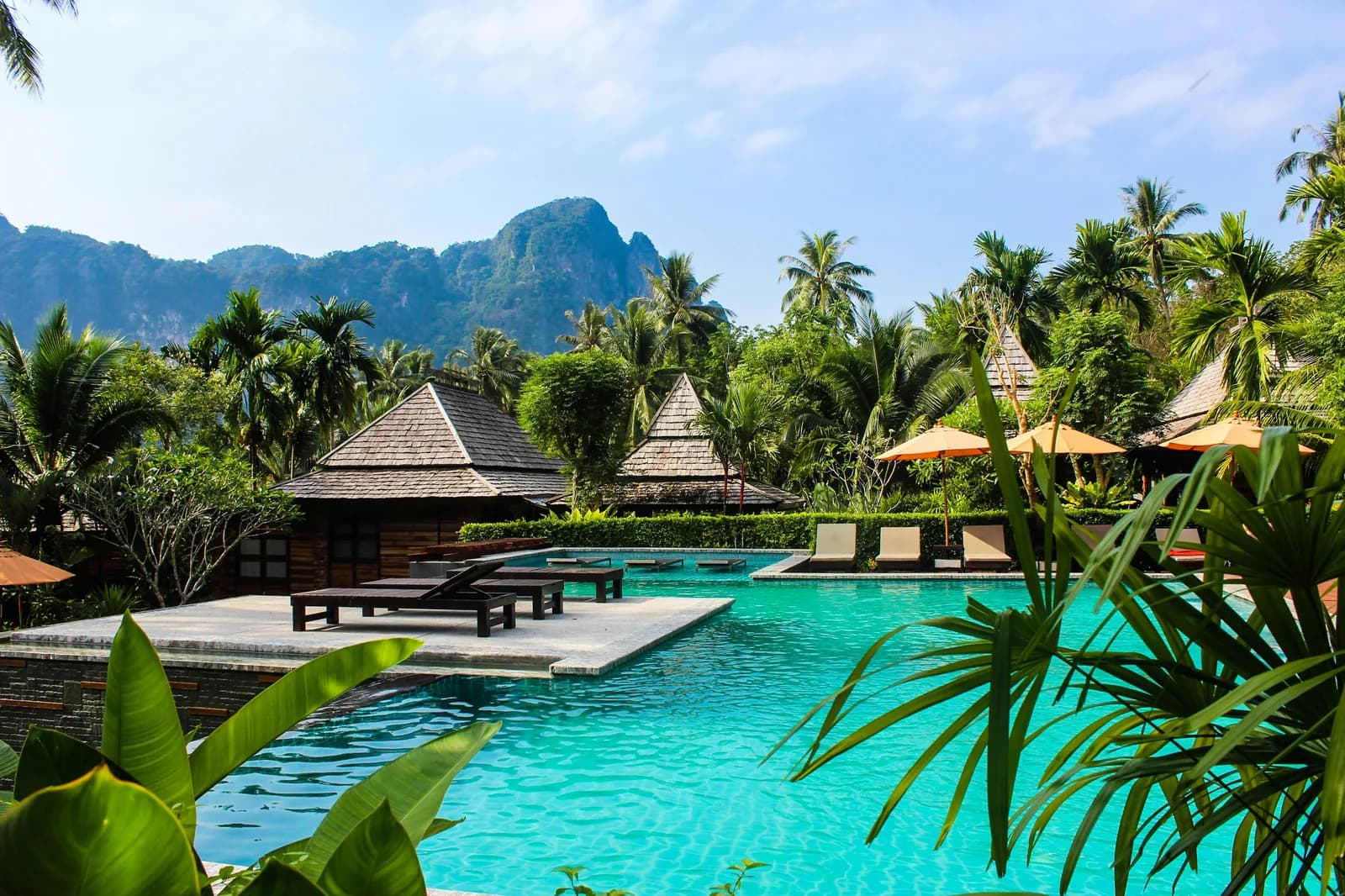
Krabi.
The Andaman's quieter geometry: Railay's roadless karst peninsula, the four-islands tour timed to the tide, a temple at the top of 1,237 steps — and the same monsoon calendar that rules Phuket, with a fraction of the traffic.
Krabi is what the Andaman coast looks like when the karst does the talking: a mainland province across the bay from Phuket where limestone towers rise vertically out of jungle and sea, longtail boats are the road network, and the marquee destination — Railay — cannot be reached by car at all. It runs the same turquoise water and the same dry-season calendar as its famous neighbour at lower volume in every sense: fewer lanes of traffic, fewer storeys of hotel, and mornings on the right beaches that still feel like a secret the geography is keeping.
The March guide called Railay's quiet mornings "the version of Thailand people fly back for". This is the manual for getting there.
When to go — Phuket's calendar, verbatim
November through April, dry and glassy: 31–33°C with the sea at 28–29°C, longtails and island boats running like clockwork. February–March is the balance point (February flags the peak-dry sweet spot); April adds Songkran's water-fight new year and the year's top heat.
May through October is the southwest monsoon — the database's avoid list in full: west-facing swell, cancelled island runs, and day-long rains at the season's core (September the statistical pit). A monsoon "deal" here buys you the view without the boats, and the boats are the point.
Getting there
Krabi (KBV) takes direct lift from the Gulf hubs and Bangkok, plus growing seasonal European charters. The airport sits between Krabi Town and Ao Nang: shuttle buses and taxis cover both (30–45 minutes, €8–20). There's no need for a car — this coast runs on longtails and songthaews — though scooters exist with the usual licence-and-insurance sermon attached.
The geography to internalise: Krabi Town is the river-port province capital (markets, cheap beds, no beach); Ao Nang is the main resort strip and boat hub; Railay is the roadless peninsula fifteen longtail-minutes beyond it; Klong Muang and Tubkaek are the quiet hotel beaches north with the Hong islands offshore.
Railay — the roadless peninsula
Railay isn't an island, but the karst wall behind it seals it from the road network completely — everything and everyone arrives by longtail (from Ao Nang's beach or Ao Nam Mao pier, ~10 minutes, a couple of euros). Four beaches share the peninsula: Railay West (the sunset postcard — soft sand between cliff faces), Railay East (mangrove and mudflat — the cheap-sleeps side, not a swimming beach), Phra Nang (the jewel: a cliff-backed cove with a cave shrine where fishermen leave carved offerings to a sea princess — the guidebooks blush; the boatmen don't), and climbers' Ton Sai around the headland.
The peninsula is also one of the planet's storied rock-climbing venues — 700-odd bolted routes up overhanging orange limestone, with half-day beginner courses (€25–40) that put total novices on real rock above a postcard. The non-climbing equivalents: the viewpoint-and-lagoon scramble off the East side (red-clay, ropes, proper shoes — earn it early) and dawn laps of Phra Nang before the day boats arrive at ten.
Stay a night or two on the peninsula if the budget allows; Railay between 17:00 and 10:00 — after the day-trippers leave — is the trip.
The boat days
- The four-islands tour — the Ao Nang classic (€15–25 longtail, €30–45 speedboat with lunch): Poda's white crescent, Chicken Island's namesake stack, snorkel stops, and the finale that makes it — Tup Island's sandbar, which surfaces at low tide to link three islets in a walkable curve of waist-deep turquoise. Check the tide table before booking the day; high-tide departures literally miss the headline.
- The Hong islands — north off Tubkaek: a hidden lagoon entered through a cleft, quieter sand, emerald shallows (€35–50).
- Phi Phi from the east — Krabi's piers run the same Maya Bay circuit as Phuket's; the same honest advice applies — earliest boat or skip.
Inland — the temple and the pools
- Tiger Cave Temple (Wat Tham Suea) — 1,237 concrete steps straight up a karst tower to a golden Buddha and a 360° panorama of the whole limestone province. Go at 07:00 (heat) carrying water (monkeys audit bags). The province's best earned view.
- Emerald Pool and the hot springs — an hour inland: a jungle pool of improbable green (early morning before the tour vans) paired with cascade hot-spring tubs in the forest. A gentle full day with lunch in between.
Where to stay
Luxury — Rayavadee, Railay
Two-storey pavilions in a coconut grove at the peninsula's tip, with Phra Nang as the de facto house beach. The Andaman's most coveted address for a reason. Around €450–550/night in season. Check rates on Booking →
Mid-range — The Tubkaak Boutique Resort, Tubkaek beach
Low timber buildings on a quiet northern beach staring straight at the Hong islands — sunsets do their full theatre here. Adults-calm, around €180–230/night. Check rates on Booking →
Budget — Ban Sainai Resort, Ao Nang
Cottages under the karst a short walk back from the strip: pool, gardens, the cliffs glowing over breakfast. Around €80–110/night in season. Check rates on Booking →
What to eat
Krabi Town earns an evening for its food alone: the riverside night market (Khong Kha, by the pier) for grilled river prawns and southern curries, and the weekend walking street for the full snack-crawl economy. In Ao Nang, Lae Lay Grill on its hillside does the seafood-with-view institution properly (book the terrace, €15–25); at Klong Muang, Krua Thara is the local seafood hall the province drives to. Everywhere: southern Thailand's heat is real — gaeng som asks for respect — and the roti pancake stands solve dessert nightly. Street-stall rule as ever: queues of locals beat laminated photos.
Practical notes
- Tides run the schedule — the sandbar, Phra Nang's width and longtail loading all swing with them; any boat office shows today's table.
- Sea honesty: 28–29°C and calm all dry season; monsoon swell closes the west-facing stretches and the red flags mean it here too.
- Cash: baht for longtails, markets and island lunches; ATMs cluster in Ao Nang and town.
- Wildlife small print: the macaques of Railay East and the Tiger Cave steps are professional thieves; zip the bag, skip the feeding.
- Pairing: Krabi chains naturally with Ko Lanta (two gentle hours south by van-ferry) for the slow-island second week.
The summary
Fly KBV in the dry window, split the stay: two or three nights on Railay itself (Rayavadee if the trip is the splurge; the East-side guesthouses if it isn't) for the dawn beaches and the climbing, then Tubkaek or Ao Nang for the boat days — four islands timed to low tide, the Hong lagoon, Tiger Cave at 07:00, Krabi Town's night market for the last dinner. November to April, February–March at the centre. Krabi is Phuket's headline geography with the volume turned to human — the Andaman as the postcards promised, minus the traffic jam in front of them.