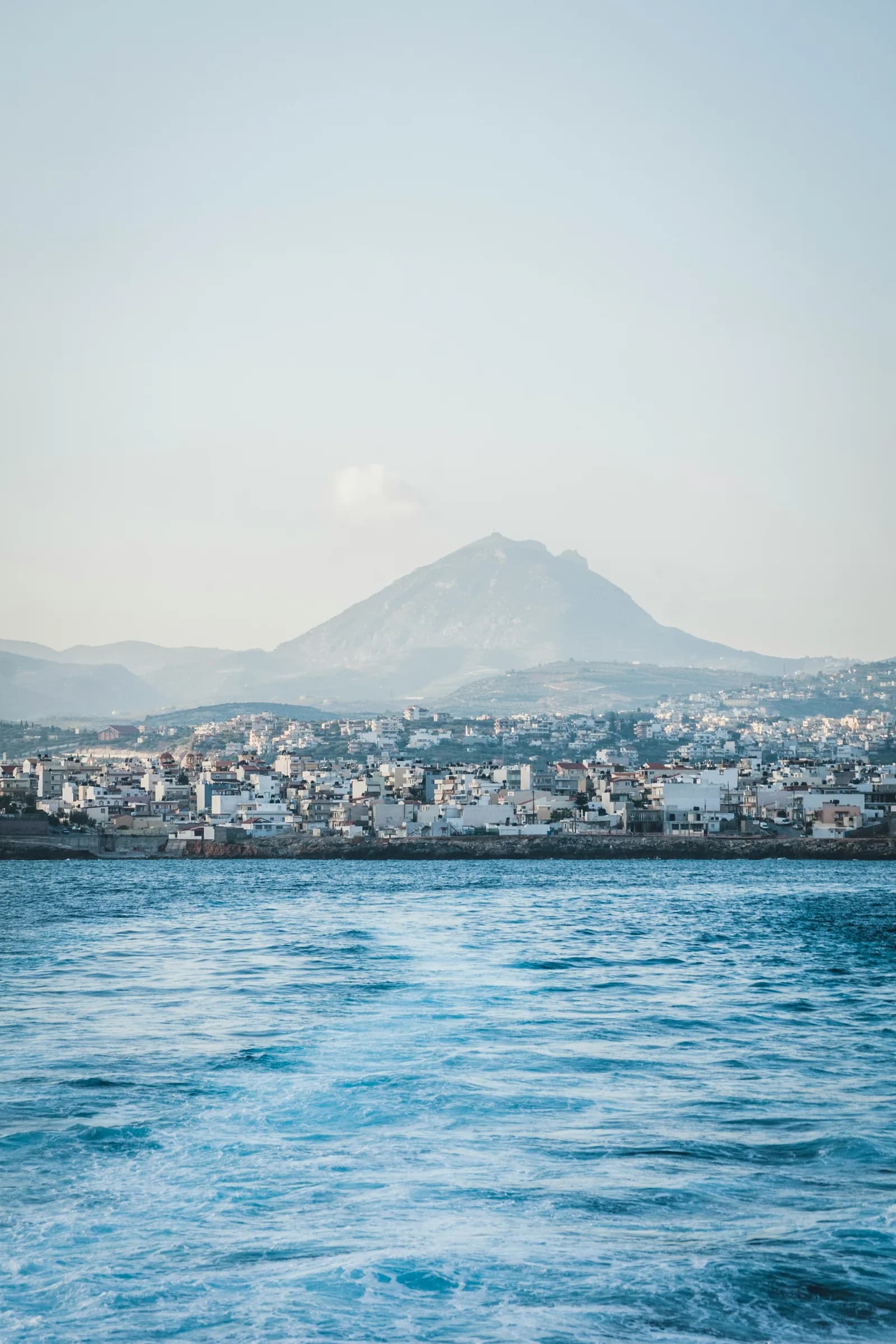
Heraklion.
Most people treat it as an airport with a motorway attached. The case for staying: Knossos at opening time, the best food culture in Greece, a Venetian harbour city that doesn't perform for tourists, and wine country twenty minutes south.
Heraklion is the most under-loved city in the Greek islands, mostly because nobody gives it a chance: a million-plus visitors a year land at the airport and drive straight past the city walls toward a beach resort. Their loss is measurable. This is Crete's working capital — a real Greek city of 170,000 with a Venetian harbour, the second-most-visited museum in Greece, Europe's oldest city ruins twenty minutes away, and a food culture that the rest of Greece quietly concedes is the country's best.
The honest pitch isn't a week in Heraklion. It's two or three nights bolted to the front of a Crete trip, doing the things only this city can do, before the beach phase begins.
When to go
Crete runs the longest season in Greece, and the database's verdict matches the lived one: May, June, September and October are the windows.
May is 22–26°C with the sea at 19–20°C — wildflowers still on the hills, Knossos uncrowded. June climbs to 27°C and a 22–23°C sea (the June guide ranks Heraklion in its top tier). September is the connoisseur pick: 26–27°C, the sea at its 25°C annual peak, crowds halved, grape harvest in the villages. October still delivers 23°C days and swimmable water.
July and August are flagged honestly: 29–33°C with spikes beyond, peak crowds at the sites, and the heat-risk pattern our climate study tracks across the southern Aegean. Crete gets more breeze than the mainland and less meltemi chaos than the Cyclades, but a Knossos queue at 14:00 in early August is a punishment nobody needs.
Getting there
Heraklion (HER) is Greece's second-busiest airport — direct seasonal flights from all over Europe, year-round links via Athens. The airport sits 5 km east of the centre: a taxi is €15–20, city buses run constantly for about €2. (A new airport at Kastelli has been under construction for years; until it actually opens, HER's slightly chaotic charm endures.)
Ferries connect the harbour to Santorini (2 hours on the fast boats — which is why Heraklion pairs naturally with a Cyclades hop) and overnight to Piraeus.
Where to stay
Stay between the Venetian harbour and Lions Square (Plateia Liontarion) — the walkable kilometre that holds the evening volta, the fountain, the market streets and most of the food. The beach resorts immediately east (Amoudara) and the package strip toward Hersonissos are a different trip.
Luxury — GDM Megaron
The grand hotel of the city, in a restored 1920s building above the harbour: rooftop pool with the bay view, proper service, breakfast on the roof watching the ferries leave for Santorini. Around €180–230/night in season — what "luxury" costs in a city tourists skip is one of Heraklion's better jokes. Check rates on Booking →
Mid-range — Olive Green Hotel
Modern, eco-minded rooms a block from the market streets — tablet-controlled everything, comfortable beds, walkable to all of it. Around €120–150/night. The sensible default. Check rates on Booking →
Budget — Kastro Hotel
Family-run, plain and friendly, ten minutes' walk from the harbour, with a roof terrace for the evening beer. Around €80–100/night in season. Check rates on Booking →
Knossos, done right
Knossos is 5 km south of the centre (bus #2 from the city, every 20 minutes) and it is both the real thing — a 4,000-year-old palace complex, the labyrinth myth's postal address — and a 1920s editorial decision. Arthur Evans didn't just excavate; he rebuilt chunks in reinforced concrete and painted them, which archaeologists have argued about ever since. Knowing that before you go is the difference between disappointment and fascination: you're reading two stories at once, Bronze Age and British imagination.
The logistics that matter: be at the gate at 08:00 when it opens, ahead of the cruise buses that arrive from 10:00; the site is nearly shadeless, so summer afternoons are brutal; tickets around €15–18, and the combined ticket with the Archaeological Museum is the correct purchase. Do the museum the same day — the actual frescoes (the Bull-Leapers, the Prince of the Lilies), the snake goddesses and the still-undeciphered Phaistos Disc all live there, not at the site. Museum first if you like context before ruins; site first if you want the 08:00 cool.
The Cretan table
Crete's food argument is structural: the island grows everything, the olive oil is the country's best, and the kafeneio-to-taverna ecosystem never industrialised. The fixed points — dakos (barley rusk, grated tomato, mizithra cheese), apaki (smoked pork), snails boubouristi (fried with rosemary and vinegar, better than it sounds), gamopilafo (the buttery "wedding rice"), and raki appearing unbidden at the end of everything, with fruit, on the house. Refusing the raki is theoretically possible.
- Peskesi — the famous one, in a restored mansion: farm-to-table Cretan cooking from their own land, ancient grains, the dishes grandmothers stopped making. Reserve a day or two ahead. €25–35 per person, absurd value.
- Ippokampos — the seafront mezedopoleio locals defend like family: fried smelt, octopus, barrel wine, elbow-to-elbow tables. Arrive before 20:30 or queue.
- Kirkor, Lions Square — the morning institution: bougatsa (custard or cheese pie, dusted with cinnamon) made the same way for a century. Breakfast solved.
Twenty minutes south, the Peza and Dafnes wine country grows Vidiano and Kotsifali on slopes the Minoans planted first — several wineries (Lyrarakis is the established name) run tastings that cost less than an Athens cocktail.
The city itself
Give it half a day on its own merits: the Koules fortress on the harbour mole (€4, climb for the bay panorama), the Venetian loggia and the Morosini lion fountain, the covered market streets off 1866 Street, and the city walls — Europe's longest surviving Venetian fortifications, with Nikos Kazantzakis' grave on the southern bastion under his own epitaph: I hope for nothing. I fear nothing. I am free. Sunset up there, city on one side, vineyards on the other, is Heraklion's quiet best moment.
Day trips worth taking
- Matala (1h15 south) — the Roman cave-cliff beach where the 1960s hippies wintered (Joni Mitchell wrote it into Carey); still a proper swim with a backstory.
- Spinalonga (1h east to Plaka, then the short boat) — the Venetian fortress islet that became Greece's last leper colony, told in The Island. Haunting, popular, worth it.
- Rethymno (1h west) — the prettier Venetian old town, for balance.
- Santorini by fast ferry (2h each way) — doable as a long day; better as the next stop.
Practical notes
- Getting around: city buses are fine for Knossos; everything else on this page except the day trips is walkable. Rent a car only when you leave the city.
- Sea honesty: the city's own beaches are functional, not the postcard. Crete's great beaches (Elafonissi, Balos, Preveli) are 2+ hour drives west or south — that's the next leg of the trip, not the Heraklion stay.
- Crowds: the museum and Knossos absorb cruise traffic late morning; both are calm at opening and after 16:00.
- Cash: cards work everywhere, but village tavernas and the raki economy still appreciate notes.
The summary
Land at HER, take two nights in the centre at the Megaron or Olive Green. Day one: Knossos at 08:00, museum after, long Peskesi dinner. Day two: walls and Kazantzakis in the morning, Peza wineries or Matala in the afternoon, Ippokampos by the water at night. Then collect the rental car and head west or south for the beach phase. Crete is the most complete Greek island; this is its front door, and it deserves better than a drive-by.