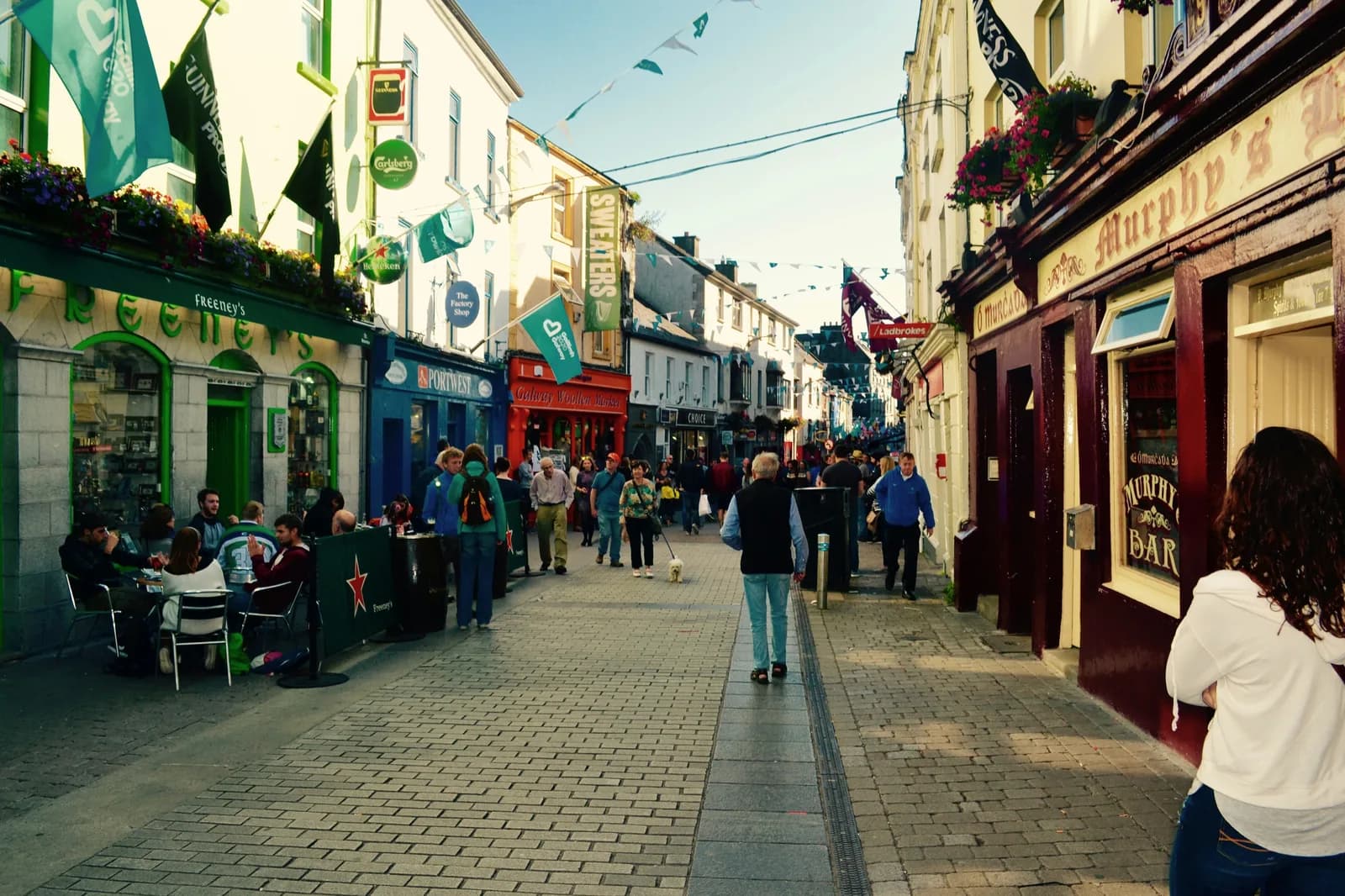
Galway.
Ireland's festival city on the edge of the Atlantic: buskers and trad sessions in the Latin Quarter, cold dips off the Blackrock tower, oysters by the bay, and the launchpad for the Cliffs of Moher and Connemara. A soft 19–20°C, and it never bakes.
Galway is the most fun a cool-summer city break can be. It sits where Ireland runs out into the Atlantic — a small, walkable medieval port of painted shopfronts and stone lanes, with a busking-and-trad-music street culture that spills out of the pubs every evening, a seafront promenade where locals dive into the bay year-round, and a doorstep that opens onto the Cliffs of Moher, the Aran Islands and the wild bogs of Connemara. The weather is the soft, temperate Atlantic kind — 19–20°C in July, and it genuinely never has a heatwave — so you escape the continental furnace into a place where 22°C counts as a hot day and the pints are poured slow.
The honesty is the Irish kind: there's no heat to fear (Galway rarely tops 25°C), but the Atlantic weather is changeable — sun, cloud and a shower can pass through in an hour. Pack layers and a rain jacket, prize the bright spells, and let the indoor pub-and-music culture carry the wet ones.
When to go
June to August is the season — warmest, liveliest, and the festival window. Galway is Ireland's festival capital: the Galway International Arts Festival (mid-July) and the Galway Races (late July/early August) light the city up, and the Oyster Festival lands in September. May and September are quieter, softer and cheaper. The Atlantic weather is changeable in any month — you come for the light, the coast and the culture, not guaranteed sun.
Getting there
Galway has no commercial airport — you arrive via Shannon (SNN, ~1 hour by coach/car) or Dublin (DUB, ~2.5 hours by direct GoBus/Citylink coach or train). Mediterranean travellers fly into Dublin (direct from Madrid, Barcelona, Rome, Milan, Lisbon) and coach across — the Dublin–Galway coach is frequent, comfortable and drops you in the centre. Once there, the medieval core is tiny and entirely walkable; you won't need a car except for the day trips, where one helps.
The Latin Quarter and the city
Galway's centre is a ten-minute stroll end to end, and it's all atmosphere:
- Shop Street & the Latin Quarter — the pedestrian spine: buskers (Galway launched more than one famous act), painted pubs, the trad sessions that are the city's heartbeat. Duck into a pub on Quay Street any evening and there'll be music.
- The Spanish Arch & Galway City Museum — the 16th-century arch on the river, with the free city museum beside it; the Long Walk's painted houses make the postcard.
- Galway Cathedral — the great domed church on the river island.
- Eyre Square — the central green, the city's front room.
- The Claddagh — the old fishing village across the river that gave the world the Claddagh ring; a short, lovely walk.
- The Saturday Market — by St Nicholas' Church: oysters, cheese, crêpes, the weekend ritual.
The sea — Salthill and the swim culture
Galway swims. The Salthill Promenade runs two kilometres along the bay to the iconic Blackrock Diving Tower, where locals leap into the Atlantic year-round (the water's a brisk ~15°C — this is cold-dip, "forty-foot" culture, alive and well). The Salthill beaches (Ladies' Beach, Grattan) are sandy and swimmable for the hardy. The local tradition is to walk the full Prom and "kick the wall" at the end — do it. A bracing dip followed by a pint is the Galway summer in miniature.
The food
Galway is a UNESCO City of Gastronomy, and it earns it on Atlantic seafood: oysters above all (Galway Bay's are world-famous — the International Oyster Festival is September), plus mussels, crab, and the chowder in every pub.
- McDonagh's — the legendary fish and chips on Quay Street; the institution.
- Aniar and Loam — the two Michelin-starred terroir kitchens for the splurge.
- Kai — the beloved bistro (book).
- The Quay Street pubs — seafood chowder, brown bread, a pint of Guinness and a trad session: the essential Galway evening.
- Oysters with a stout, anywhere on the bay, in season.
The day trips — the Wild Atlantic Way
Galway is the gateway, and the trips are the reason half the visitors come:
- The Cliffs of Moher — the 214-metre Atlantic cliffs an hour and a half south, Ireland's top-selling day tour: vertiginous, dramatic, often wind-lashed (which is the point). Guided day trips handle the logistics; pair with the lunar limestone of the Burren.
- The Aran Islands — the three Irish-speaking islands off the bay (ferry from Rossaveel): stone-walled fields, the cliff-edge fort of Dún Aonghasa, bikes and a step back in time. A full, brilliant day.
- Connemara — the bog-and-mountain wilderness west of the city: Kylemore Abbey on its lake, the Twelve Bens, the empty Atlantic coast road. A self-drive or guided loop.
Practical notes
- Money: euro (Ireland is in the eurozone — no exchange faff); cards everywhere, some rural pubs prefer cash.
- Language: English, with Irish (Gaeilge) official and genuinely spoken out toward Connemara and the Aran Islands.
- Weather: soft and changeable — layers and a waterproof always; "summer" is 19–20°C with passing showers, and that's the charm.
- No Scandic in Ireland: book through the wider market (Booking strip below). Landmarks: The g Hotel & Spa (Philip Treacy design), Glenlo Abbey (country estate), The Hardiman (historic, Eyre Square), The House Hotel (Latin Quarter boutique), the Maldron/Jurys chains for mid-range, the city hostels for budget.
The summary
Coach in from Dublin or Shannon, base in the walkable centre. Spend the evenings in the Latin Quarter's trad sessions, walk the Salthill Prom and kick the wall (dip if you dare), eat oysters and McDonagh's fish and chips, then give full days to the Cliffs of Moher, the Aran Islands and Connemara. June to August for the festivals and the light. When Madrid melts at 32°C, Galway offers a soft 19°C, the Wild Atlantic Way at the door, and trad music until late in the long Irish twilight — a cool escape with a pint in its hand.