Fuerteventura.
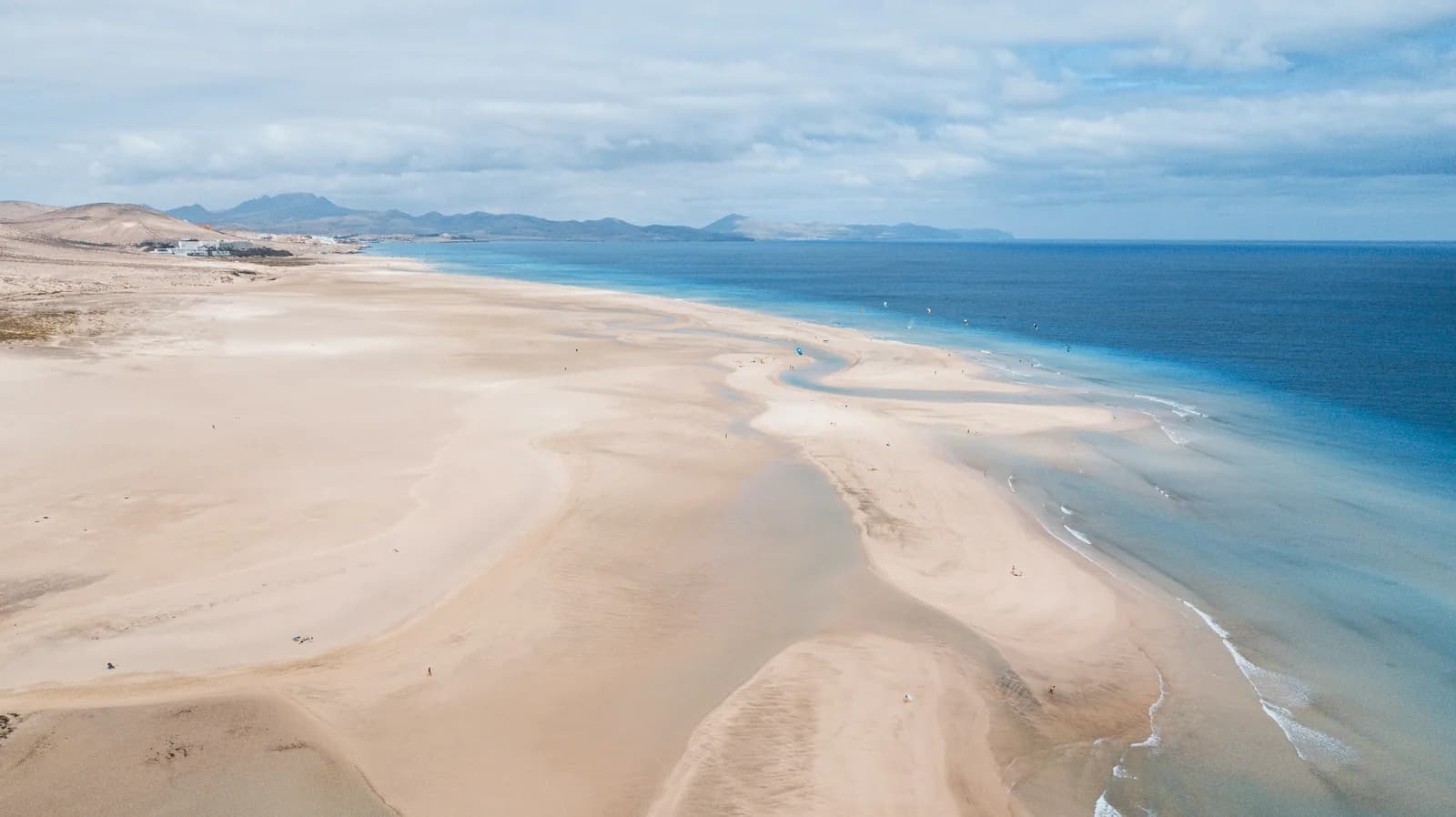
The Canaries' beach specialist: 150 km of sand on an island shaped by wind — the dunes of Corralejo, the Sotavento lagoon, wild Cofete behind the mountains. Where each coast wins, and what the wind honestly costs.
Every Canary Island has a specialism. Fuerteventura's is sand: roughly 150 km of it, more beach than the rest of the archipelago combined, on an island of just 120,000 people that sits 100 km off the Sahara. It is the oldest, flattest, emptiest of the major Canaries — a tawny desert plateau where goats outnumber argument — and its name contains the customer notice: fuerte viento, strong wind, is the standard etymology locals enjoy, and whatever the linguists actually conclude, the trade winds are the island's co-author. They built the dunes, they power Europe's best wind-sports water, and they will flap your parasol. This guide tells you where they help and where to hide from them.
When to go
Classic Canarian year-round physics, winter-weighted like its siblings: October to May is the core — 21–24°C days, sea 18–21°C, while Northern Europe does the other thing. Summer runs 26–28°C, dry, and windier: the trade winds peak June–August, which is precisely when the kite and windsurf calendar peaks with them (the world windsurfing tour has stopped at Sotavento for decades). The calima — the Saharan dust haze — visits here first and thickest of all the Canaries, a few uncomfortable days at a time, then clears.
The honest framing: Fuerteventura is two or three degrees breezier than Gran Canaria or Tenerife South on an average day. In exchange you get the beaches. That's the trade; take it knowingly.
Getting there
Fuerteventura (FUE) sits outside Puerto del Rosario, the low-key capital: 35–40 minutes to Corralejo in the north, 50–60 to the Jandía resorts in the south. Buses (Tiadhe) cover both for under €10; transfers and taxis run €40–70 depending on the end. The year-round low-cost network from Northern Europe is dense — this island lives on it.
The island is 100 km long and its best corners are roadside-empty: rent a car, at least for two or three days. Roads are excellent and traffic is a rumour.
Where to stay — north or south, choose once
The island polarises: Corralejo in the north is the proper town — old harbour core, restaurants, surf schools, the dunes next door, the Lanzarote ferry. The Jandía peninsula in the south (Costa Calma, Esquinzo, Morro Jable) is purpose-built resort coast pinned to the island's most spectacular beaches. North = character and a base for everything; south = the beach machine at maximum. Caleta de Fuste, mid-east, is the airport-convenient compromise that compromises everything else.
Luxury — Gran Hotel Atlantis Bahía Real, Corralejo
The island's flagship: a kasbah-styled spread on the waterfront facing Lobos islet and Lanzarote beyond, pools stepping down to the sea, a spa that takes the assignment seriously. Around €280–360/night in winter season. Check rates on Booking →
Mid-range — Avanti Lifestyle Hotel, Corralejo
Adults-only boutique conversion in the old town, a minute from the harbour: design rooms, small rooftop pool, breakfast worth lingering over. Around €140–180/night. Check rates on Booking →
Budget — Surfing Colors, Corralejo
Bright apartment-hotel blocks by the dunes' edge with a pool and surf-school energy, around €80–110/night. The savings buy the rental car this island actually requires. Check rates on Booking →
The beach taxonomy
- Corralejo dunes (Parque Natural) — 10 km of Sahara-grade dune field meeting turquoise flats, starting at the town's edge. The northern "Flag Beach" stretch serves the kite schools; walk south and the crowds thin to nudists and horizon. The road runs straight through the park — every pull-off is a beach.
- Sotavento (Jandía) — the famous one: a vast tidal lagoon where shallow water floods a kilometre-wide sandbar, the world-championship windsurf arena and the island's defining aerial photograph. Time it for high tide via any tide app; the lagoon at full flood is the day's event.
- Cofete — the wild monster: 12 km of untouched sand behind the Jandía mountains, reached by a 30–40 minute graded dirt road (a normal hire car survives it driven gently; your nerves may vary). No services, violent currents — this is a walking-and-awe beach, not a swimming beach — and a lone villa with a Nazi-legend backstory (Casa Winter) for seasoning. The Canaries' most cinematic place.
- El Cotillo — the northwest village: lagoon pools behind a reef on the north side (the island's calmest swimming, ideal with kids), surf beaches south of the harbour, and the sunset.
- Lobos islet — fifteen minutes by ferry from Corralejo (€15ish return): a volcanic nature-reserve speck with one lagoon, one summit, one fish restaurant. Visitor numbers are capped — book the free permit online a few days ahead; the boat operators walk you through it.
Wind sports, honestly graded
This is Europe's best learning water for kitesurfing and windsurfing: warm, shallow, reliable wind, schools by the dozen at Flag Beach and Sotavento (a multi-day beginner kite course runs €250–350). Surfers get their own season — the north shore reels from October to March, with El Cotillo and the north-track reefs as the arena and Corralejo full of board rentals. If you want none of this, the same wind is why your beach day belongs on the leeward (west and south-facing) sides — and why El Cotillo's lagoons exist on the brochure.
What to eat
The island's pride is queso majorero — the PDO goat cheese, paprika- or gofio-rubbed, that wins international medals from a island of dusty goat farms. Taste it at source: Casa Marcos in Villaverde (north) does the farmhouse table — cheese boards, slow goat stew (cabrito), under €25. On the coast: La Vaca Azul in El Cotillo, the fish institution over the old harbour — pescado a la espalda, wrinkled potatoes, both mojos, the sunset thrown in (€30–40). In Corralejo the harbour-front grills do the daily catch simply; anything advertising photos of fifteen cuisines is exactly what it appears.
Round it off Canarian: papas arrugadas, carajacas if you're brave, and the local Maxorata cheese ice cream where it appears — better than it has any right to be.
Practical notes
- Wind management: check a forecast app daily and pick the day's coast accordingly — the island always has a leeward somewhere.
- Sea honesty: Atlantic, 18–22°C by season; the east-coast lagoons (Sotavento, El Cotillo) are the calm-water options, the west (Cofete, La Pared) is current country — admire, paddle, don't swim out.
- Driving: the Cofete track and the dune-park road are the only "adventures"; everything else is empty tarmac. Fuel up — stations thin out in the south.
- Day trip: Lanzarote is 30 minutes by ferry from Corralejo — Timanfaya's volcanoes and Manrique's island make a legitimate add-on day.
- Timezone: GMT, like the rest of the Canaries.
The summary
Fly FUE, rent the car at the terminal, base in Corralejo at the Avanti or the Bahía Real. One dune-park morning walked south into emptiness, one full Jandía day timed to Sotavento's high tide with the Cofete track if your nerve holds, one El Cotillo lagoon-and-sunset day closing at La Vaca Azul, one Lobos islet permit morning, cheese at Casa Marcos on the drive between. October to May for the classic winter-sun version; summer if the wind is the point. Fuerteventura does one thing — but nowhere in Europe does that thing bigger.