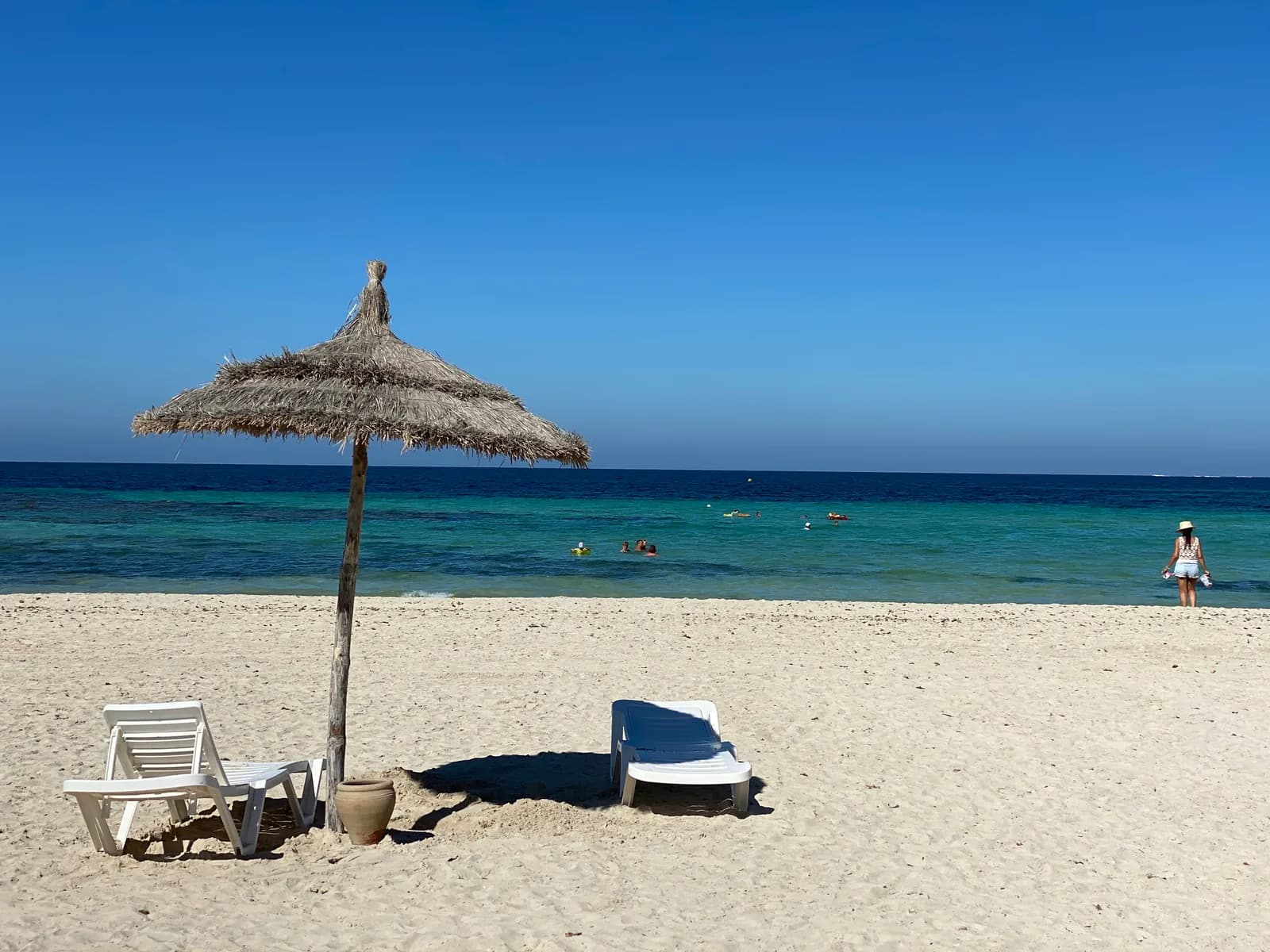
Djerba.
Tunisia's island of calm at prices the Greek islands abandoned a decade ago: the street-art village of Erriadh, Africa's oldest synagogue, the fish-auction lunch ritual in Houmt Souk — and a flamingo lagoon reached by pirate ship.
Djerba is the Mediterranean's best-kept value secret hiding in plain sight: a flat, palm-and-olive island off Tunisia's southern coast — legend says Homer's lotus-eaters lived here, and the pace supports the theory — where whitewashed menzel farmsteads dot the interior, a 2,500-year-old Jewish community keeps Africa's oldest synagogue, one village turned itself into an open-air street-art museum, and the northeast coast runs kilometres of white sand at four-star all-inclusive prices that stopped existing in Greece around 2015. The April guide made the point with a number: Djerba before its summer crowd, at a price point the Greek islands abandoned years ago.
It is not undiscovered — French and German charters have wintered here for decades — but it remains under-considered by everyone else, which is the gap this guide argues you should exploit.
When to go
April, May, June, September, October — the database's window, North African Mediterranean in shape.
April–May: 23–27°C, the island green from spring, sea climbing from 18 to 21°C — sightseeing weather with swimming arriving mid-spring. June: 30°C, sea 23–24°C, the full beach product before the August surge. September–October: 31–26°C descending with the sea at its 25–24°C best — the swimmers' window and our overall pick. July–August are flagged: 35–38°C with Saharan intent (the chehili wind can spike it further), plus the Franco-German peak season at peak rates — though "peak" here still undercuts a Spanish shoulder season.
Winter runs a mild 16–18°C — thalasso-and-quiet territory, not a sun trip, with hotel rates that border on typographical errors.
Getting there
Djerba–Zarzis (DJE) takes direct seasonal charters and low-costs from France, Germany and increasingly elsewhere; connections via Tunis cover the rest of the year. The airport sits 9 km from Houmt Souk: taxis run €5–8 (metered — Tunisia's taxis are honest by regional standards), hotel transfers similar. On-island: louages (shared vans) and cheap taxis cover the triangle of town, beach zone and villages; a rental car (€30–40/day) unlocks the interior menzels and the southern lagoons in a day or two.
Where to stay
The hotel zone lines the Sidi Mahres beach on the northeast — the long white strip where the all-inclusives stand in gardens rather than towers. Houmt Souk, the market capital fifteen minutes west, holds the character stock: converted fondouks (caravanserai courtyards) at hostel-adjacent prices. The split-stay logic writes itself.
Luxury — Radisson Blu Palace Resort & Thalasso
The strip's polished flagship: a serious thalassotherapy centre (the island's specialty — seawater spa culture is a French-colonial inheritance done well), pools to the dune line, around €140–190/night. Luxury at Djerba pricing. Check rates on Booking →
Mid-range — Hôtel Dar Dhiafa, Erriadh
The island's boutique original: several menzel houses fused into a labyrinth of courtyards, vaulted rooms and two small pools, in the street-art village itself. Around €100–140/night. Check rates on Booking →
Budget — Dar Bibine, Erriadh
A design guesthouse in village whitewash — five rooms, a plunge-pool courtyard, breakfast under the fig tree — around €70–90/night, which buys the kind of aesthetic Santorini invoices triple digits for. Check rates on Booking →
Erriadh — the street-art village and the synagogue
Erriadh, mid-island, holds Djerba's two most surprising assets within ten minutes' walk of each other.
The Djerbahood project invited some 250 international street artists to paint the village's lanes and doorways — and unlike most municipal mural schemes, the result genuinely works: calligraffiti across crumbling plaster, optical illusions around corners, herons and Berber motifs over studded doors, the whole village an unticketed open-air gallery best wandered in the soft morning light with a pastry and no map.
Five minutes away, El Ghriba is Africa's oldest synagogue — a serene blue-and-white interior of tile and timber, foundation legends reaching back to the First Temple's fall, and the heart of the annual Lag BaOmer pilgrimage that draws the Jewish diaspora each spring. Modest dress, a small donation, airport-style security at the gate (long-standing and unobtrusive); the welcome inside is warm. That a living synagogue, centuries of Ibadi mosques and the market mosques of Houmt Souk share one small island is Djerba's quiet civics lesson.
The interior generally rewards aimless driving: fortified menzels, the underground oil presses, and Guellala, the pottery village on the southern rise, where the workshops still throw the island's clay (the camel-driven press demonstration is for tourists; the pots are real).
Houmt Souk and the fish-auction lunch
The capital is a low white market town arranged around fondouk courtyards and a genuinely usable souk — wool blankets, ceramics, silver by the gram, haggling at conversational volume. Its set piece is the fish auction: mid-morning at the market hall, auctioneers walk the floor with bundles of the night's catch strung on palm fibre, selling by theatrical decree. The visitor's move, sanctioned by long custom: buy a bundle (dorade, mullet, prawns — a few dinars settles it, any local will steer you), carry it to one of the grill kitchens around the hall, and for a couple of euros' service they return it charcoal-grilled with salad, harissa and bread. The island's best meal, twice the theatre of any restaurant.
Otherwise eat: brik à l'œuf (the crisp egg-and-tuna pastry that is Tunisia's national starter), couscous au poisson (the Djerban signature — fish couscous with the island's sweet-hot depth), grilled octopus everywhere, and El Fondouk in Houmt Souk for the courtyard-restaurant version of all of it (€15–25). Tunisian rosé and Celtia lager exist in licensed restaurants and hotels; the mint-tea-with-pine-nuts habit needs no licence.
The lagoon, the flamingos and the beaches
- Sidi Mahres — the main event: kilometres of white sand, shallow warm water, hotel loungers and public stretches interleaved. The Mediterranean at its most patient.
- Seguia (southeast) — the quieter golden arc with beach-club pockets; locals' weekend choice.
- Ras R'mal — the flamingo island — the sandspit lagoon north of the coast, visited by the cheerfully absurd "pirate ship" excursions from Houmt Souk's port (€15–25 with lunch): two hours of sandbar, shallow turquoise and — October through March — the pink flotillas the spit is named for. Kitsch transport, genuine lagoon; the contradiction resolves in the water.
A flat island with constant breeze also means kitesurf lagoons (the south's Lagune de Bin El Ouedian operates schools) and cycling that requires no legs to speak of.
One honest flag: the roadside crocodile farm and similar animal attractions on the excursion menus — skip them; the island's actual charms don't need cages.
Practical notes
- Money: Tunisian dinar (closed currency — exchange on arrival, re-exchange before leaving); cards in hotels and larger restaurants, cash in the souk and at the auction.
- Haggling: expected in the souk at friendly amplitude; fixed prices in food markets.
- Getting around: taxis are cheap and metered; agree-first for excursion distances. The interior wants a rental car for one day.
- Dress: beachwear belongs to the beach zone; shoulders-and-knees courtesy in villages, the synagogue and mosque exteriors.
- Language: Tunisian Arabic and French run the island; English functions in tourism and improves yearly.
The summary
Fly DJE, split the stay: three or four nights on Sidi Mahres at the Radisson tier for the sea and the thalasso, two in Erriadh at Dar Dhiafa or Dar Bibine for the village mornings. One Houmt Souk morning timed to the fish auction, one Djerbahood-and-El Ghriba wander, one pirate-ship lagoon run in flamingo season, one interior drive through Guellala and the menzels. April–June or September–October. Djerba delivers the calm-white-island product the Aegean sells — lotus included — at prices that haven't read this decade's brochures.