Antalya.
Turkey's riviera capital: an Ottoman old town wrapped around a Roman harbour, waterfalls that drop straight into the sea, the best-preserved ancient theatre anywhere — and resort value the euro can't argue with.
Antalya gets filed as a package-resort brand, which misses what's actually here: a city of 2.6 million — Turkey's riviera capital — wrapped around a walled Ottoman quarter that drops in flower-hung lanes to a Roman harbour, with a 50-kilometre backdrop of Taurus mountains that hold snow into May while you swim. Within an hour's radius lie some of the finest classical sites in the Mediterranean, mostly unvisited by the resort crowd sunbathing between them. And the economics, for euro and pound travellers, are from a different decade: the five-star beachfront that costs €400 in the Balearics runs €120–150 here, dinner for two with wine clears €30, and the hammam afterwards is the price of a Spanish gin and tonic.
The honest counterweight is the calendar: midsummer here is genuinely fierce. Get the month right and Antalya over-delivers almost embarrassingly.
When to go
May, June, September and October — the database's window, and the gap between it and midsummer is wider here than most places.
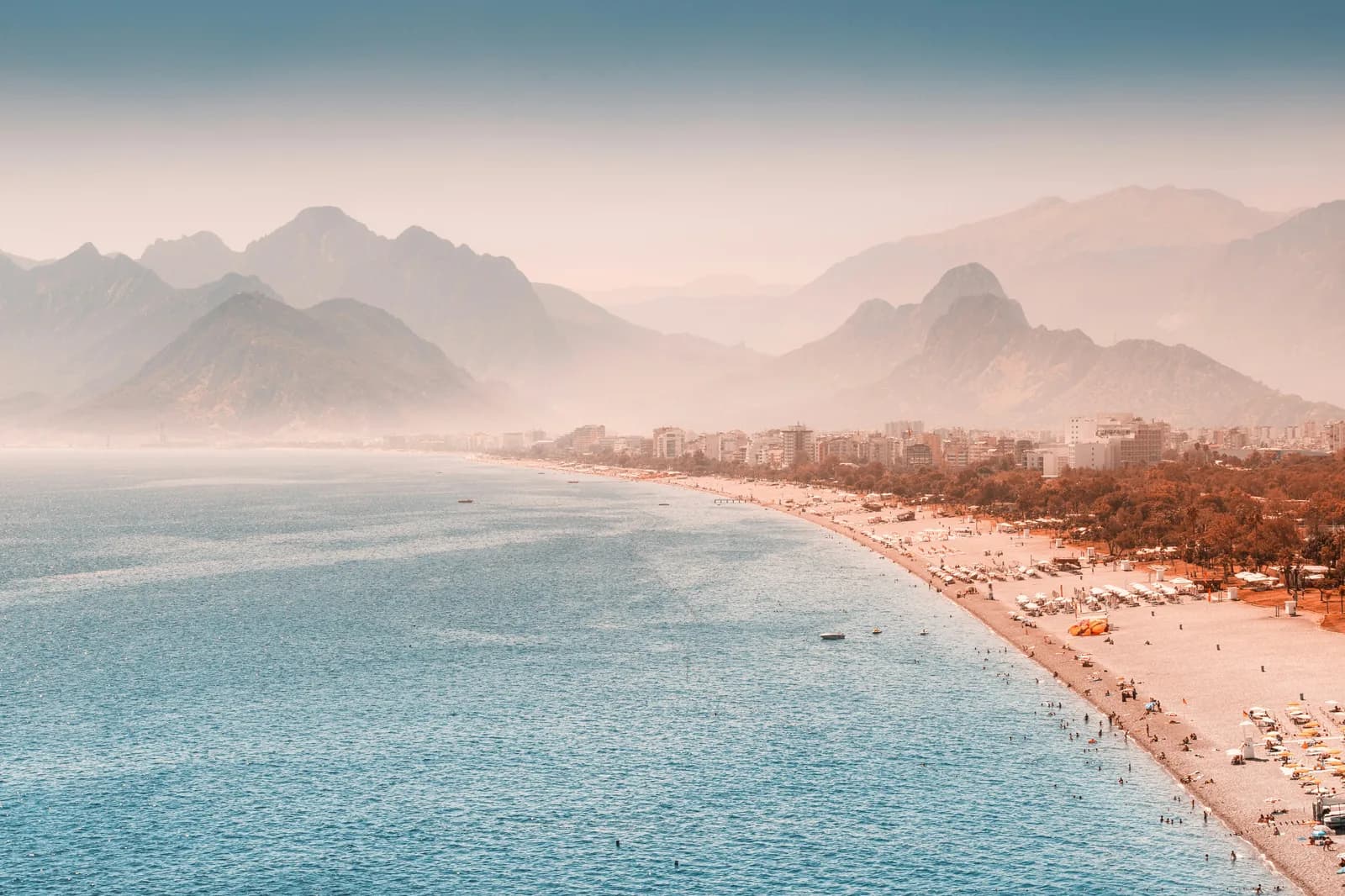
May: 26–28°C, sea at 21–22°C, the Taurus still snow-capped behind the beach — the photograph that sells the city. June: 30–32°C, sea 24°C, the full season running. September stays hot — 31°C with a 27°C sea, the year's warmest water — and October is the local secret: 26–27°C, sea still 24–25°C, crowds gone, ruins walkable at noon.
July and August are flagged hard: 36–40°C with coastal humidity, among the toughest midsummer climates of any Mediterranean resort coast — the climate study is unambiguous. The all-inclusives respond with pools and air conditioning; the city and the ruins simply become afternoon-hostile. Don't book these weeks for sightseeing intentions you won't keep.
Getting there
Antalya (AYT) is one of the Mediterranean's busiest holiday airports — direct seasonal lift from everywhere in Northern Europe, year-round Turkish Airlines via Istanbul. The airport sits 13 km east: the tram (AntRay) connects for pennies if you're patient, taxis run €15–25 to the centre, and resort transfers are an industrial process that works.
City logistics: the old town is walkable (and partly car-free), the tram line spans the centre to the museum, and ride-hailing (BiTaksi) fixes the rest. Day-tripping the ruins is easiest by rental car — roads are good — or the gauntlet of reasonable organised tours.
Where to stay — Kaleiçi or the beach machine
The real choice: the old town (Kaleiçi) in a converted Ottoman mansion, or the Lara/Belek resort strips in a sea-front machine. Kaleiçi gives you the city — courtyards, rooftop harbour views, restaurants at your door; Lara gives you the sand and the waterparks. Mixing (city base + beach days, or 2+5 split) beats committing wholly to either.
Luxury — Tuvana Hotel, Kaleiçi
A compound of six restored Ottoman houses in the old town's quietest corner: walled gardens, a serious restaurant (Seraser, below), a pool under orange trees. Around €140–180/night in season — "luxury" at Antalya pricing. Check rates on Booking →
Mid-range — Alp Paşa Hotel, Kaleiçi
Ottoman-boutique with carved ceilings, a courtyard pool the evenings revolve around, and its own small hammam. Around €70–100/night. Check rates on Booking →
Budget — Sabah Pansiyon, Kaleiçi
The travellers' institution: simple rooms around a sociable courtyard, run by a family who've been orienting newcomers for decades. Around €35–50/night. Check rates on Booking →
Kaleiçi and the city
Enter through Hadrian's Gate — three marble arches raised for the emperor's visit in 130 AD, now the threshold between traffic and the old town's hush. Inside: lanes of timbered Ottoman houses in states from immaculate to romantically collapsing, the Yivli Minare (the fluted Seljuk minaret that is the city's logo), the Hıdırlık tower where the walls meet the cliff — sunset station — and below it all the Roman harbour, a half-moon of café terraces and excursion boats under forty metres of cliff.
Two city set pieces beyond the walls: the Antalya Museum (tram to its door), one of Turkey's great collections, where the sculpture hall of gods hauled from Perge stops conversation; and the Düden waterfalls — the upper falls in a park you walk behind, and the lower falls dropping thirty metres straight off the city cliff into the sea, best from the boat tours out of the old harbour (€10–15).
And do one hammam properly: the historic Sefa Hamamı in Kaleiçi scrubs centuries plus your sunburn for €25–35 all in.
The ruins radius — the actual treasure
This coast was Pamphylia, and its cities are the day-trip currency:
- Aspendos (45 min) — the best-preserved Roman theatre in existence, full stop: 15,000 seats, stage building intact to the roofline, acoustics still employed every September for an opera festival. €10ish; go first or last hour.
- Perge (20 min) — a whole street-gridded city: colonnaded avenue with the water channel down its spine, stadium, baths. The statues you met in the museum lived here.
- Side (1h15) — the Temple of Apollo's surviving columns on a harbour point, framing sunset between resort streets; touristy and worth it anyway.
- Termessos (40 min) — the wild one: an unexcavated mountain city at 1,000 m in a national park, theatre cracked open to a gorge view, tombs in the maquis, eagles overhead. The most atmospheric site on the coast and the emptiest. Proper shoes, water, spring or autumn only.
Rafting the Köprülü canyon (1h30) slots in if the group needs one adrenaline day — mass-market but genuinely fun, €25–40 with lunch.
The beaches
Konyaaltı, west of the cliffs: pebble, improbably clear water and the full Taurus panorama behind — the city's own swim, tram-reachable. Lara, east: the long sand strip where the theme-hotels stand shoulder to shoulder; public beach segments thread between them. Out of town, Çıralı (90 min southwest) pairs a low-rise pension beach with the Chimera's eternal gas flames on the hillside after dark and the Olympos ruins at its far end — the antidote day when the resort coast palls.
What to eat
Antalya's table is Turkish-Mediterranean with a city signature: piyaz — white beans dressed in tahini, here elevated to identity — plus şiş köfte off the charcoal, the tomato-butter heft of a proper pide, orange juice squeezed at every third doorway (the province grows the country's citrus), and künefe finishing everything in molten-cheese-and-syrup honour.
- 7 Mehmet, Konyaaltı — the city's institution since the 1930s: meze spread, lamb from the wood grill, terrace over the bay. €20–30.
- Seraser, Kaleiçi — the old town's fine-dining standard in the Tuvana's garden; Ottoman-modern, €30–45 with wine, which is the joke and the point.
- The Dönerciler Çarşısı (rotisserie market row) by the clock tower — lunch among locals for a fiver.
Drink: Efes cold, rakı with meze if you're committing, and Turkish coffee read properly afterwards.
Practical notes
- Money: Turkish lira; cards near-universal, cash for markets and tips. Prices quoted in euros at tourist businesses — paying in lira is usually kinder.
- Haggling: bazaar yes, shops no, taxis meter (insist).
- Dress: resort-relaxed everywhere; shoulders covered for mosque visits.
- Visas: most European passports enter visa-free for tourism; check current rules before flying.
- Sea honesty: 21°C in May to a bath-like 27–28°C in August–September — the warmest swim window on this site's European map.
The summary
Fly AYT, base at the Tuvana or Alp Paşa in Kaleiçi. One city day (gate, lanes, museum, harbour boat under the falls, hammam by dusk), one Perge-plus-Aspendos day, one Termessos morning before a Konyaaltı afternoon, one Çıralı-and-Chimera escape — and beach days threaded between at a fraction of the western Mediterranean's tariff. May, June, September or October; October if swimming matters most. Antalya is what a riviera looks like when the history is real and the bill is reasonable.